

446 Modern Food Microbiology
Table 18–2 “Alarm Water” Content for Miscellaneous
Foods
Foods
% Water
Whole milk powder
∼ 8
Dehydrated whole eggs
10–11
Wheat flour
13–15
Rice
13–15
Milk powder (separated)
15
Fat-free hydrated meat
15
Pulses
15
Dehydrated vegetables
14–20
Starch
18
Dehydrated fruit
18–25
Note: RH = 70%; temperature = 20 ◦ C.
Source: From Mossel and Ingram. 25
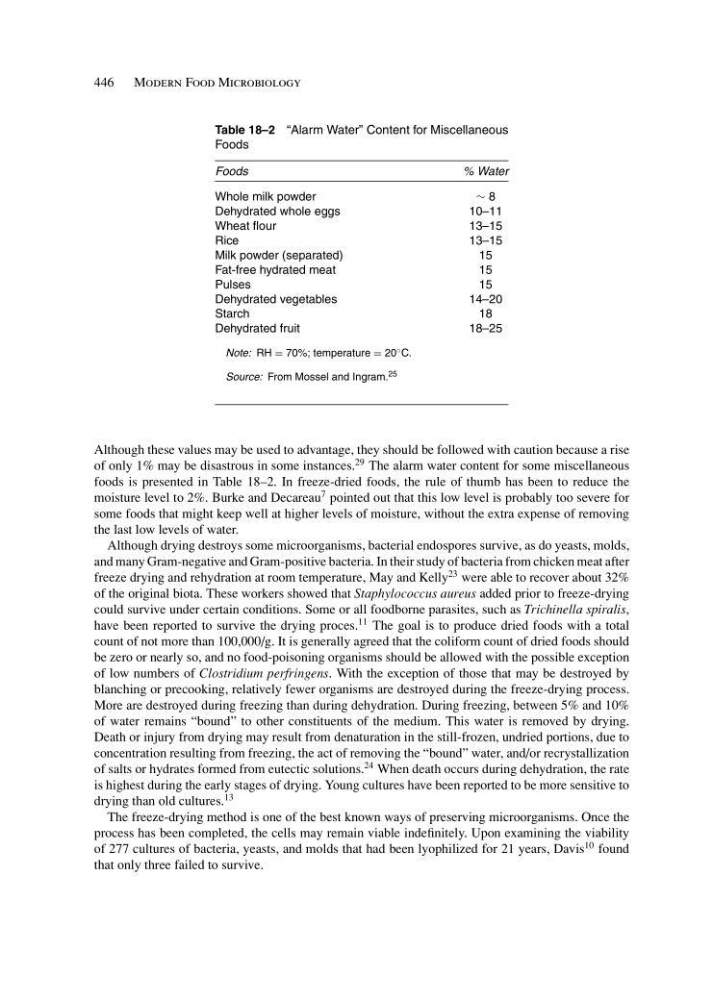
Although these values may be used to advantage, they should be followed with caution because a rise
of only 1% may be disastrous in some instances.
29 The alarm water content for some miscellaneous
foods is presented in Table 18–2. In freeze-dried foods, the rule of thumb has been to reduce the
moisture level to 2%. Burke and Decareau
7 pointed out that this low level is probably too severe for
some foods that might keep well at higher levels of moisture, without the extra expense of removing
the last low levels of water.
Although drying destroys some microorganisms, bacterial endospores survive, as do yeasts, molds,
and many Gram-negative and Gram-positive bacteria. In their study of bacteria from chicken meat after
freeze drying and rehydration at room temperature, May and Kelly
23 were able to recover about 32%
of the original biota. These workers showed that Staphylococcus aureus added prior to freeze-drying
could survive under certain conditions. Some or all foodborne parasites, such as Trichinella spiralis,
have been reported to survive the drying proces.
11 The goal is to produce dried foods with a total
count of not more than 100,000/g. It is generally agreed that the coliform count of dried foods should
be zero or nearly so, and no food-poisoning organisms should be allowed with the possible exception
of low numbers of Clostridium perfringens. With the exception of those that may be destroyed by
blanching or precooking, relatively fewer organisms are destroyed during the freeze-drying process.
More are destroyed during freezing than during dehydration. During freezing, between 5% and 10%
of water remains “bound” to other constituents of the medium. This water is removed by drying.
Death or injury from drying may result from denaturation in the still-frozen, undried portions, due to
concentration resulting from freezing, the act of removing the “bound” water, and/or recrystallization
of salts or hydrates formed from eutectic solutions.
24 When death occurs during dehydration, the rate
is highest during the early stages of drying. Young cultures have been reported to be more sensitive to
drying than old cultures.
13
The freeze-drying method is one of the best known ways of preserving microorganisms. Once the
process has been completed, the cells may remain viable indefinitely. Upon examining the viability
of 277 cultures of bacteria, yeasts, and molds that had been lyophilized for 21 years, Davis
10 found
that only three failed to survive.
Table 18–2 “Alarm Water” Content for Miscellaneous
Foods
Foods
% Water
Whole milk powder
∼ 8
Dehydrated whole eggs
10–11
Wheat flour
13–15
Rice
13–15
Milk powder (separated)
15
Fat-free hydrated meat
15
Pulses
15
Dehydrated vegetables
14–20
Starch
18
Dehydrated fruit
18–25
Note: RH = 70%; temperature = 20 ◦ C.
Source: From Mossel and Ingram. 25
Although these values may be used to advantage, they should be followed with caution because a rise
of only 1% may be disastrous in some instances.
29 The alarm water content for some miscellaneous
foods is presented in Table 18–2. In freeze-dried foods, the rule of thumb has been to reduce the
moisture level to 2%. Burke and Decareau
7 pointed out that this low level is probably too severe for
some foods that might keep well at higher levels of moisture, without the extra expense of removing
the last low levels of water.
Although drying destroys some microorganisms, bacterial endospores survive, as do yeasts, molds,
and many Gram-negative and Gram-positive bacteria. In their study of bacteria from chicken meat after
freeze drying and rehydration at room temperature, May and Kelly
23 were able to recover about 32%
of the original biota. These workers showed that Staphylococcus aureus added prior to freeze-drying
could survive under certain conditions. Some or all foodborne parasites, such as Trichinella spiralis,
have been reported to survive the drying proces.
11 The goal is to produce dried foods with a total
count of not more than 100,000/g. It is generally agreed that the coliform count of dried foods should
be zero or nearly so, and no food-poisoning organisms should be allowed with the possible exception
of low numbers of Clostridium perfringens. With the exception of those that may be destroyed by
blanching or precooking, relatively fewer organisms are destroyed during the freeze-drying process.
More are destroyed during freezing than during dehydration. During freezing, between 5% and 10%
of water remains “bound” to other constituents of the medium. This water is removed by drying.
Death or injury from drying may result from denaturation in the still-frozen, undried portions, due to
concentration resulting from freezing, the act of removing the “bound” water, and/or recrystallization
of salts or hydrates formed from eutectic solutions.
24 When death occurs during dehydration, the rate
is highest during the early stages of drying. Young cultures have been reported to be more sensitive to
drying than old cultures.
13
The freeze-drying method is one of the best known ways of preserving microorganisms. Once the
process has been completed, the cells may remain viable indefinitely. Upon examining the viability
of 277 cultures of bacteria, yeasts, and molds that had been lyophilized for 21 years, Davis
10 found
that only three failed to survive.