

Protection of Foods by Drying
445
EFFECT OF DRYING ON MICROORGANISMS
Although some microorganisms are destroyed in the process of drying, this process is not lethal
per se to microorganisms, and, indeed, many types may be recovered from dried foods, especially if
poor-quality foods are used for drying and if proper practices are not followed in the drying steps.
Bacteria require relatively high levels of moisture for their growth, with yeasts requiring less and
molds still less. Because most bacteria require a w values above 0.90 for growth, they play no role in
the spoilage of dried foods. With respect to the stability of dried foods, Scott
29 has related a w levels to
the probability of spoilage in the following manner. At a w values of between 0.80 and 0.85, spoilage
occurs readily by a variety of fungi in 1–2 weeks. At a w values of 0.75, spoilage is delayed, with fewer
types of organisms in those products that spoil. At an a w of 0.70, spoilage is greatly delayed and may
not occur during prolonged holding. At an a w of 0.65, very few organisms are known to grow, and
spoilage is most unlikely to occur for even up to 2 years. Some investigators have suggested that dried
foods to be held for several years should be processed so that the final a w is between 0.65 and 0.75,
with 0.70 suggested by most.
At a w levels of about 0.90, the organisms most likely to grow are yeasts and molds. This value is
near the minimum for most normal yeasts. Even though spoilage is all but prevented at an a w less
than 0.65, some molds are known to grow very slowly at a w 0.60–0.62. Osmophilic yeasts such as
Zygosaccharomyces rouxii strains have been reported to grow at an a w of 0.65 under certain conditions.
The most troublesome group of microorganisms in dried foods is the mold, with the Aspergillus
glaucus group being the most notorious at low a w values. The minimum a w values reported for the
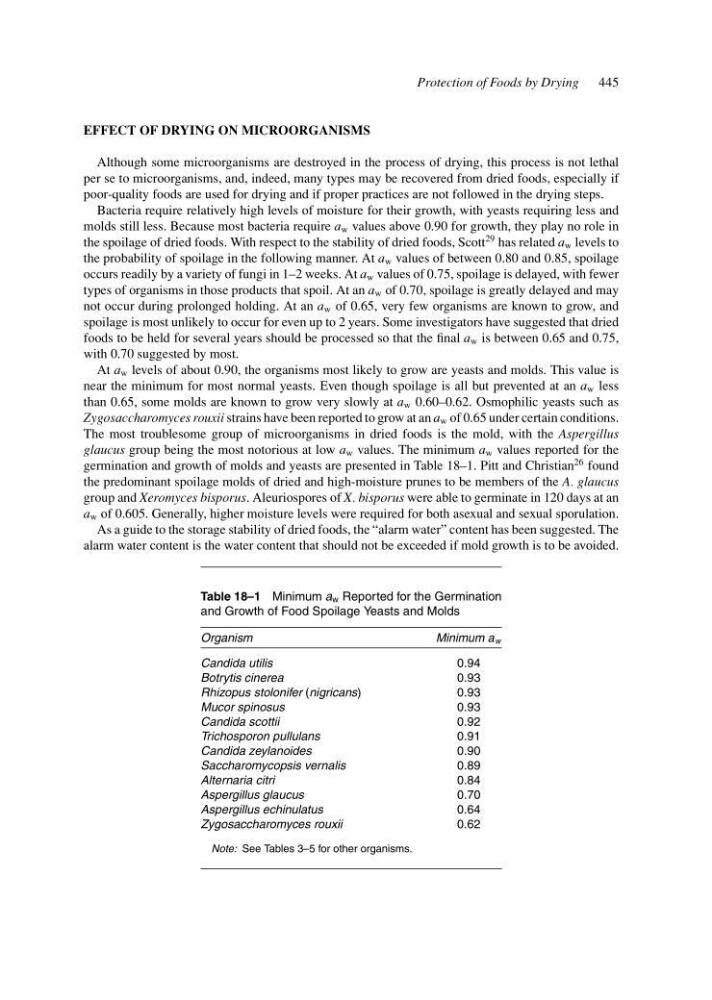
germination and growth of molds and yeasts are presented in Table 18–1. Pitt and Christian
26 found
the predominant spoilage molds of dried and high-moisture prunes to be members of the A. glaucus
group and Xeromyces bisporus. Aleuriospores of X. bisporus were able to germinate in 120 days at an
a w of 0.605. Generally, higher moisture levels were required for both asexual and sexual sporulation.
As a guide to the storage stability of dried foods, the “alarm water” content has been suggested. The
alarm water content is the water content that should not be exceeded if mold growth is to be avoided.
Table 18–1 Minimum a w Reported for the Germination
and Growth of Food Spoilage Yeasts and Molds
Organism
Minimum a w
Candida utilis
0.94
Botrytis cinerea
0.93
Rhizopus stolonifer (nigricans)
0.93
Mucor spinosus
0.93
Candida scottii
0.92
Trichosporon pullulans
0.91
Candida zeylanoides
0.90
Saccharomycopsis vernalis
0.89
Alternaria citri
0.84
Aspergillus glaucus
0.70
Aspergillus echinulatus
0.64
Zygosaccharomyces rouxii
0.62
Note: See Tables 3–5 for other organisms.
445
EFFECT OF DRYING ON MICROORGANISMS
Although some microorganisms are destroyed in the process of drying, this process is not lethal
per se to microorganisms, and, indeed, many types may be recovered from dried foods, especially if
poor-quality foods are used for drying and if proper practices are not followed in the drying steps.
Bacteria require relatively high levels of moisture for their growth, with yeasts requiring less and
molds still less. Because most bacteria require a w values above 0.90 for growth, they play no role in
the spoilage of dried foods. With respect to the stability of dried foods, Scott
29 has related a w levels to
the probability of spoilage in the following manner. At a w values of between 0.80 and 0.85, spoilage
occurs readily by a variety of fungi in 1–2 weeks. At a w values of 0.75, spoilage is delayed, with fewer
types of organisms in those products that spoil. At an a w of 0.70, spoilage is greatly delayed and may
not occur during prolonged holding. At an a w of 0.65, very few organisms are known to grow, and
spoilage is most unlikely to occur for even up to 2 years. Some investigators have suggested that dried
foods to be held for several years should be processed so that the final a w is between 0.65 and 0.75,
with 0.70 suggested by most.
At a w levels of about 0.90, the organisms most likely to grow are yeasts and molds. This value is
near the minimum for most normal yeasts. Even though spoilage is all but prevented at an a w less
than 0.65, some molds are known to grow very slowly at a w 0.60–0.62. Osmophilic yeasts such as
Zygosaccharomyces rouxii strains have been reported to grow at an a w of 0.65 under certain conditions.
The most troublesome group of microorganisms in dried foods is the mold, with the Aspergillus
glaucus group being the most notorious at low a w values. The minimum a w values reported for the
germination and growth of molds and yeasts are presented in Table 18–1. Pitt and Christian
26 found
the predominant spoilage molds of dried and high-moisture prunes to be members of the A. glaucus
group and Xeromyces bisporus. Aleuriospores of X. bisporus were able to germinate in 120 days at an
a w of 0.605. Generally, higher moisture levels were required for both asexual and sexual sporulation.
As a guide to the storage stability of dried foods, the “alarm water” content has been suggested. The
alarm water content is the water content that should not be exceeded if mold growth is to be avoided.
Table 18–1 Minimum a w Reported for the Germination
and Growth of Food Spoilage Yeasts and Molds
Organism
Minimum a w
Candida utilis
0.94
Botrytis cinerea
0.93
Rhizopus stolonifer (nigricans)
0.93
Mucor spinosus
0.93
Candida scottii
0.92
Trichosporon pullulans
0.91
Candida zeylanoides
0.90
Saccharomycopsis vernalis
0.89
Alternaria citri
0.84
Aspergillus glaucus
0.70
Aspergillus echinulatus
0.64
Zygosaccharomyces rouxii
0.62
Note: See Tables 3–5 for other organisms.