

438 Modern Food Microbiology
Table 17–16 Some Features of Canned Food Spoilage Resulting from Understerilization and
Seam Leakage
Feature
Understerilization
Leakage
Can
Flat or swelled; seams generally
normal
Swelled; may show defects
Product appearance
Sloppy or fermented
Frothy fermentation; viscous
Odor
Normal, sour, or putrid but
generally consistent
Sour, fecal, generally varying
from can to can
PH
Usually fairly constant
Wide variation
Microscopic and cultural
Pure cultures, sporeformers;
growth at 98
◦ F and/or 113
◦ F;
may be characteristic on
special media, e.g., acid agar
for tomato juice
Mixed cultures, generally rods
and cocci; growth only at usual
temperatures
History
Spoilage usually confined to
certain portions of pack. In
acid products, diagnosis may
be less clearly defined. Similar
organisms may be involved in
understerilization and leakage
Spoilage scattered
Source: From Schmitt. 47
punch, the gases will displace the dilute KOH inside the tube. Before removing the open end from the
beaker, close the tube by placing the thumb over the end. To test for CO 2 , shake the tube and look for
a vacuum as evidenced by suction against the finger. To test for hydrogen, repeat the test and apply a
match near the top of the tube and then quickly remove the thumb. A “pop” indicates the presence of
hydrogen. Both gases may be found in some cans of spoiled foods.
“Leakage-type” spoilage of canned foods is characterized by a biota of non-sporeforming organisms
that would not survive the heat treatment normally given to heat-processed foods. These organisms
enter cans at the start of cooling through faulty seams, which generally result from can abuse. The
organisms that cause leakage-type spoilage can be found either on the cans or in the cooling water. This
problem is minimized if the cannery cooling water contains <100 bacteria/ml. This type of spoilage
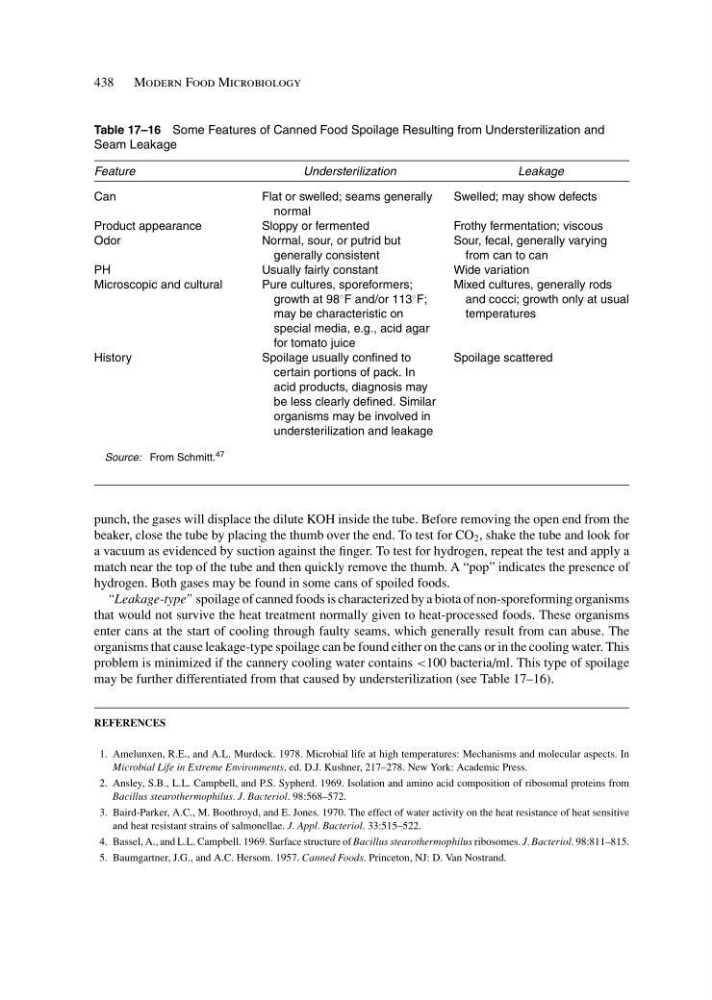
may be further differentiated from that caused by understerilization (see Table 17–16).
REFERENCES
1. Amelunxen, R.E., and A.L. Murdock. 1978. Microbial life at high temperatures: Mechanisms and molecular aspects. In
Microbial Life in Extreme Environments, ed. D.J. Kushner, 217–278. New York: Academic Press.
2. Ansley, S.B., L.L. Campbell, and P.S. Sypherd. 1969. Isolation and amino acid composition of ribosomal proteins from
Bacillus stearothermophilus. J. Bacteriol. 98:568–572.
3. Baird-Parker, A.C., M. Boothroyd, and E. Jones. 1970. The effect of water activity on the heat resistance of heat sensitive
and heat resistant strains of salmonellae. J. Appl. Bacteriol. 33:515–522.
4. Bassel, A., and L.L. Campbell. 1969. Surface structure of Bacillus stearothermophilus ribosomes. J. Bacteriol. 98:811–815.
5. Baumgartner, J.G., and A.C. Hersom. 1957. Canned Foods. Princeton, NJ: D. Van Nostrand.
Table 17–16 Some Features of Canned Food Spoilage Resulting from Understerilization and
Seam Leakage
Feature
Understerilization
Leakage
Can
Flat or swelled; seams generally
normal
Swelled; may show defects
Product appearance
Sloppy or fermented
Frothy fermentation; viscous
Odor
Normal, sour, or putrid but
generally consistent
Sour, fecal, generally varying
from can to can
PH
Usually fairly constant
Wide variation
Microscopic and cultural
Pure cultures, sporeformers;
growth at 98
◦ F and/or 113
◦ F;
may be characteristic on
special media, e.g., acid agar
for tomato juice
Mixed cultures, generally rods
and cocci; growth only at usual
temperatures
History
Spoilage usually confined to
certain portions of pack. In
acid products, diagnosis may
be less clearly defined. Similar
organisms may be involved in
understerilization and leakage
Spoilage scattered
Source: From Schmitt. 47
punch, the gases will displace the dilute KOH inside the tube. Before removing the open end from the
beaker, close the tube by placing the thumb over the end. To test for CO 2 , shake the tube and look for
a vacuum as evidenced by suction against the finger. To test for hydrogen, repeat the test and apply a
match near the top of the tube and then quickly remove the thumb. A “pop” indicates the presence of
hydrogen. Both gases may be found in some cans of spoiled foods.
“Leakage-type” spoilage of canned foods is characterized by a biota of non-sporeforming organisms
that would not survive the heat treatment normally given to heat-processed foods. These organisms
enter cans at the start of cooling through faulty seams, which generally result from can abuse. The
organisms that cause leakage-type spoilage can be found either on the cans or in the cooling water. This
problem is minimized if the cannery cooling water contains <100 bacteria/ml. This type of spoilage
may be further differentiated from that caused by understerilization (see Table 17–16).
REFERENCES
1. Amelunxen, R.E., and A.L. Murdock. 1978. Microbial life at high temperatures: Mechanisms and molecular aspects. In
Microbial Life in Extreme Environments, ed. D.J. Kushner, 217–278. New York: Academic Press.
2. Ansley, S.B., L.L. Campbell, and P.S. Sypherd. 1969. Isolation and amino acid composition of ribosomal proteins from
Bacillus stearothermophilus. J. Bacteriol. 98:568–572.
3. Baird-Parker, A.C., M. Boothroyd, and E. Jones. 1970. The effect of water activity on the heat resistance of heat sensitive
and heat resistant strains of salmonellae. J. Appl. Bacteriol. 33:515–522.
4. Bassel, A., and L.L. Campbell. 1969. Surface structure of Bacillus stearothermophilus ribosomes. J. Bacteriol. 98:811–815.
5. Baumgartner, J.G., and A.C. Hersom. 1957. Canned Foods. Princeton, NJ: D. Van Nostrand.