

430 Modern Food Microbiology
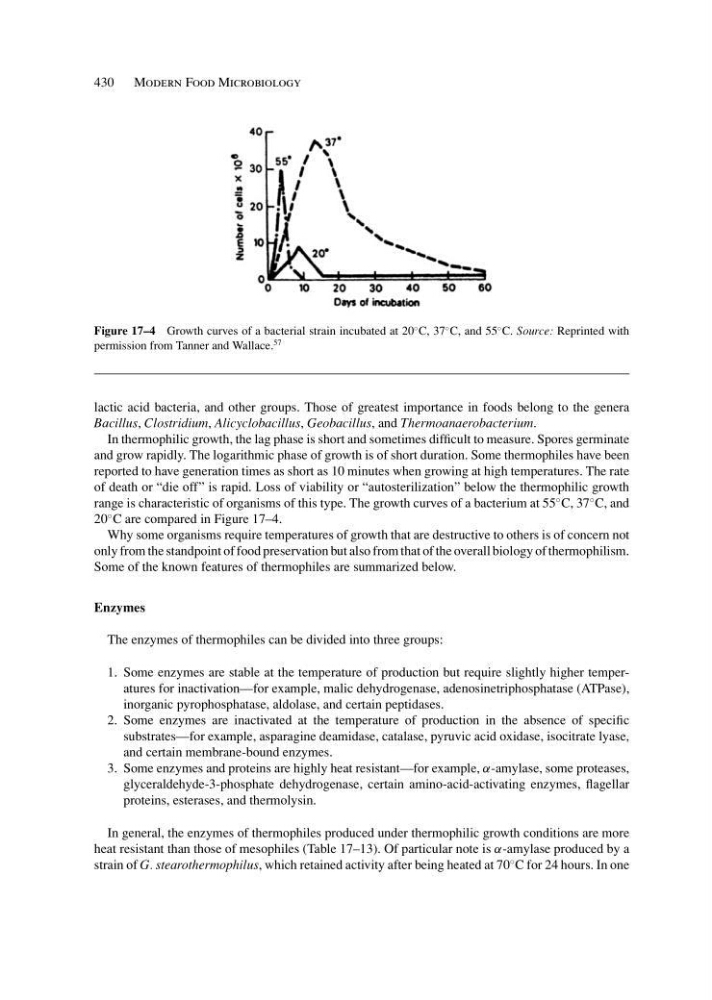
Figure 17–4 Growth curves of a bacterial strain incubated at 20
◦ C, 37
◦ C, and 55
◦ C. Source: Reprinted with
permission from Tanner and Wallace.
57
lactic acid bacteria, and other groups. Those of greatest importance in foods belong to the genera
Bacillus, Clostridium, Alicyclobacillus, Geobacillus, and Thermoanaerobacterium.
In thermophilic growth, the lag phase is short and sometimes difficult to measure. Spores germinate
and grow rapidly. The logarithmic phase of growth is of short duration. Some thermophiles have been
reported to have generation times as short as 10 minutes when growing at high temperatures. The rate
of death or “die off” is rapid. Loss of viability or “autosterilization” below the thermophilic growth
range is characteristic of organisms of this type. The growth curves of a bacterium at 55
◦ C, 37
◦ C, and
20
◦ C are compared in Figure 17–4.
Why some organisms require temperatures of growth that are destructive to others is of concern not
only from the standpoint of food preservation but also from that of the overall biology of thermophilism.
Some of the known features of thermophiles are summarized below.
Enzymes
The enzymes of thermophiles can be divided into three groups:
1. Some enzymes are stable at the temperature of production but require slightly higher temperatures for inactivation—for example, malic dehydrogenase, adenosinetriphosphatase (ATPase),
inorganic pyrophosphatase, aldolase, and certain peptidases.
2. Some enzymes are inactivated at the temperature of production in the absence of specific
substrates—for example, asparagine deamidase, catalase, pyruvic acid oxidase, isocitrate lyase,
and certain membrane-bound enzymes.
3. Some enzymes and proteins are highly heat resistant—for example, α-amylase, some proteases,
glyceraldehyde-3-phosphate dehydrogenase, certain amino-acid-activating enzymes, flagellar
proteins, esterases, and thermolysin.
In general, the enzymes of thermophiles produced under thermophilic growth conditions are more
heat resistant than those of mesophiles (Table 17–13). Of particular note is α-amylase produced by a
strain of G. stearothermophilus, which retained activity after being heated at 70
◦ C for 24 hours. In one
Figure 17–4 Growth curves of a bacterial strain incubated at 20
◦ C, 37
◦ C, and 55
◦ C. Source: Reprinted with
permission from Tanner and Wallace.
57
lactic acid bacteria, and other groups. Those of greatest importance in foods belong to the genera
Bacillus, Clostridium, Alicyclobacillus, Geobacillus, and Thermoanaerobacterium.
In thermophilic growth, the lag phase is short and sometimes difficult to measure. Spores germinate
and grow rapidly. The logarithmic phase of growth is of short duration. Some thermophiles have been
reported to have generation times as short as 10 minutes when growing at high temperatures. The rate
of death or “die off” is rapid. Loss of viability or “autosterilization” below the thermophilic growth
range is characteristic of organisms of this type. The growth curves of a bacterium at 55
◦ C, 37
◦ C, and
20
◦ C are compared in Figure 17–4.
Why some organisms require temperatures of growth that are destructive to others is of concern not
only from the standpoint of food preservation but also from that of the overall biology of thermophilism.
Some of the known features of thermophiles are summarized below.
Enzymes
The enzymes of thermophiles can be divided into three groups:
1. Some enzymes are stable at the temperature of production but require slightly higher temperatures for inactivation—for example, malic dehydrogenase, adenosinetriphosphatase (ATPase),
inorganic pyrophosphatase, aldolase, and certain peptidases.
2. Some enzymes are inactivated at the temperature of production in the absence of specific
substrates—for example, asparagine deamidase, catalase, pyruvic acid oxidase, isocitrate lyase,
and certain membrane-bound enzymes.
3. Some enzymes and proteins are highly heat resistant—for example, α-amylase, some proteases,
glyceraldehyde-3-phosphate dehydrogenase, certain amino-acid-activating enzymes, flagellar
proteins, esterases, and thermolysin.
In general, the enzymes of thermophiles produced under thermophilic growth conditions are more
heat resistant than those of mesophiles (Table 17–13). Of particular note is α-amylase produced by a
strain of G. stearothermophilus, which retained activity after being heated at 70
◦ C for 24 hours. In one