

410 Modern Food Microbiology
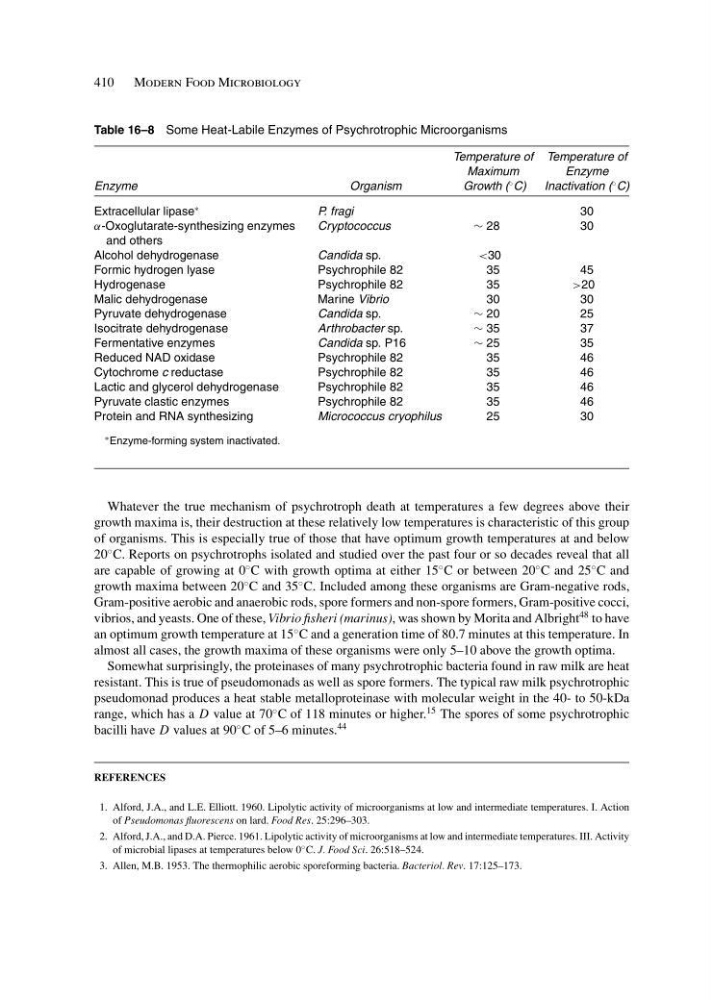
Table 16–8 Some Heat-Labile Enzymes of Psychrotrophic Microorganisms
Temperature of Temperature of
Maximum
Enzyme
Enzyme
Organism
Growth (
◦ C)
Inactivation (
◦ C)
Extracellular lipase
∗
P. fragi
30
α-Oxoglutarate-synthesizing enzymes
and others
Cryptococcus
∼ 28
30
Alcohol dehydrogenase
Candida sp.
<30
Formic hydrogen lyase
Psychrophile 82
35
45
Hydrogenase
Psychrophile 82
35
>20
Malic dehydrogenase
Marine Vibrio
30
30
Pyruvate dehydrogenase
Candida sp.
∼ 20
25
Isocitrate dehydrogenase
Arthrobacter sp.
∼ 35
37
Fermentative enzymes
Candida sp. P16
∼ 25
35
Reduced NAD oxidase
Psychrophile 82
35
46
Cytochrome c reductase
Psychrophile 82
35
46
Lactic and glycerol dehydrogenase
Psychrophile 82
35
46
Pyruvate clastic enzymes
Psychrophile 82
35
46
Protein and RNA synthesizing
Micrococcus cryophilus
25
30
∗ Enzyme-forming system inactivated.
Whatever the true mechanism of psychrotroph death at temperatures a few degrees above their
growth maxima is, their destruction at these relatively low temperatures is characteristic of this group
of organisms. This is especially true of those that have optimum growth temperatures at and below
20
◦ C. Reports on psychrotrophs isolated and studied over the past four or so decades reveal that all
are capable of growing at 0
◦ C with growth optima at either 15
◦ C or between 20
◦ C and 25
◦ C and
growth maxima between 20
◦ C and 35
◦ C. Included among these organisms are Gram-negative rods,
Gram-positive aerobic and anaerobic rods, spore formers and non-spore formers, Gram-positive cocci,
vibrios, and yeasts. One of these, Vibrio fisheri (marinus), was shown by Morita and Albright
48 to have
an optimum growth temperature at 15
◦ C and a generation time of 80.7 minutes at this temperature. In
almost all cases, the growth maxima of these organisms were only 5–10 above the growth optima.
Somewhat surprisingly, the proteinases of many psychrotrophic bacteria found in raw milk are heat
resistant. This is true of pseudomonads as well as spore formers. The typical raw milk psychrotrophic
pseudomonad produces a heat stable metalloproteinase with molecular weight in the 40- to 50-kDa
range, which has a D value at 70
◦ C of 118 minutes or higher.
15 The spores of some psychrotrophic
bacilli have D values at 90
◦ C of 5–6 minutes.
44
REFERENCES
1. Alford, J.A., and L.E. Elliott. 1960. Lipolytic activity of microorganisms at low and intermediate temperatures. I. Action
of Pseudomonas fluorescens on lard. Food Res. 25:296–303.
2. Alford, J.A., and D.A. Pierce. 1961. Lipolytic activity of microorganisms at low and intermediate temperatures. III. Activity
of microbial lipases at temperatures below 0 ◦ C. J. Food Sci. 26:518–524.
3. Allen, M.B. 1953. The thermophilic aerobic sporeforming bacteria. Bacteriol. Rev. 17:125–173.
Table 16–8 Some Heat-Labile Enzymes of Psychrotrophic Microorganisms
Temperature of Temperature of
Maximum
Enzyme
Enzyme
Organism
Growth (
◦ C)
Inactivation (
◦ C)
Extracellular lipase
∗
P. fragi
30
α-Oxoglutarate-synthesizing enzymes
and others
Cryptococcus
∼ 28
30
Alcohol dehydrogenase
Candida sp.
<30
Formic hydrogen lyase
Psychrophile 82
35
45
Hydrogenase
Psychrophile 82
35
>20
Malic dehydrogenase
Marine Vibrio
30
30
Pyruvate dehydrogenase
Candida sp.
∼ 20
25
Isocitrate dehydrogenase
Arthrobacter sp.
∼ 35
37
Fermentative enzymes
Candida sp. P16
∼ 25
35
Reduced NAD oxidase
Psychrophile 82
35
46
Cytochrome c reductase
Psychrophile 82
35
46
Lactic and glycerol dehydrogenase
Psychrophile 82
35
46
Pyruvate clastic enzymes
Psychrophile 82
35
46
Protein and RNA synthesizing
Micrococcus cryophilus
25
30
∗ Enzyme-forming system inactivated.
Whatever the true mechanism of psychrotroph death at temperatures a few degrees above their
growth maxima is, their destruction at these relatively low temperatures is characteristic of this group
of organisms. This is especially true of those that have optimum growth temperatures at and below
20
◦ C. Reports on psychrotrophs isolated and studied over the past four or so decades reveal that all
are capable of growing at 0
◦ C with growth optima at either 15
◦ C or between 20
◦ C and 25
◦ C and
growth maxima between 20
◦ C and 35
◦ C. Included among these organisms are Gram-negative rods,
Gram-positive aerobic and anaerobic rods, spore formers and non-spore formers, Gram-positive cocci,
vibrios, and yeasts. One of these, Vibrio fisheri (marinus), was shown by Morita and Albright
48 to have
an optimum growth temperature at 15
◦ C and a generation time of 80.7 minutes at this temperature. In
almost all cases, the growth maxima of these organisms were only 5–10 above the growth optima.
Somewhat surprisingly, the proteinases of many psychrotrophic bacteria found in raw milk are heat
resistant. This is true of pseudomonads as well as spore formers. The typical raw milk psychrotrophic
pseudomonad produces a heat stable metalloproteinase with molecular weight in the 40- to 50-kDa
range, which has a D value at 70
◦ C of 118 minutes or higher.
15 The spores of some psychrotrophic
bacilli have D values at 90
◦ C of 5–6 minutes.
44
REFERENCES
1. Alford, J.A., and L.E. Elliott. 1960. Lipolytic activity of microorganisms at low and intermediate temperatures. I. Action
of Pseudomonas fluorescens on lard. Food Res. 25:296–303.
2. Alford, J.A., and D.A. Pierce. 1961. Lipolytic activity of microorganisms at low and intermediate temperatures. III. Activity
of microbial lipases at temperatures below 0 ◦ C. J. Food Sci. 26:518–524.
3. Allen, M.B. 1953. The thermophilic aerobic sporeforming bacteria. Bacteriol. Rev. 17:125–173.