

Protection of Foods with Low-Temperatures
401
Although the metabolic activities of all microorganisms can be stopped at freezer temperatures,
frozen foods may not be kept indefinitely if the thawed product is to retain the original flavor and
texture. Most frozen foods are assigned a freezer life. The suggested maximum holding time for frozen
foods is not based on the microbiology of such foods but on such factors as texture, flavor, tenderness,
color, and overall nutritional quality upon thawing, and subsequent cooking.
Some foods that are improperly wrapped during freezer storage undergo freezer burn, characterized
by a browning of light-colored foods such as the skin of chicken meat.The browning results from the
loss of moisture at the surface, leaving the product more porous than the original at the affected site.
The condition is irreversible and is known to affect certain fruits, poultry, meats, and fish, both raw
and cooked.
EFFECT OF FREEZING ON MICROORGANISMS
In considering the effect of freezing on those microorganisms that are unable to grow at freezing
temperatures, it is well known that freezing is one means of preserving microbial cultures, with freeze
drying being perhaps the best method known. However, freezing temperatures have been shown to
effect the killing of certain microorganisms of importance in foods. Ingram
32 summarized the salient
facts of what happens to certain microorganisms upon freezing:
1. There is a sudden mortality immediately on freezing, varying with species.
2. The proportion of cells surviving immediately after freezing die gradually when stored in the
frozen state.
3. This decline in numbers is relatively rapid at temperatures just below the freezing point, especially
about −2
◦ C, but less so at lower temperatures, and it is usually slow below −20
◦ C.
Bacteria differ in their capacity to survive during freezing, with cocci being generally more resistant
than Gram-negative rods. Of the food-poisoning bacteria, salmonellae are less resistant than Staphylococcus aureus or vegetative cells of clostridia, whereas endospores and food-poisoning toxins are
apparently unaffected by low temperatures.
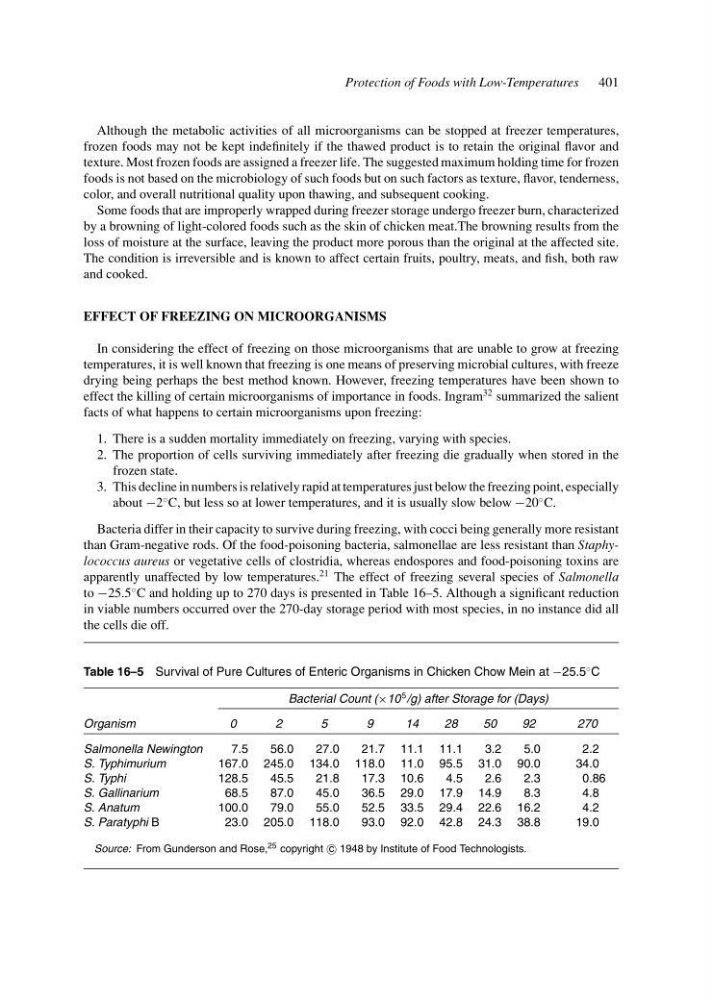
21 The effect of freezing several species of Salmonella
to −25.5
◦ C and holding up to 270 days is presented in Table 16–5. Although a significant reduction
in viable numbers occurred over the 270-day storage period with most species, in no instance did all
the cells die off.
Table 16–5 Survival of Pure Cultures of Enteric Organisms in Chicken Chow Mein at −25.5
◦ C
Bacterial Count (×10
5 /g) after Storage for (Days)
Organism
0
2
5
9
1 4
2 8
5 0
9 2
2 7 0
Salmonella Newington
7.5
56.0
27.0
21.7 11.1 11.1
3.2
5.0
2.2
S. Typhimurium
167.0 245.0 134.0 118.0 11.0 95.5 31.0 90.0
34.0
S. Typhi
128.5
45.5
21.8
17.3 10.6
4.5
2.6
2.3
0.86
S. Gallinarium
68.5
87.0
45.0
36.5 29.0 17.9 14.9
8.3
4.8
S. Anatum
100.0
79.0
55.0
52.5 33.5 29.4 22.6 16.2
4.2
S. Paratyphi B
23.0 205.0 118.0
93.0 92.0 42.8 24.3 38.8
19.0
Source: From Gunderson and Rose, 25 copyright c
1948 by Institute of Food Technologists.
401
Although the metabolic activities of all microorganisms can be stopped at freezer temperatures,
frozen foods may not be kept indefinitely if the thawed product is to retain the original flavor and
texture. Most frozen foods are assigned a freezer life. The suggested maximum holding time for frozen
foods is not based on the microbiology of such foods but on such factors as texture, flavor, tenderness,
color, and overall nutritional quality upon thawing, and subsequent cooking.
Some foods that are improperly wrapped during freezer storage undergo freezer burn, characterized
by a browning of light-colored foods such as the skin of chicken meat.The browning results from the
loss of moisture at the surface, leaving the product more porous than the original at the affected site.
The condition is irreversible and is known to affect certain fruits, poultry, meats, and fish, both raw
and cooked.
EFFECT OF FREEZING ON MICROORGANISMS
In considering the effect of freezing on those microorganisms that are unable to grow at freezing
temperatures, it is well known that freezing is one means of preserving microbial cultures, with freeze
drying being perhaps the best method known. However, freezing temperatures have been shown to
effect the killing of certain microorganisms of importance in foods. Ingram
32 summarized the salient
facts of what happens to certain microorganisms upon freezing:
1. There is a sudden mortality immediately on freezing, varying with species.
2. The proportion of cells surviving immediately after freezing die gradually when stored in the
frozen state.
3. This decline in numbers is relatively rapid at temperatures just below the freezing point, especially
about −2
◦ C, but less so at lower temperatures, and it is usually slow below −20
◦ C.
Bacteria differ in their capacity to survive during freezing, with cocci being generally more resistant
than Gram-negative rods. Of the food-poisoning bacteria, salmonellae are less resistant than Staphylococcus aureus or vegetative cells of clostridia, whereas endospores and food-poisoning toxins are
apparently unaffected by low temperatures.
21 The effect of freezing several species of Salmonella
to −25.5
◦ C and holding up to 270 days is presented in Table 16–5. Although a significant reduction
in viable numbers occurred over the 270-day storage period with most species, in no instance did all
the cells die off.
Table 16–5 Survival of Pure Cultures of Enteric Organisms in Chicken Chow Mein at −25.5
◦ C
Bacterial Count (×10
5 /g) after Storage for (Days)
Organism
0
2
5
9
1 4
2 8
5 0
9 2
2 7 0
Salmonella Newington
7.5
56.0
27.0
21.7 11.1 11.1
3.2
5.0
2.2
S. Typhimurium
167.0 245.0 134.0 118.0 11.0 95.5 31.0 90.0
34.0
S. Typhi
128.5
45.5
21.8
17.3 10.6
4.5
2.6
2.3
0.86
S. Gallinarium
68.5
87.0
45.0
36.5 29.0 17.9 14.9
8.3
4.8
S. Anatum
100.0
79.0
55.0
52.5 33.5 29.4 22.6 16.2
4.2
S. Paratyphi B
23.0 205.0 118.0
93.0 92.0 42.8 24.3 38.8
19.0
Source: From Gunderson and Rose, 25 copyright c
1948 by Institute of Food Technologists.