

388 Modern Food Microbiology
Table 15–7 Effects of Oxidizing and Reducing
Conditions on Resistance to Radiation of Deinococcus
radiodurans (Table of Means)
Condition
Log of Surviving Fraction
∗
Buffer, unmodified
−3.11542
Oxygen flushed
−3.89762
Nitrogen flushed
−2.29335
H 2 O 2 (100 ppm)
−3.47710
Thioglycolate (0.01 M)
−1.98455
Cysteine (0.1 M)
−0.81880
Ascorbate (0.1 M)
−5.36050
Note: Determined by count reduction after exposure to 10 kGy
of gamma radiation in 0.05 M phosphate buffer. LSD: P = 0.05
(1.98116); P = 0.01 (2.61533).
∗ Averages of four replicates.
Source: Giddings. 22
most resistant of Gram negatives. Gram-positive cocci are the most resistant of nonsporing bacteria,
including micrococci, staphylococci, and enterococci. What makes one organism more sensitive or
resistant than another is not only a matter of fundamental biological interest but also is of interest in the
application of irradiation to the preservation/protection of foods. A better understanding of resistance
mechanisms can lead to ways of increasing radiation sensitivity and, consequently, to the use of lower
doses for food use.
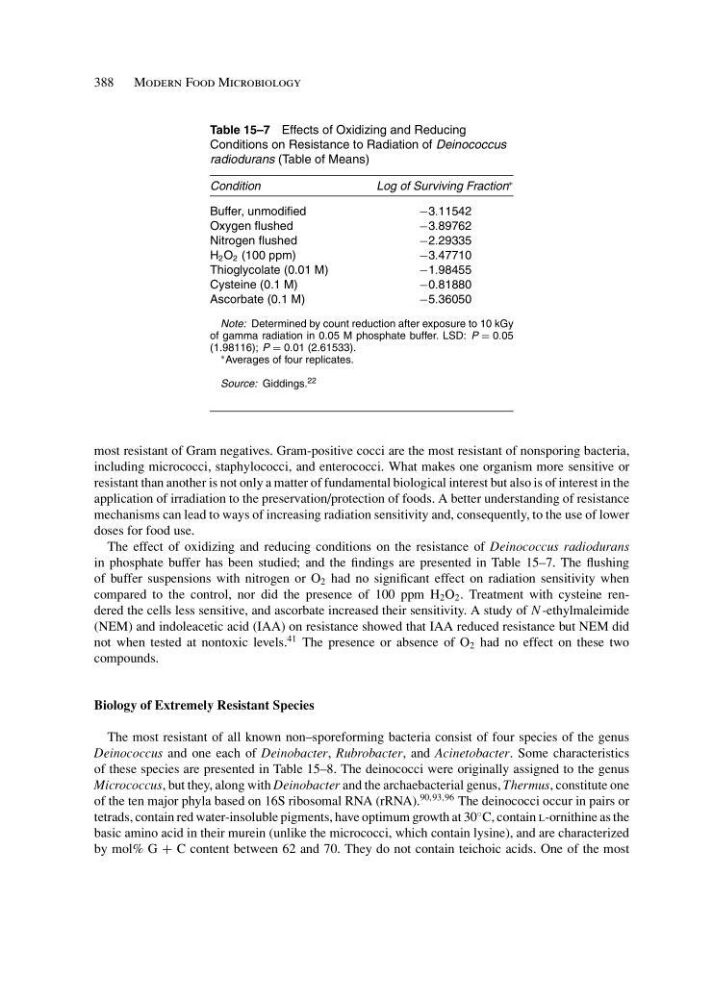
The effect of oxidizing and reducing conditions on the resistance of Deinococcus radiodurans
in phosphate buffer has been studied; and the findings are presented in Table 15–7. The flushing
of buffer suspensions with nitrogen or O 2 had no significant effect on radiation sensitivity when
compared to the control, nor did the presence of 100 ppm H 2 O 2 . Treatment with cysteine rendered the cells less sensitive, and ascorbate increased their sensitivity. A study of N -ethylmaleimide
(NEM) and indoleacetic acid (IAA) on resistance showed that IAA reduced resistance but NEM did
not when tested at nontoxic levels.
41 The presence or absence of O 2 had no effect on these two
compounds.
Biology of Extremely Resistant Species
The most resistant of all known non–sporeforming bacteria consist of four species of the genus
Deinococcus and one each of Deinobacter, Rubrobacter, and Acinetobacter. Some characteristics
of these species are presented in Table 15–8. The deinococci were originally assigned to the genus
Micrococcus, but they, along with Deinobacter and the archaebacterial genus, Thermus, constitute one
of the ten major phyla based on 16S ribosomal RNA (rRNA).
90,93,96 The deinococci occur in pairs or
tetrads, contain red water-insoluble pigments, have optimum growth at 30
◦ C, contain l-ornithine as the
basic amino acid in their murein (unlike the micrococci, which contain lysine), and are characterized
by mol% G + C content between 62 and 70. They do not contain teichoic acids. One of the most
Table 15–7 Effects of Oxidizing and Reducing
Conditions on Resistance to Radiation of Deinococcus
radiodurans (Table of Means)
Condition
Log of Surviving Fraction
∗
Buffer, unmodified
−3.11542
Oxygen flushed
−3.89762
Nitrogen flushed
−2.29335
H 2 O 2 (100 ppm)
−3.47710
Thioglycolate (0.01 M)
−1.98455
Cysteine (0.1 M)
−0.81880
Ascorbate (0.1 M)
−5.36050
Note: Determined by count reduction after exposure to 10 kGy
of gamma radiation in 0.05 M phosphate buffer. LSD: P = 0.05
(1.98116); P = 0.01 (2.61533).
∗ Averages of four replicates.
Source: Giddings. 22
most resistant of Gram negatives. Gram-positive cocci are the most resistant of nonsporing bacteria,
including micrococci, staphylococci, and enterococci. What makes one organism more sensitive or
resistant than another is not only a matter of fundamental biological interest but also is of interest in the
application of irradiation to the preservation/protection of foods. A better understanding of resistance
mechanisms can lead to ways of increasing radiation sensitivity and, consequently, to the use of lower
doses for food use.
The effect of oxidizing and reducing conditions on the resistance of Deinococcus radiodurans
in phosphate buffer has been studied; and the findings are presented in Table 15–7. The flushing
of buffer suspensions with nitrogen or O 2 had no significant effect on radiation sensitivity when
compared to the control, nor did the presence of 100 ppm H 2 O 2 . Treatment with cysteine rendered the cells less sensitive, and ascorbate increased their sensitivity. A study of N -ethylmaleimide
(NEM) and indoleacetic acid (IAA) on resistance showed that IAA reduced resistance but NEM did
not when tested at nontoxic levels.
41 The presence or absence of O 2 had no effect on these two
compounds.
Biology of Extremely Resistant Species
The most resistant of all known non–sporeforming bacteria consist of four species of the genus
Deinococcus and one each of Deinobacter, Rubrobacter, and Acinetobacter. Some characteristics
of these species are presented in Table 15–8. The deinococci were originally assigned to the genus
Micrococcus, but they, along with Deinobacter and the archaebacterial genus, Thermus, constitute one
of the ten major phyla based on 16S ribosomal RNA (rRNA).
90,93,96 The deinococci occur in pairs or
tetrads, contain red water-insoluble pigments, have optimum growth at 30
◦ C, contain l-ornithine as the
basic amino acid in their murein (unlike the micrococci, which contain lysine), and are characterized
by mol% G + C content between 62 and 70. They do not contain teichoic acids. One of the most