

378 Modern Food Microbiology
Table 15–1 Effect of Irradiation Temperature on D Values of Two Load
Levels of C. botulinum 33A in Precooked Ground Beef
D (kGy)
Temperature (
◦
C)
∼5 × 10
6 Spores/Can
∼2 × 10
8 Spores/Can
−196
5.77
5.95
−150
5.32
5.43
−100
4.83
4.86
−50
4.34
4.30
0
3.85
3.73
25
3.60
3.45
65
3.21
2.99
Note: Data are based on linear spore destruction.
Source: Grecz et al. 27 reproduced by permission of National Research Council of
Canada from Canadian Journal of Microbiology 17:135–142, 1971.
Radappertization
Radappertization of any foods may be achieved by application of the proper dose of radiation under
the proper conditions. The effect of this treatment on endospores and exotoxins of C. botulinum is
of obvious interest. Type E spores have been reported to possess radiation D values on the order of
1.2–1.7 kGy.
71 Types A and B spores were found by Kempe
37 to have D values of 2.79 and 2.38 kGy,
respectively. Type E spores are the most radiation sensitive of these three types.
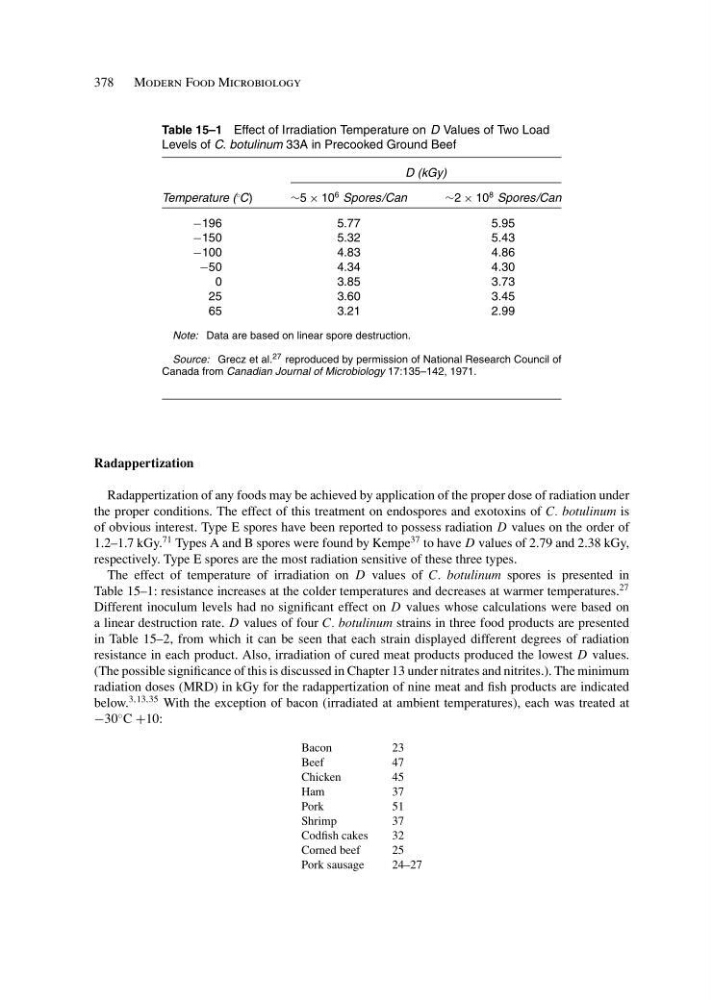
The effect of temperature of irradiation on D values of C. botulinum spores is presented in
Table 15–1: resistance increases at the colder temperatures and decreases at warmer temperatures.
27
Different inoculum levels had no significant effect on D values whose calculations were based on
a linear destruction rate. D values of four C. botulinum strains in three food products are presented
in Table 15–2, from which it can be seen that each strain displayed different degrees of radiation
resistance in each product. Also, irradiation of cured meat products produced the lowest D values.
(The possible significance of this is discussed in Chapter 13 under nitrates and nitrites.). The minimum
radiation doses (MRD) in kGy for the radappertization of nine meat and fish products are indicated
below.
3,13,35 With the exception of bacon (irradiated at ambient temperatures), each was treated at
−30
◦ C +10:
Bacon
23
Beef
47
Chicken
45
Ham
37
Pork
51
Shrimp
37
Codfish cakes
32
Corned beef
25
Pork sausage
24–27
Table 15–1 Effect of Irradiation Temperature on D Values of Two Load
Levels of C. botulinum 33A in Precooked Ground Beef
D (kGy)
Temperature (
◦
C)
∼5 × 10
6 Spores/Can
∼2 × 10
8 Spores/Can
−196
5.77
5.95
−150
5.32
5.43
−100
4.83
4.86
−50
4.34
4.30
0
3.85
3.73
25
3.60
3.45
65
3.21
2.99
Note: Data are based on linear spore destruction.
Source: Grecz et al. 27 reproduced by permission of National Research Council of
Canada from Canadian Journal of Microbiology 17:135–142, 1971.
Radappertization
Radappertization of any foods may be achieved by application of the proper dose of radiation under
the proper conditions. The effect of this treatment on endospores and exotoxins of C. botulinum is
of obvious interest. Type E spores have been reported to possess radiation D values on the order of
1.2–1.7 kGy.
71 Types A and B spores were found by Kempe
37 to have D values of 2.79 and 2.38 kGy,
respectively. Type E spores are the most radiation sensitive of these three types.
The effect of temperature of irradiation on D values of C. botulinum spores is presented in
Table 15–1: resistance increases at the colder temperatures and decreases at warmer temperatures.
27
Different inoculum levels had no significant effect on D values whose calculations were based on
a linear destruction rate. D values of four C. botulinum strains in three food products are presented
in Table 15–2, from which it can be seen that each strain displayed different degrees of radiation
resistance in each product. Also, irradiation of cured meat products produced the lowest D values.
(The possible significance of this is discussed in Chapter 13 under nitrates and nitrites.). The minimum
radiation doses (MRD) in kGy for the radappertization of nine meat and fish products are indicated
below.
3,13,35 With the exception of bacon (irradiated at ambient temperatures), each was treated at
−30
◦ C +10:
Bacon
23
Beef
47
Chicken
45
Ham
37
Pork
51
Shrimp
37
Codfish cakes
32
Corned beef
25
Pork sausage
24–27