

Food Protection with Chemicals, and by Biocontrol 329
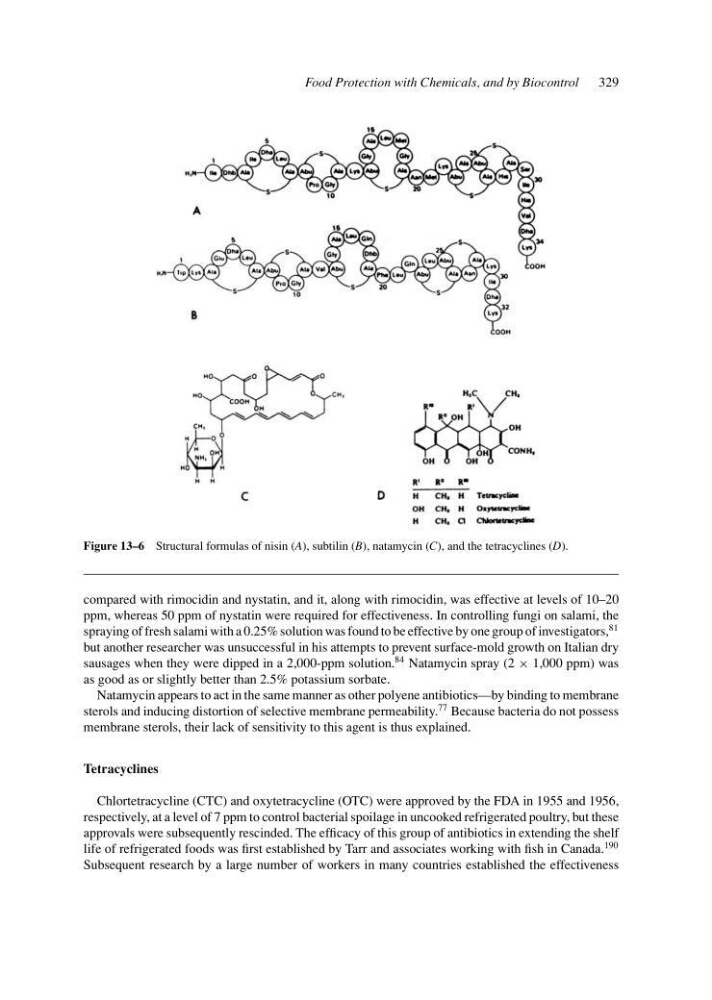
Figure 13–6 Structural formulas of nisin (A), subtilin (B), natamycin (C), and the tetracyclines (D).
compared with rimocidin and nystatin, and it, along with rimocidin, was effective at levels of 10–20
ppm, whereas 50 ppm of nystatin were required for effectiveness. In controlling fungi on salami, the
spraying of fresh salami with a 0.25% solution was found to be effective by one group of investigators,
81
but another researcher was unsuccessful in his attempts to prevent surface-mold growth on Italian dry
sausages when they were dipped in a 2,000-ppm solution.
84 Natamycin spray (2 × 1,000 ppm) was
as good as or slightly better than 2.5% potassium sorbate.
Natamycin appears to act in the same manner as other polyene antibiotics—by binding to membrane
sterols and inducing distortion of selective membrane permeability.
77 Because bacteria do not possess
membrane sterols, their lack of sensitivity to this agent is thus explained.
Tetracyclines
Chlortetracycline (CTC) and oxytetracycline (OTC) were approved by the FDA in 1955 and 1956,
respectively, at a level of 7 ppm to control bacterial spoilage in uncooked refrigerated poultry, but these
approvals were subsequently rescinded. The efficacy of this group of antibiotics in extending the shelf
life of refrigerated foods was first established by Tarr and associates working with fish in Canada.
190
Subsequent research by a large number of workers in many countries established the effectiveness
Figure 13–6 Structural formulas of nisin (A), subtilin (B), natamycin (C), and the tetracyclines (D).
compared with rimocidin and nystatin, and it, along with rimocidin, was effective at levels of 10–20
ppm, whereas 50 ppm of nystatin were required for effectiveness. In controlling fungi on salami, the
spraying of fresh salami with a 0.25% solution was found to be effective by one group of investigators,
81
but another researcher was unsuccessful in his attempts to prevent surface-mold growth on Italian dry
sausages when they were dipped in a 2,000-ppm solution.
84 Natamycin spray (2 × 1,000 ppm) was
as good as or slightly better than 2.5% potassium sorbate.
Natamycin appears to act in the same manner as other polyene antibiotics—by binding to membrane
sterols and inducing distortion of selective membrane permeability.
77 Because bacteria do not possess
membrane sterols, their lack of sensitivity to this agent is thus explained.
Tetracyclines
Chlortetracycline (CTC) and oxytetracycline (OTC) were approved by the FDA in 1955 and 1956,
respectively, at a level of 7 ppm to control bacterial spoilage in uncooked refrigerated poultry, but these
approvals were subsequently rescinded. The efficacy of this group of antibiotics in extending the shelf
life of refrigerated foods was first established by Tarr and associates working with fish in Canada.
190
Subsequent research by a large number of workers in many countries established the effectiveness