

328 Modern Food Microbiology
Table 13–9 Properties of Some Antibiotics
Property
Tetracyclines
Subtilin
Tylosin
Nisin
Natamycin
Widely used in foods
No
No
No
Yes
Yes
First food use
1950
1950
1961
1951
1956
Chemical nature
Tetracycline
Polypeptide
Macrolide
Polypeptide
Polyene
Used as heat adjunct
No
Yes
Yes
Yes
No
Heat stability
Sensitive
Stable
Stable
Stable
Stable
Microbial spectrum
G
+ , G
−
G
+
G
+
G
+
Fungi
Used medically
Yes
No
Yes
∗
No
Yes
†
Used in feeds
Yes
No
Yes
No
No
∗ In treating poultry diseases.
† Limited.
Source: reference 96.
medically or in animal feeds, and although nisin is used in many countries, subtilin is not. The structural
similarities of these two antibiotics may be noted from Figure 13–6.
Monensin
This antibiotic was approved by the FDA as a cattle feed additive in the 1970s, and it is used
primarily to improve feed efficiency in ruminants. Its amino acid-sparing action has been demonstrated
in fistulated cows.
113 It inhibits Gram-positive bacteria, and thus its long-term use has the potential of
shifting the gastrointestinal tract bacterial biota from one that is normally Gram positive to one that
is more Gram negative. Like nisin, monensin is an ionophore (destroys selective permeability of cell
membranes), and the two agents compare favorably as feed additives.
26 See Chapter 27 for possible
effect on E. coli 0157:H7 in animal feces.
Natamycin
This antibiotic (also known as pimaricin, tennecetin, and myprozine) is a polyene that is quite
effective against yeasts and molds but not bacteria. Natamycin is the international nonproprietary name,
as it was isolated from Streptomyces natalensis. Its structural formula is presented in Figure 13–6.
In granting the acceptance of natamycin as a food preservative, the joint Food and Agriculture
Organization/the World Health Organization (FAO/WHO) Expert Committee
59 took the following
into consideration: it does not affect bacteria, it stimulates an unusually low level of resistance among
fungi, it is rarely involved in cross-resistance among other antifungal polyenes, and DNA transfer
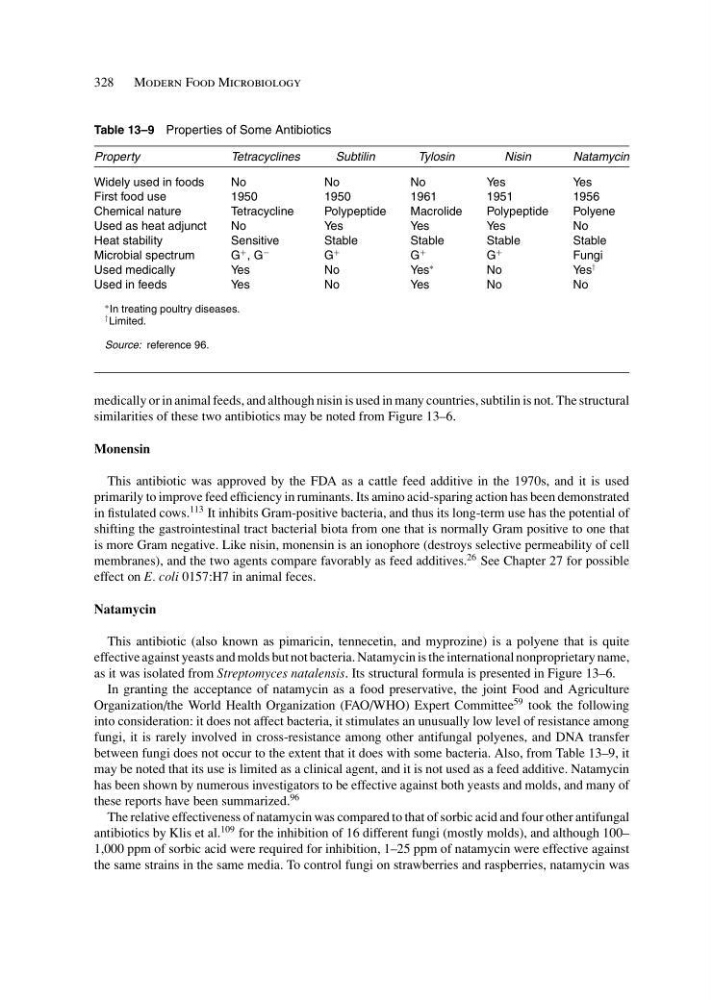
between fungi does not occur to the extent that it does with some bacteria. Also, from Table 13–9, it
may be noted that its use is limited as a clinical agent, and it is not used as a feed additive. Natamycin
has been shown by numerous investigators to be effective against both yeasts and molds, and many of
these reports have been summarized.
96
The relative effectiveness of natamycin was compared to that of sorbic acid and four other antifungal
antibiotics by Klis et al.
109 for the inhibition of 16 different fungi (mostly molds), and although 100–
1,000 ppm of sorbic acid were required for inhibition, 1–25 ppm of natamycin were effective against
the same strains in the same media. To control fungi on strawberries and raspberries, natamycin was
Table 13–9 Properties of Some Antibiotics
Property
Tetracyclines
Subtilin
Tylosin
Nisin
Natamycin
Widely used in foods
No
No
No
Yes
Yes
First food use
1950
1950
1961
1951
1956
Chemical nature
Tetracycline
Polypeptide
Macrolide
Polypeptide
Polyene
Used as heat adjunct
No
Yes
Yes
Yes
No
Heat stability
Sensitive
Stable
Stable
Stable
Stable
Microbial spectrum
G
+ , G
−
G
+
G
+
G
+
Fungi
Used medically
Yes
No
Yes
∗
No
Yes
†
Used in feeds
Yes
No
Yes
No
No
∗ In treating poultry diseases.
† Limited.
Source: reference 96.
medically or in animal feeds, and although nisin is used in many countries, subtilin is not. The structural
similarities of these two antibiotics may be noted from Figure 13–6.
Monensin
This antibiotic was approved by the FDA as a cattle feed additive in the 1970s, and it is used
primarily to improve feed efficiency in ruminants. Its amino acid-sparing action has been demonstrated
in fistulated cows.
113 It inhibits Gram-positive bacteria, and thus its long-term use has the potential of
shifting the gastrointestinal tract bacterial biota from one that is normally Gram positive to one that
is more Gram negative. Like nisin, monensin is an ionophore (destroys selective permeability of cell
membranes), and the two agents compare favorably as feed additives.
26 See Chapter 27 for possible
effect on E. coli 0157:H7 in animal feces.
Natamycin
This antibiotic (also known as pimaricin, tennecetin, and myprozine) is a polyene that is quite
effective against yeasts and molds but not bacteria. Natamycin is the international nonproprietary name,
as it was isolated from Streptomyces natalensis. Its structural formula is presented in Figure 13–6.
In granting the acceptance of natamycin as a food preservative, the joint Food and Agriculture
Organization/the World Health Organization (FAO/WHO) Expert Committee
59 took the following
into consideration: it does not affect bacteria, it stimulates an unusually low level of resistance among
fungi, it is rarely involved in cross-resistance among other antifungal polyenes, and DNA transfer
between fungi does not occur to the extent that it does with some bacteria. Also, from Table 13–9, it
may be noted that its use is limited as a clinical agent, and it is not used as a feed additive. Natamycin
has been shown by numerous investigators to be effective against both yeasts and molds, and many of
these reports have been summarized.
96
The relative effectiveness of natamycin was compared to that of sorbic acid and four other antifungal
antibiotics by Klis et al.
109 for the inhibition of 16 different fungi (mostly molds), and although 100–
1,000 ppm of sorbic acid were required for inhibition, 1–25 ppm of natamycin were effective against
the same strains in the same media. To control fungi on strawberries and raspberries, natamycin was