

Taxonomy, Role, and Significance of Microorganisms in Foods
17
Bacteria
Acinetobacter
Erwinia
Proteus
Aeromonas
Escherichia
Pseudomonas
Alcaligenes
Flavobacterium
Psychrobacter
Arcobacter
Hafnia
Salmonella
Bacillus
Kocuria
Serratia
Brevibacillus
Lactococcus
Shewanella
Brochothrix
Lactobacillus
Shigella
Burkholderia
Leuconostoc
Sphingomonas
Campylobacter
Listeria
Stenotrophomonas
Carnobacterium
Micrococcus
Staphylococcus
Citrobacter
Moraxella
Vagococcus
Clostridium
Paenibacillus
Vibrio
Corynebacterium
Pandoraea
Weissella
Enterobacter
Pantoea
Yersinia
Enterococcus
Pediococcus
Molds
Alternaria
Colletotrichum
Penicillium
Aspergillus
Fusarium
Rhizopus
Aureobasidium
Geotrichum
Trichothecium
Botrytis
Monilia
Wallemia
Byssochlamys
Mucor
Xeromyces
Cladosporium
Yeasts
Brettanomyces/Dekkera
Issatchenkia
Schizosaccharomyces
Candida
Kluyveromyces
Torulaspora
Cryptococcus
Pichia
Trichosporon
Debaryomyces
Rhodotorula
Yarrowia
Hanseniaspora
Saccharomyces
Zygosaccharomyces
Protozoa
Cryptosporidium parvum
Entamoeba histolytica
Toxoplasma gondii
Cyclospora cayetanensis
Giardia lamblia
PRIMARY SOURCES OF MICROORGANISMS FOUND IN FOODS
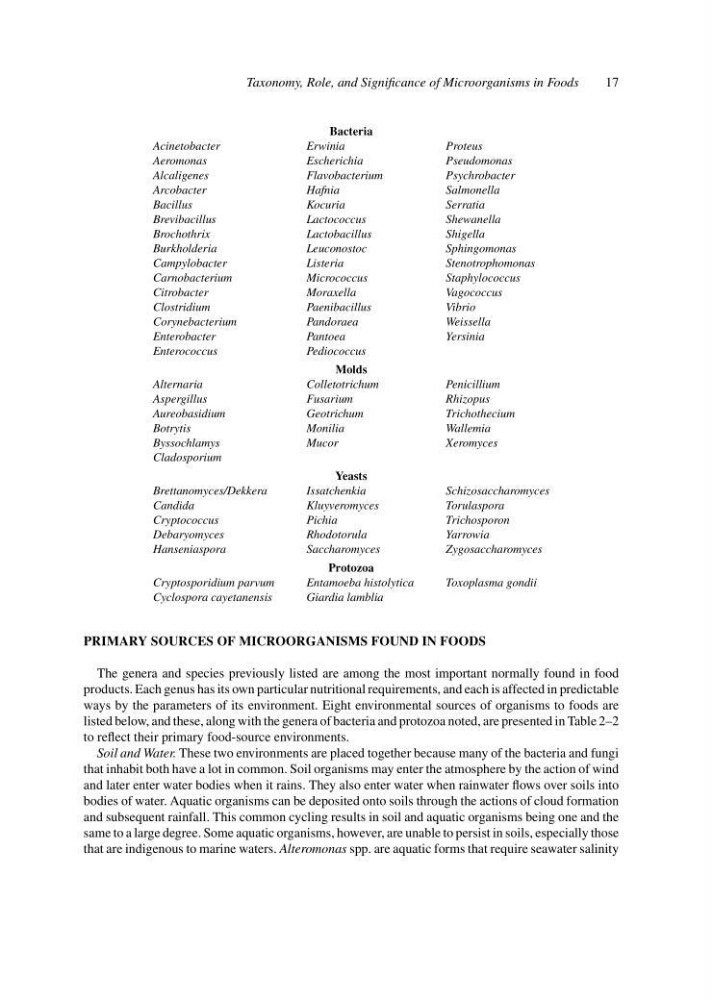
The genera and species previously listed are among the most important normally found in food
products. Each genus has its own particular nutritional requirements, and each is affected in predictable
ways by the parameters of its environment. Eight environmental sources of organisms to foods are
listed below, and these, along with the genera of bacteria and protozoa noted, are presented in Table 2–2
to reflect their primary food-source environments.
Soil and Water. These two environments are placed together because many of the bacteria and fungi
that inhabit both have a lot in common. Soil organisms may enter the atmosphere by the action of wind
and later enter water bodies when it rains. They also enter water when rainwater flows over soils into
bodies of water. Aquatic organisms can be deposited onto soils through the actions of cloud formation
and subsequent rainfall. This common cycling results in soil and aquatic organisms being one and the
same to a large degree. Some aquatic organisms, however, are unable to persist in soils, especially those
that are indigenous to marine waters. Alteromonas spp. are aquatic forms that require seawater salinity
17
Bacteria
Acinetobacter
Erwinia
Proteus
Aeromonas
Escherichia
Pseudomonas
Alcaligenes
Flavobacterium
Psychrobacter
Arcobacter
Hafnia
Salmonella
Bacillus
Kocuria
Serratia
Brevibacillus
Lactococcus
Shewanella
Brochothrix
Lactobacillus
Shigella
Burkholderia
Leuconostoc
Sphingomonas
Campylobacter
Listeria
Stenotrophomonas
Carnobacterium
Micrococcus
Staphylococcus
Citrobacter
Moraxella
Vagococcus
Clostridium
Paenibacillus
Vibrio
Corynebacterium
Pandoraea
Weissella
Enterobacter
Pantoea
Yersinia
Enterococcus
Pediococcus
Molds
Alternaria
Colletotrichum
Penicillium
Aspergillus
Fusarium
Rhizopus
Aureobasidium
Geotrichum
Trichothecium
Botrytis
Monilia
Wallemia
Byssochlamys
Mucor
Xeromyces
Cladosporium
Yeasts
Brettanomyces/Dekkera
Issatchenkia
Schizosaccharomyces
Candida
Kluyveromyces
Torulaspora
Cryptococcus
Pichia
Trichosporon
Debaryomyces
Rhodotorula
Yarrowia
Hanseniaspora
Saccharomyces
Zygosaccharomyces
Protozoa
Cryptosporidium parvum
Entamoeba histolytica
Toxoplasma gondii
Cyclospora cayetanensis
Giardia lamblia
PRIMARY SOURCES OF MICROORGANISMS FOUND IN FOODS
The genera and species previously listed are among the most important normally found in food
products. Each genus has its own particular nutritional requirements, and each is affected in predictable
ways by the parameters of its environment. Eight environmental sources of organisms to foods are
listed below, and these, along with the genera of bacteria and protozoa noted, are presented in Table 2–2
to reflect their primary food-source environments.
Soil and Water. These two environments are placed together because many of the bacteria and fungi
that inhabit both have a lot in common. Soil organisms may enter the atmosphere by the action of wind
and later enter water bodies when it rains. They also enter water when rainwater flows over soils into
bodies of water. Aquatic organisms can be deposited onto soils through the actions of cloud formation
and subsequent rainfall. This common cycling results in soil and aquatic organisms being one and the
same to a large degree. Some aquatic organisms, however, are unable to persist in soils, especially those
that are indigenous to marine waters. Alteromonas spp. are aquatic forms that require seawater salinity