

16
Modern Food Microbiology
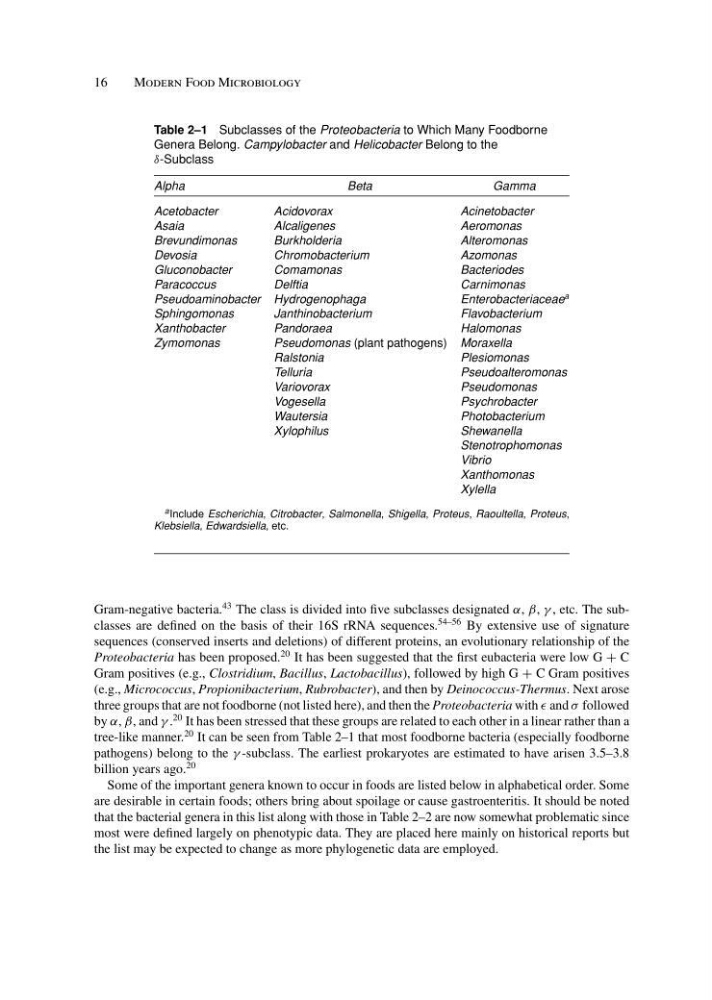
Table 2–1 Subclasses of the Proteobacteria to Which Many Foodborne
Genera Belong. Campylobacter and Helicobacter Belong to the
δ-Subclass
Alpha
Beta
Gamma
Acetobacter
Acidovorax
Acinetobacter
Asaia
Alcaligenes
Aeromonas
Brevundimonas
Burkholderia
Alteromonas
Devosia
Chromobacterium
Azomonas
Gluconobacter
Comamonas
Bacteriodes
Paracoccus
Delftia
Carnimonas
Pseudoaminobacter Hydrogenophaga
Enterobacteriaceae
a
Sphingomonas
Janthinobacterium
Flavobacterium
Xanthobacter
Pandoraea
Halomonas
Zymomonas
Pseudomonas (plant pathogens) Moraxella
Ralstonia
Plesiomonas
Telluria
Pseudoalteromonas
Variovorax
Pseudomonas
Vogesella
Psychrobacter
Wautersia
Photobacterium
Xylophilus
Shewanella
Stenotrophomonas
Vibrio
Xanthomonas
Xylella
a Include Escherichia, Citrobacter, Salmonella, Shigella, Proteus, Raoultella, Proteus,
Klebsiella, Edwardsiella, etc.
Gram-negative bacteria.
43 The class is divided into five subclasses designated α, β, γ , etc. The subclasses are defined on the basis of their 16S rRNA sequences.
54–56 By extensive use of signature
sequences (conserved inserts and deletions) of different proteins, an evolutionary relationship of the
Proteobacteria has been proposed.
20 It has been suggested that the first eubacteria were low G + C
Gram positives (e.g., Clostridium, Bacillus, Lactobacillus), followed by high G + C Gram positives
(e.g., Micrococcus, Propionibacterium, Rubrobacter), and then by Deinococcus-Thermus. Next arose
three groups that are not foodborne (not listed here), and then the Proteobacteria with and σ followed
by α, β, and γ .
20 It has been stressed that these groups are related to each other in a linear rather than a
tree-like manner.
20 It can be seen from Table 2–1 that most foodborne bacteria (especially foodborne
pathogens) belong to the γ -subclass. The earliest prokaryotes are estimated to have arisen 3.5–3.8
billion years ago.
20
Some of the important genera known to occur in foods are listed below in alphabetical order. Some
are desirable in certain foods; others bring about spoilage or cause gastroenteritis. It should be noted
that the bacterial genera in this list along with those in Table 2–2 are now somewhat problematic since
most were defined largely on phenotypic data. They are placed here mainly on historical reports but
the list may be expected to change as more phylogenetic data are employed.
Modern Food Microbiology
Table 2–1 Subclasses of the Proteobacteria to Which Many Foodborne
Genera Belong. Campylobacter and Helicobacter Belong to the
δ-Subclass
Alpha
Beta
Gamma
Acetobacter
Acidovorax
Acinetobacter
Asaia
Alcaligenes
Aeromonas
Brevundimonas
Burkholderia
Alteromonas
Devosia
Chromobacterium
Azomonas
Gluconobacter
Comamonas
Bacteriodes
Paracoccus
Delftia
Carnimonas
Pseudoaminobacter Hydrogenophaga
Enterobacteriaceae
a
Sphingomonas
Janthinobacterium
Flavobacterium
Xanthobacter
Pandoraea
Halomonas
Zymomonas
Pseudomonas (plant pathogens) Moraxella
Ralstonia
Plesiomonas
Telluria
Pseudoalteromonas
Variovorax
Pseudomonas
Vogesella
Psychrobacter
Wautersia
Photobacterium
Xylophilus
Shewanella
Stenotrophomonas
Vibrio
Xanthomonas
Xylella
a Include Escherichia, Citrobacter, Salmonella, Shigella, Proteus, Raoultella, Proteus,
Klebsiella, Edwardsiella, etc.
Gram-negative bacteria.
43 The class is divided into five subclasses designated α, β, γ , etc. The subclasses are defined on the basis of their 16S rRNA sequences.
54–56 By extensive use of signature
sequences (conserved inserts and deletions) of different proteins, an evolutionary relationship of the
Proteobacteria has been proposed.
20 It has been suggested that the first eubacteria were low G + C
Gram positives (e.g., Clostridium, Bacillus, Lactobacillus), followed by high G + C Gram positives
(e.g., Micrococcus, Propionibacterium, Rubrobacter), and then by Deinococcus-Thermus. Next arose
three groups that are not foodborne (not listed here), and then the Proteobacteria with and σ followed
by α, β, and γ .
20 It has been stressed that these groups are related to each other in a linear rather than a
tree-like manner.
20 It can be seen from Table 2–1 that most foodborne bacteria (especially foodborne
pathogens) belong to the γ -subclass. The earliest prokaryotes are estimated to have arisen 3.5–3.8
billion years ago.
20
Some of the important genera known to occur in foods are listed below in alphabetical order. Some
are desirable in certain foods; others bring about spoilage or cause gastroenteritis. It should be noted
that the bacterial genera in this list along with those in Table 2–2 are now somewhat problematic since
most were defined largely on phenotypic data. They are placed here mainly on historical reports but
the list may be expected to change as more phylogenetic data are employed.