

Food Protection with Chemicals, and by Biocontrol 315
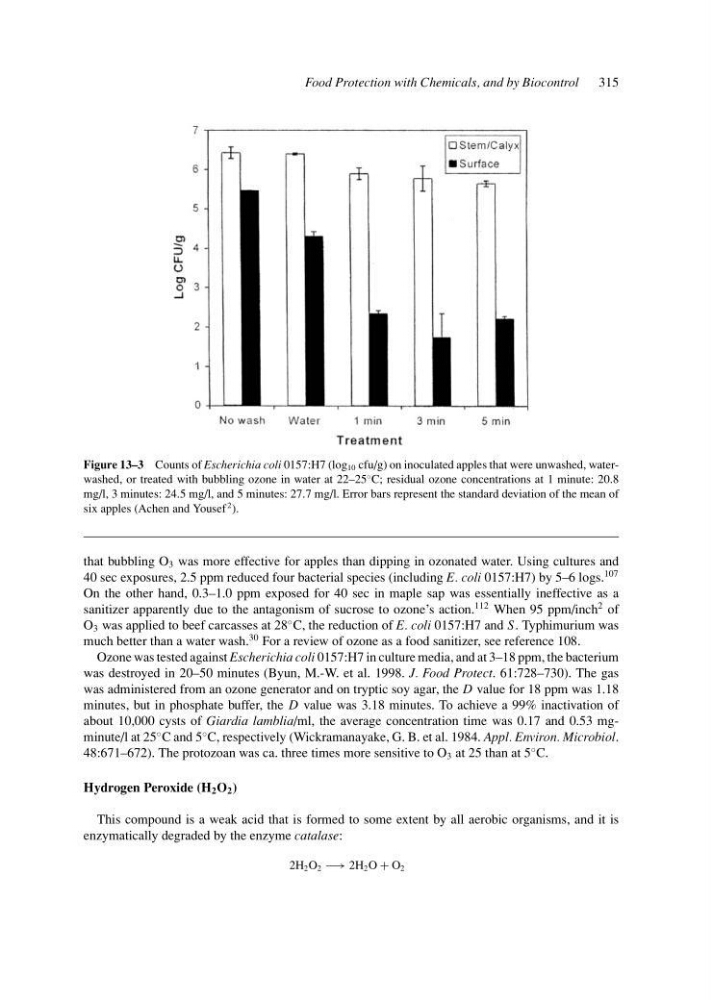
Figure 13–3 Counts of Escherichia coli 0157:H7 (log 10 cfu/g) on inoculated apples that were unwashed, waterwashed, or treated with bubbling ozone in water at 22–25
◦ C; residual ozone concentrations at 1 minute: 20.8
mg/l, 3 minutes: 24.5 mg/l, and 5 minutes: 27.7 mg/l. Error bars represent the standard deviation of the mean of
six apples (Achen and Yousef
2 ).
that bubbling O 3 was more effective for apples than dipping in ozonated water. Using cultures and
40 sec exposures, 2.5 ppm reduced four bacterial species (including E. coli 0157:H7) by 5–6 logs.
107
On the other hand, 0.3–1.0 ppm exposed for 40 sec in maple sap was essentially ineffective as a
sanitizer apparently due to the antagonism of sucrose to ozone’s action.
112 When 95 ppm/inch
2 of
O 3 was applied to beef carcasses at 28
◦ C, the reduction of E. coli 0157:H7 and S. Typhimurium was
much better than a water wash.
30 For a review of ozone as a food sanitizer, see reference 108.
Ozone was tested against Escherichia coli 0157:H7 in culture media, and at 3–18 ppm, the bacterium
was destroyed in 20–50 minutes (Byun, M.-W. et al. 1998. J. Food Protect. 61:728–730). The gas
was administered from an ozone generator and on tryptic soy agar, the D value for 18 ppm was 1.18
minutes, but in phosphate buffer, the D value was 3.18 minutes. To achieve a 99% inactivation of
about 10,000 cysts of Giardia lamblia/ml, the average concentration time was 0.17 and 0.53 mgminute/l at 25
◦ C and 5
◦ C, respectively (Wickramanayake, G. B. et al. 1984. Appl. Environ. Microbiol.
48:671–672). The protozoan was ca. three times more sensitive to O 3 at 25 than at 5
◦ C.
Hydrogen Peroxide (H 2 O 2 )
This compound is a weak acid that is formed to some extent by all aerobic organisms, and it is
enzymatically degraded by the enzyme catalase:
2H 2 O 2 −→ 2H 2 O + O 2
Figure 13–3 Counts of Escherichia coli 0157:H7 (log 10 cfu/g) on inoculated apples that were unwashed, waterwashed, or treated with bubbling ozone in water at 22–25
◦ C; residual ozone concentrations at 1 minute: 20.8
mg/l, 3 minutes: 24.5 mg/l, and 5 minutes: 27.7 mg/l. Error bars represent the standard deviation of the mean of
six apples (Achen and Yousef
2 ).
that bubbling O 3 was more effective for apples than dipping in ozonated water. Using cultures and
40 sec exposures, 2.5 ppm reduced four bacterial species (including E. coli 0157:H7) by 5–6 logs.
107
On the other hand, 0.3–1.0 ppm exposed for 40 sec in maple sap was essentially ineffective as a
sanitizer apparently due to the antagonism of sucrose to ozone’s action.
112 When 95 ppm/inch
2 of
O 3 was applied to beef carcasses at 28
◦ C, the reduction of E. coli 0157:H7 and S. Typhimurium was
much better than a water wash.
30 For a review of ozone as a food sanitizer, see reference 108.
Ozone was tested against Escherichia coli 0157:H7 in culture media, and at 3–18 ppm, the bacterium
was destroyed in 20–50 minutes (Byun, M.-W. et al. 1998. J. Food Protect. 61:728–730). The gas
was administered from an ozone generator and on tryptic soy agar, the D value for 18 ppm was 1.18
minutes, but in phosphate buffer, the D value was 3.18 minutes. To achieve a 99% inactivation of
about 10,000 cysts of Giardia lamblia/ml, the average concentration time was 0.17 and 0.53 mgminute/l at 25
◦ C and 5
◦ C, respectively (Wickramanayake, G. B. et al. 1984. Appl. Environ. Microbiol.
48:671–672). The protozoan was ca. three times more sensitive to O 3 at 25 than at 5
◦ C.
Hydrogen Peroxide (H 2 O 2 )
This compound is a weak acid that is formed to some extent by all aerobic organisms, and it is
enzymatically degraded by the enzyme catalase:
2H 2 O 2 −→ 2H 2 O + O 2