

Chapter 13
Food Protection with Chemicals,
and by Biocontrol
The use of chemicals to prevent or delay the spoilage of foods derives in part from the fact that such
compounds are used with great success in the treatment of diseases of humans, animals, and plants.
This is not to imply that any and all chemotherapeutic compounds can or should be used as food
preservatives. On the other hand, there are some chemicals of value as food preservatives that would
be ineffective or too toxic as chemotherapeutic compounds. With the exception of certain antibiotics,
none of the food preservatives now used find any real use as chemotherapeutic compounds in people
and animals. Although a large number of chemicals have been described that show potential as food
preservatives, only a relatively small number are allowed in food products, due in large part to the
strict rules of safety adhered to by the Food and Drug Administration (FDA) and to a lesser extent to
the fact that not all compounds that show antimicrobial activity in vitro do so when added to certain
foods. Described below are those compounds most widely used, their modes of action where known,
and the types of foods in which they are used. Those chemical preservatives generally recognized as
safe (GRAS) are summarized in Table 13–1.
BENZOIC ACID AND THE PARABENS
Benzoic acid (C 6 H 5 COOH) and its sodium salt (C 7 H 5 NaO 2 ), along with the esters of
p-hydroxybenzoic acid (parabens), are considered together in this section. Sodium benzoate was
the first chemical preservative permitted in foods by the FDA, and it continues in wide use today in a
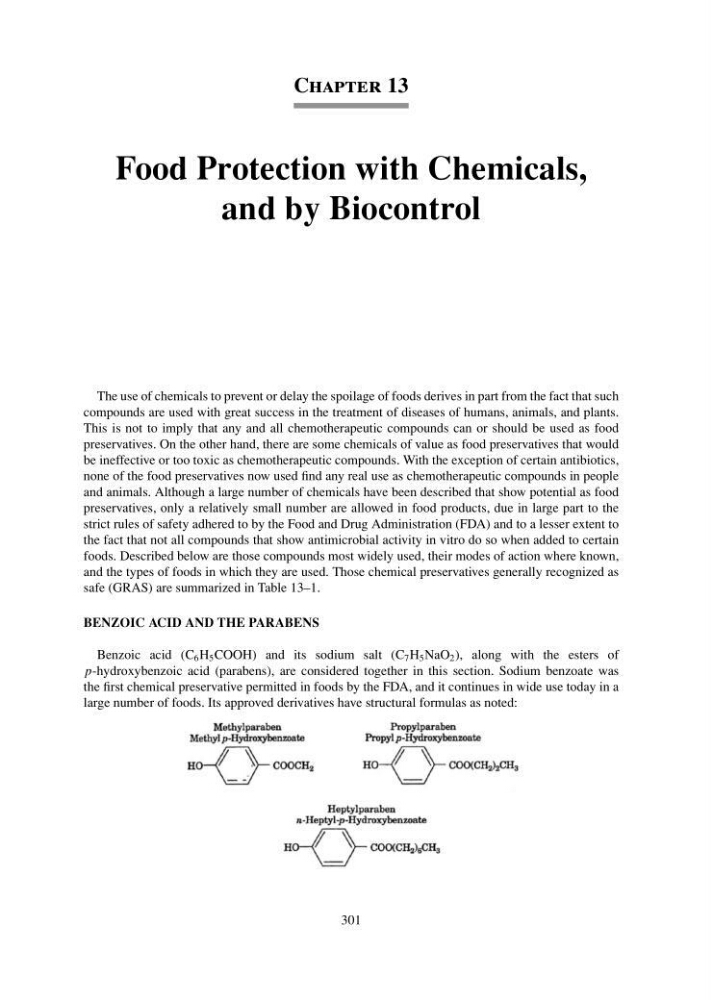
large number of foods. Its approved derivatives have structural formulas as noted:
301
Food Protection with Chemicals,
and by Biocontrol
The use of chemicals to prevent or delay the spoilage of foods derives in part from the fact that such
compounds are used with great success in the treatment of diseases of humans, animals, and plants.
This is not to imply that any and all chemotherapeutic compounds can or should be used as food
preservatives. On the other hand, there are some chemicals of value as food preservatives that would
be ineffective or too toxic as chemotherapeutic compounds. With the exception of certain antibiotics,
none of the food preservatives now used find any real use as chemotherapeutic compounds in people
and animals. Although a large number of chemicals have been described that show potential as food
preservatives, only a relatively small number are allowed in food products, due in large part to the
strict rules of safety adhered to by the Food and Drug Administration (FDA) and to a lesser extent to
the fact that not all compounds that show antimicrobial activity in vitro do so when added to certain
foods. Described below are those compounds most widely used, their modes of action where known,
and the types of foods in which they are used. Those chemical preservatives generally recognized as
safe (GRAS) are summarized in Table 13–1.
BENZOIC ACID AND THE PARABENS
Benzoic acid (C 6 H 5 COOH) and its sodium salt (C 7 H 5 NaO 2 ), along with the esters of
p-hydroxybenzoic acid (parabens), are considered together in this section. Sodium benzoate was
the first chemical preservative permitted in foods by the FDA, and it continues in wide use today in a
large number of foods. Its approved derivatives have structural formulas as noted:
301