

Bioassay and Related Methods
287
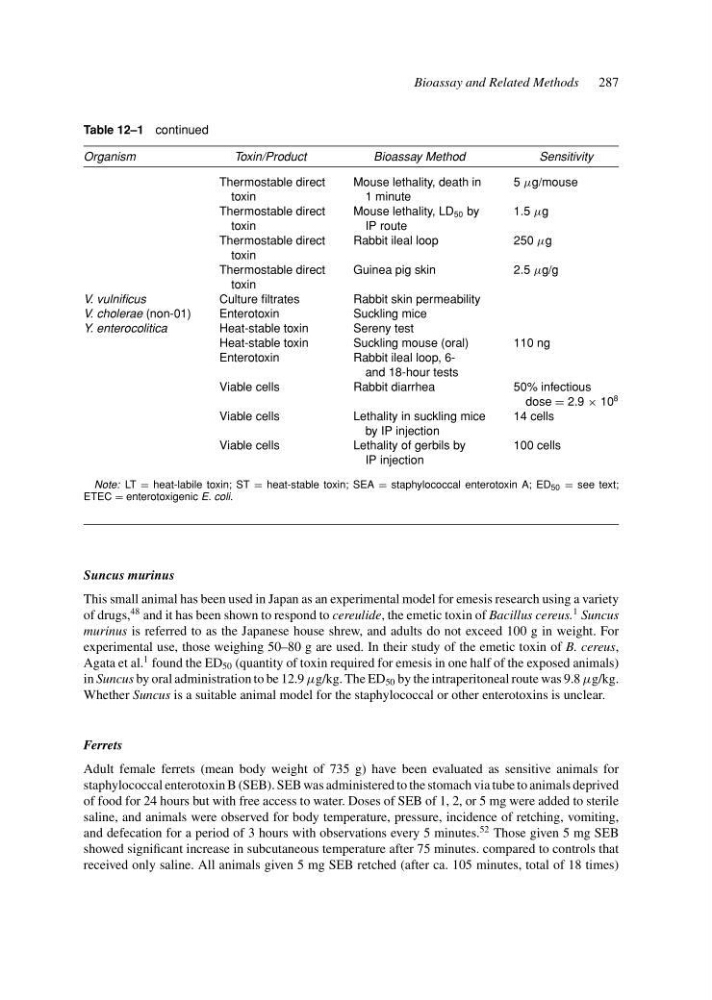
Table 12–1 continued
Organism
Toxin/Product
Bioassay Method
Sensitivity
Thermostable direct
Mouse lethality, death in
5 µg/mouse
toxin
1 minute
Thermostable direct
Mouse lethality, LD 50 by
1.5 µg
toxin
IP route
Thermostable direct
Rabbit ileal loop
250 µg
toxin
Thermostable direct
Guinea pig skin
2.5 µg/g
toxin
V. vulnificus
Culture filtrates
Rabbit skin permeability
V. cholerae (non-01)
Enterotoxin
Suckling mice
Y. enterocolitica
Heat-stable toxin
Sereny test
Heat-stable toxin
Suckling mouse (oral)
110 ng
Enterotoxin
Rabbit ileal loop, 6and 18-hour tests
Viable cells
Rabbit diarrhea
50% infectious
dose = 2.9 × 10
8
Viable cells
Lethality in suckling mice
14 cells
by IP injection
Viable cells
Lethality of gerbils by
100 cells
IP injection
Note: LT = heat-labile toxin; ST = heat-stable toxin; SEA = staphylococcal enterotoxin A; ED 50 = see text;
ETEC = enterotoxigenic E. coli.
Suncus murinus
This small animal has been used in Japan as an experimental model for emesis research using a variety
of drugs,
48 and it has been shown to respond to cereulide, the emetic toxin of Bacillus cereus.
1 Suncus
murinus is referred to as the Japanese house shrew, and adults do not exceed 100 g in weight. For
experimental use, those weighing 50–80 g are used. In their study of the emetic toxin of B. cereus,
Agata et al.
1 found the ED 50 (quantity of toxin required for emesis in one half of the exposed animals)
in Suncus by oral administration to be 12.9 µg/kg. The ED 50 by the intraperitoneal route was 9.8 µg/kg.
Whether Suncus is a suitable animal model for the staphylococcal or other enterotoxins is unclear.
Ferrets
Adult female ferrets (mean body weight of 735 g) have been evaluated as sensitive animals for
staphylococcal enterotoxin B (SEB). SEB was administered to the stomach via tube to animals deprived
of food for 24 hours but with free access to water. Doses of SEB of 1, 2, or 5 mg were added to sterile
saline, and animals were observed for body temperature, pressure, incidence of retching, vomiting,
and defecation for a period of 3 hours with observations every 5 minutes.
52 Those given 5 mg SEB
showed significant increase in subcutaneous temperature after 75 minutes. compared to controls that
received only saline. All animals given 5 mg SEB retched (after ca. 105 minutes, total of 18 times)
287
Table 12–1 continued
Organism
Toxin/Product
Bioassay Method
Sensitivity
Thermostable direct
Mouse lethality, death in
5 µg/mouse
toxin
1 minute
Thermostable direct
Mouse lethality, LD 50 by
1.5 µg
toxin
IP route
Thermostable direct
Rabbit ileal loop
250 µg
toxin
Thermostable direct
Guinea pig skin
2.5 µg/g
toxin
V. vulnificus
Culture filtrates
Rabbit skin permeability
V. cholerae (non-01)
Enterotoxin
Suckling mice
Y. enterocolitica
Heat-stable toxin
Sereny test
Heat-stable toxin
Suckling mouse (oral)
110 ng
Enterotoxin
Rabbit ileal loop, 6and 18-hour tests
Viable cells
Rabbit diarrhea
50% infectious
dose = 2.9 × 10
8
Viable cells
Lethality in suckling mice
14 cells
by IP injection
Viable cells
Lethality of gerbils by
100 cells
IP injection
Note: LT = heat-labile toxin; ST = heat-stable toxin; SEA = staphylococcal enterotoxin A; ED 50 = see text;
ETEC = enterotoxigenic E. coli.
Suncus murinus
This small animal has been used in Japan as an experimental model for emesis research using a variety
of drugs,
48 and it has been shown to respond to cereulide, the emetic toxin of Bacillus cereus.
1 Suncus
murinus is referred to as the Japanese house shrew, and adults do not exceed 100 g in weight. For
experimental use, those weighing 50–80 g are used. In their study of the emetic toxin of B. cereus,
Agata et al.
1 found the ED 50 (quantity of toxin required for emesis in one half of the exposed animals)
in Suncus by oral administration to be 12.9 µg/kg. The ED 50 by the intraperitoneal route was 9.8 µg/kg.
Whether Suncus is a suitable animal model for the staphylococcal or other enterotoxins is unclear.
Ferrets
Adult female ferrets (mean body weight of 735 g) have been evaluated as sensitive animals for
staphylococcal enterotoxin B (SEB). SEB was administered to the stomach via tube to animals deprived
of food for 24 hours but with free access to water. Doses of SEB of 1, 2, or 5 mg were added to sterile
saline, and animals were observed for body temperature, pressure, incidence of retching, vomiting,
and defecation for a period of 3 hours with observations every 5 minutes.
52 Those given 5 mg SEB
showed significant increase in subcutaneous temperature after 75 minutes. compared to controls that
received only saline. All animals given 5 mg SEB retched (after ca. 105 minutes, total of 18 times)