

246 Modern Food Microbiology
products,
88,227 microbial quality of raw fish,
199 and cooked turkey rolls. In the last case, LAL titers and
numbers of Enterobacteriaceae in vacuum-packaged rolls were found to have a statistically significant
linear relationship.
45
LAL titers for foods can be determined either by direct serial dilutions or by MPN, with results by
the two methods being essentially similar.
185 To extract endotoxins from foods, the Stomacher has
been found to be generally better than the Waring blenders or the shaking of dilution bottles.
93
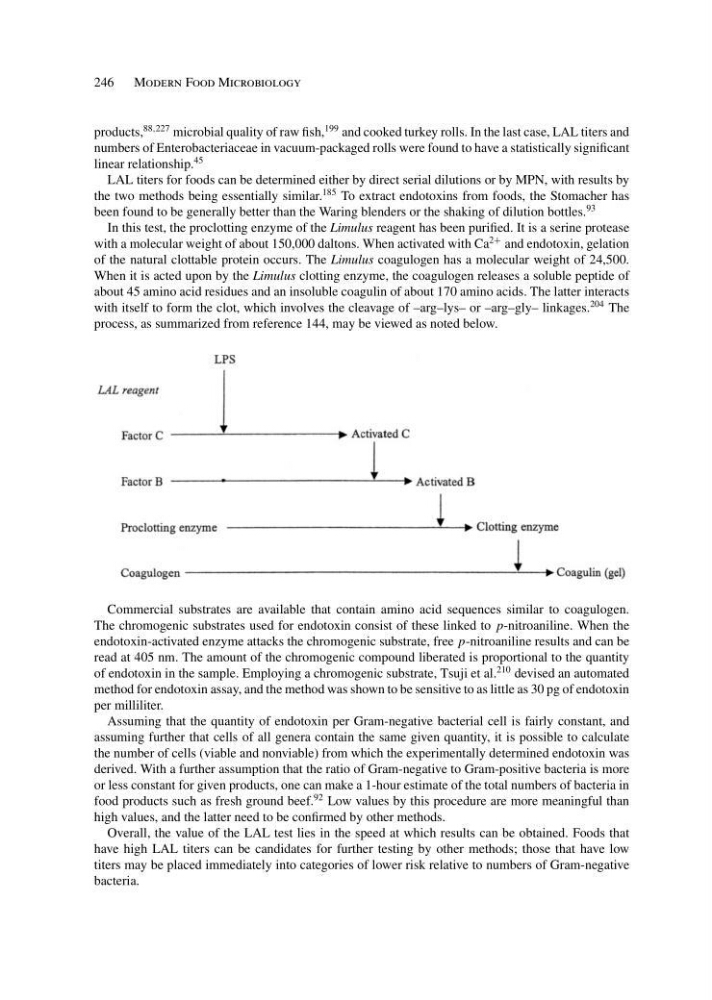
In this test, the proclotting enzyme of the Limulus reagent has been purified. It is a serine protease
with a molecular weight of about 150,000 daltons. When activated with Ca
2+ and endotoxin, gelation
of the natural clottable protein occurs. The Limulus coagulogen has a molecular weight of 24,500.
When it is acted upon by the Limulus clotting enzyme, the coagulogen releases a soluble peptide of
about 45 amino acid residues and an insoluble coagulin of about 170 amino acids. The latter interacts
with itself to form the clot, which involves the cleavage of –arg–lys– or –arg–gly– linkages.
204 The
process, as summarized from reference 144, may be viewed as noted below.
Commercial substrates are available that contain amino acid sequences similar to coagulogen.
The chromogenic substrates used for endotoxin consist of these linked to p-nitroaniline. When the
endotoxin-activated enzyme attacks the chromogenic substrate, free p-nitroaniline results and can be
read at 405 nm. The amount of the chromogenic compound liberated is proportional to the quantity
of endotoxin in the sample. Employing a chromogenic substrate, Tsuji et al.
210 devised an automated
method for endotoxin assay, and the method was shown to be sensitive to as little as 30 pg of endotoxin
per milliliter.
Assuming that the quantity of endotoxin per Gram-negative bacterial cell is fairly constant, and
assuming further that cells of all genera contain the same given quantity, it is possible to calculate
the number of cells (viable and nonviable) from which the experimentally determined endotoxin was
derived. With a further assumption that the ratio of Gram-negative to Gram-positive bacteria is more
or less constant for given products, one can make a 1-hour estimate of the total numbers of bacteria in
food products such as fresh ground beef.
92 Low values by this procedure are more meaningful than
high values, and the latter need to be confirmed by other methods.
Overall, the value of the LAL test lies in the speed at which results can be obtained. Foods that
have high LAL titers can be candidates for further testing by other methods; those that have low
titers may be placed immediately into categories of lower risk relative to numbers of Gram-negative
bacteria.
products,
88,227 microbial quality of raw fish,
199 and cooked turkey rolls. In the last case, LAL titers and
numbers of Enterobacteriaceae in vacuum-packaged rolls were found to have a statistically significant
linear relationship.
45
LAL titers for foods can be determined either by direct serial dilutions or by MPN, with results by
the two methods being essentially similar.
185 To extract endotoxins from foods, the Stomacher has
been found to be generally better than the Waring blenders or the shaking of dilution bottles.
93
In this test, the proclotting enzyme of the Limulus reagent has been purified. It is a serine protease
with a molecular weight of about 150,000 daltons. When activated with Ca
2+ and endotoxin, gelation
of the natural clottable protein occurs. The Limulus coagulogen has a molecular weight of 24,500.
When it is acted upon by the Limulus clotting enzyme, the coagulogen releases a soluble peptide of
about 45 amino acid residues and an insoluble coagulin of about 170 amino acids. The latter interacts
with itself to form the clot, which involves the cleavage of –arg–lys– or –arg–gly– linkages.
204 The
process, as summarized from reference 144, may be viewed as noted below.
Commercial substrates are available that contain amino acid sequences similar to coagulogen.
The chromogenic substrates used for endotoxin consist of these linked to p-nitroaniline. When the
endotoxin-activated enzyme attacks the chromogenic substrate, free p-nitroaniline results and can be
read at 405 nm. The amount of the chromogenic compound liberated is proportional to the quantity
of endotoxin in the sample. Employing a chromogenic substrate, Tsuji et al.
210 devised an automated
method for endotoxin assay, and the method was shown to be sensitive to as little as 30 pg of endotoxin
per milliliter.
Assuming that the quantity of endotoxin per Gram-negative bacterial cell is fairly constant, and
assuming further that cells of all genera contain the same given quantity, it is possible to calculate
the number of cells (viable and nonviable) from which the experimentally determined endotoxin was
derived. With a further assumption that the ratio of Gram-negative to Gram-positive bacteria is more
or less constant for given products, one can make a 1-hour estimate of the total numbers of bacteria in
food products such as fresh ground beef.
92 Low values by this procedure are more meaningful than
high values, and the latter need to be confirmed by other methods.
Overall, the value of the LAL test lies in the speed at which results can be obtained. Foods that
have high LAL titers can be candidates for further testing by other methods; those that have low
titers may be placed immediately into categories of lower risk relative to numbers of Gram-negative
bacteria.