

Chemical, Biological, and Physical Methods
245
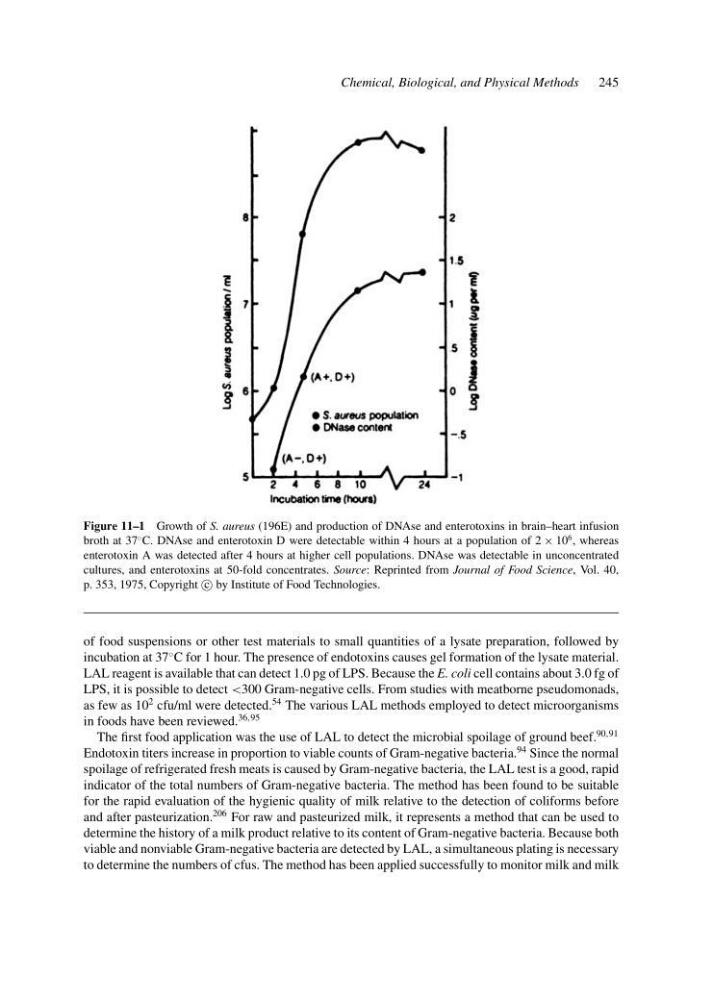
Figure 11–1 Growth of S. aureus (196E) and production of DNAse and enterotoxins in brain–heart infusion
broth at 37
◦ C. DNAse and enterotoxin D were detectable within 4 hours at a population of 2 × 10
6 , whereas
enterotoxin A was detected after 4 hours at higher cell populations. DNAse was detectable in unconcentrated
cultures, and enterotoxins at 50-fold concentrates. Source: Reprinted from Journal of Food Science, Vol. 40,
p. 353, 1975, Copyright c
by Institute of Food Technologies.
of food suspensions or other test materials to small quantities of a lysate preparation, followed by
incubation at 37
◦ C for 1 hour. The presence of endotoxins causes gel formation of the lysate material.
LAL reagent is available that can detect 1.0 pg of LPS. Because the E. coli cell contains about 3.0 fg of
LPS, it is possible to detect <300 Gram-negative cells. From studies with meatborne pseudomonads,
as few as 10
2 cfu/ml were detected.
54 The various LAL methods employed to detect microorganisms
in foods have been reviewed.
36,95
The first food application was the use of LAL to detect the microbial spoilage of ground beef.
90,91
Endotoxin titers increase in proportion to viable counts of Gram-negative bacteria.
94 Since the normal
spoilage of refrigerated fresh meats is caused by Gram-negative bacteria, the LAL test is a good, rapid
indicator of the total numbers of Gram-negative bacteria. The method has been found to be suitable
for the rapid evaluation of the hygienic quality of milk relative to the detection of coliforms before
and after pasteurization.
206 For raw and pasteurized milk, it represents a method that can be used to
determine the history of a milk product relative to its content of Gram-negative bacteria. Because both
viable and nonviable Gram-negative bacteria are detected by LAL, a simultaneous plating is necessary
to determine the numbers of cfus. The method has been applied successfully to monitor milk and milk
245
Figure 11–1 Growth of S. aureus (196E) and production of DNAse and enterotoxins in brain–heart infusion
broth at 37
◦ C. DNAse and enterotoxin D were detectable within 4 hours at a population of 2 × 10
6 , whereas
enterotoxin A was detected after 4 hours at higher cell populations. DNAse was detectable in unconcentrated
cultures, and enterotoxins at 50-fold concentrates. Source: Reprinted from Journal of Food Science, Vol. 40,
p. 353, 1975, Copyright c
by Institute of Food Technologies.
of food suspensions or other test materials to small quantities of a lysate preparation, followed by
incubation at 37
◦ C for 1 hour. The presence of endotoxins causes gel formation of the lysate material.
LAL reagent is available that can detect 1.0 pg of LPS. Because the E. coli cell contains about 3.0 fg of
LPS, it is possible to detect <300 Gram-negative cells. From studies with meatborne pseudomonads,
as few as 10
2 cfu/ml were detected.
54 The various LAL methods employed to detect microorganisms
in foods have been reviewed.
36,95
The first food application was the use of LAL to detect the microbial spoilage of ground beef.
90,91
Endotoxin titers increase in proportion to viable counts of Gram-negative bacteria.
94 Since the normal
spoilage of refrigerated fresh meats is caused by Gram-negative bacteria, the LAL test is a good, rapid
indicator of the total numbers of Gram-negative bacteria. The method has been found to be suitable
for the rapid evaluation of the hygienic quality of milk relative to the detection of coliforms before
and after pasteurization.
206 For raw and pasteurized milk, it represents a method that can be used to
determine the history of a milk product relative to its content of Gram-negative bacteria. Because both
viable and nonviable Gram-negative bacteria are detected by LAL, a simultaneous plating is necessary
to determine the numbers of cfus. The method has been applied successfully to monitor milk and milk