

188 Modern Food Microbiology
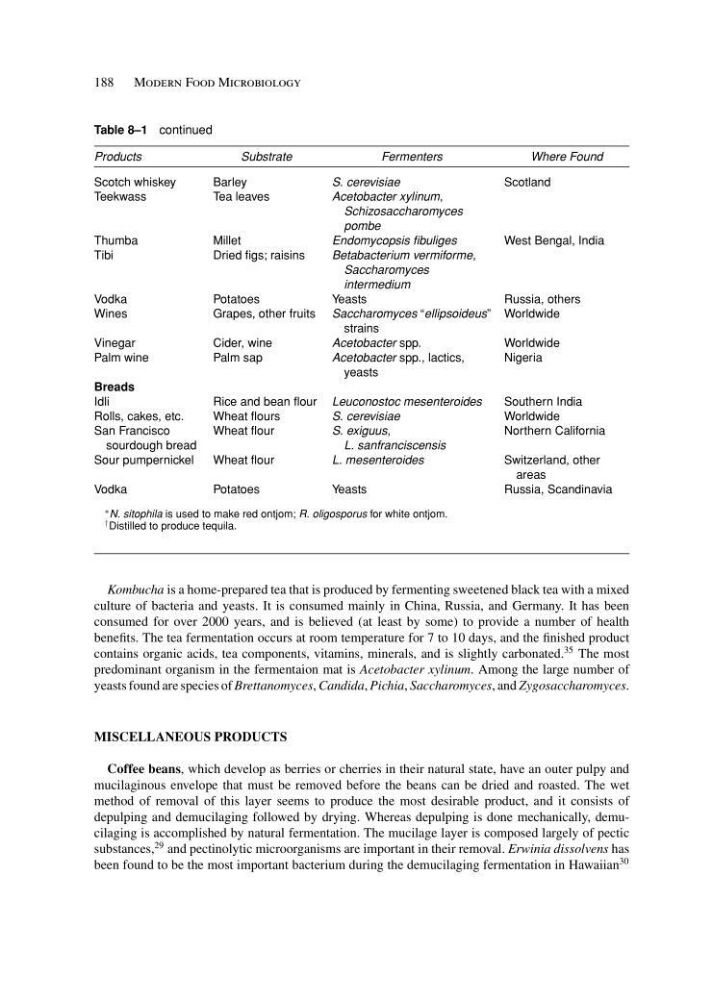
Table 8–1 continued
Products
Substrate
Fermenters
Where Found
Scotch whiskey
Barley
S. cerevisiae
Scotland
Teekwass
Tea leaves
Acetobacter xylinum,
Schizosaccharomyces
pombe
Thumba
Millet
Endomycopsis fibuliges
West Bengal, India
Tibi
Dried figs; raisins
Betabacterium vermiforme,
Saccharomyces
intermedium
Vodka
Potatoes
Yeasts
Russia, others
Wines
Grapes, other fruits Saccharomyces “ellipsoideus”
strains
Worldwide
Vinegar
Cider, wine
Acetobacter spp.
Worldwide
Palm wine
Palm sap
Acetobacter spp., lactics,
yeasts
Nigeria
Breads
Idli
Rice and bean flour Leuconostoc mesenteroides
Southern India
Rolls, cakes, etc.
Wheat flours
S. cerevisiae
Worldwide
San Francisco
sourdough bread
Wheat flour
S. exiguus,
L. sanfranciscensis
Northern California
Sour pumpernickel
Wheat flour
L. mesenteroides
Switzerland, other
areas
Vodka
Potatoes
Yeasts
Russia, Scandinavia
∗ N. sitophila is used to make red ontjom; R. oligosporus for white ontjom.
† Distilled to produce tequila.
Kombucha is a home-prepared tea that is produced by fermenting sweetened black tea with a mixed
culture of bacteria and yeasts. It is consumed mainly in China, Russia, and Germany. It has been
consumed for over 2000 years, and is believed (at least by some) to provide a number of health
benefits. The tea fermentation occurs at room temperature for 7 to 10 days, and the finished product
contains organic acids, tea components, vitamins, minerals, and is slightly carbonated.
35 The most
predominant organism in the fermentaion mat is Acetobacter xylinum. Among the large number of
yeasts found are species of Brettanomyces, Candida, Pichia, Saccharomyces, and Zygosaccharomyces.
MISCELLANEOUS PRODUCTS
Coffee beans, which develop as berries or cherries in their natural state, have an outer pulpy and
mucilaginous envelope that must be removed before the beans can be dried and roasted. The wet
method of removal of this layer seems to produce the most desirable product, and it consists of
depulping and demucilaging followed by drying. Whereas depulping is done mechanically, demucilaging is accomplished by natural fermentation. The mucilage layer is composed largely of pectic
substances,
29 and pectinolytic microorganisms are important in their removal. Erwinia dissolvens has
been found to be the most important bacterium during the demucilaging fermentation in Hawaiian
30
Table 8–1 continued
Products
Substrate
Fermenters
Where Found
Scotch whiskey
Barley
S. cerevisiae
Scotland
Teekwass
Tea leaves
Acetobacter xylinum,
Schizosaccharomyces
pombe
Thumba
Millet
Endomycopsis fibuliges
West Bengal, India
Tibi
Dried figs; raisins
Betabacterium vermiforme,
Saccharomyces
intermedium
Vodka
Potatoes
Yeasts
Russia, others
Wines
Grapes, other fruits Saccharomyces “ellipsoideus”
strains
Worldwide
Vinegar
Cider, wine
Acetobacter spp.
Worldwide
Palm wine
Palm sap
Acetobacter spp., lactics,
yeasts
Nigeria
Breads
Idli
Rice and bean flour Leuconostoc mesenteroides
Southern India
Rolls, cakes, etc.
Wheat flours
S. cerevisiae
Worldwide
San Francisco
sourdough bread
Wheat flour
S. exiguus,
L. sanfranciscensis
Northern California
Sour pumpernickel
Wheat flour
L. mesenteroides
Switzerland, other
areas
Vodka
Potatoes
Yeasts
Russia, Scandinavia
∗ N. sitophila is used to make red ontjom; R. oligosporus for white ontjom.
† Distilled to produce tequila.
Kombucha is a home-prepared tea that is produced by fermenting sweetened black tea with a mixed
culture of bacteria and yeasts. It is consumed mainly in China, Russia, and Germany. It has been
consumed for over 2000 years, and is believed (at least by some) to provide a number of health
benefits. The tea fermentation occurs at room temperature for 7 to 10 days, and the finished product
contains organic acids, tea components, vitamins, minerals, and is slightly carbonated.
35 The most
predominant organism in the fermentaion mat is Acetobacter xylinum. Among the large number of
yeasts found are species of Brettanomyces, Candida, Pichia, Saccharomyces, and Zygosaccharomyces.
MISCELLANEOUS PRODUCTS
Coffee beans, which develop as berries or cherries in their natural state, have an outer pulpy and
mucilaginous envelope that must be removed before the beans can be dried and roasted. The wet
method of removal of this layer seems to produce the most desirable product, and it consists of
depulping and demucilaging followed by drying. Whereas depulping is done mechanically, demucilaging is accomplished by natural fermentation. The mucilage layer is composed largely of pectic
substances,
29 and pectinolytic microorganisms are important in their removal. Erwinia dissolvens has
been found to be the most important bacterium during the demucilaging fermentation in Hawaiian
30