

162 Modern Food Microbiology
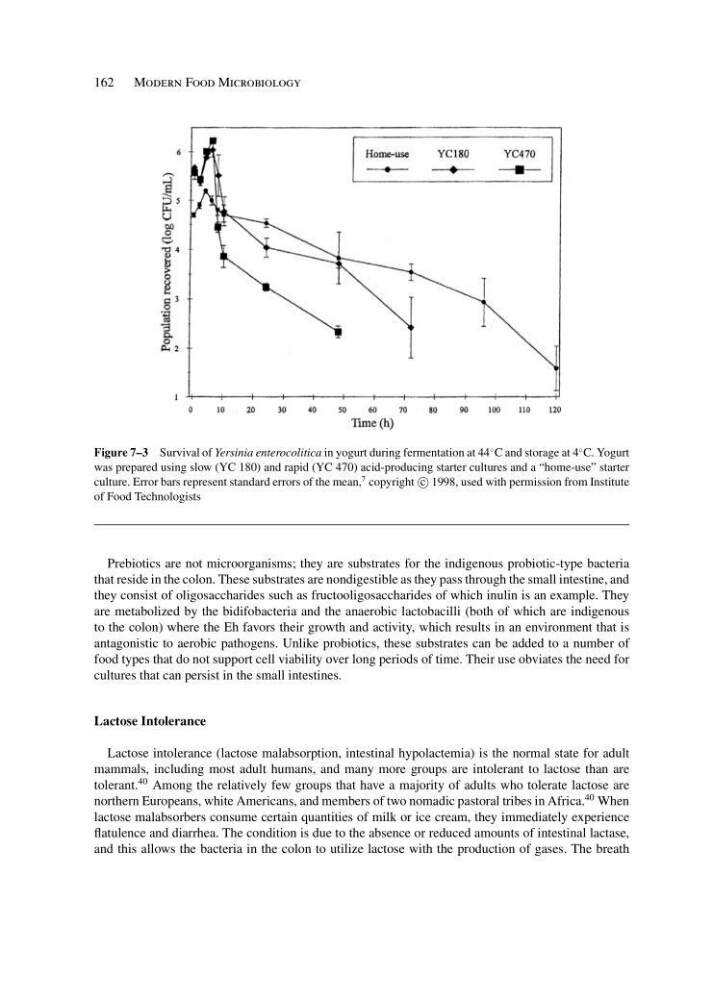
Figure 7–3 Survival of Yersinia enterocolitica in yogurt during fermentation at 44
◦ C and storage at 4
◦ C. Yogurt
was prepared using slow (YC 180) and rapid (YC 470) acid-producing starter cultures and a “home-use” starter
culture. Error bars represent standard errors of the mean,
7 copyright c
1998, used with permission from Institute
of Food Technologists
Prebiotics are not microorganisms; they are substrates for the indigenous probiotic-type bacteria
that reside in the colon. These substrates are nondigestible as they pass through the small intestine, and
they consist of oligosaccharides such as fructooligosaccharides of which inulin is an example. They
are metabolized by the bidifobacteria and the anaerobic lactobacilli (both of which are indigenous
to the colon) where the Eh favors their growth and activity, which results in an environment that is
antagonistic to aerobic pathogens. Unlike probiotics, these substrates can be added to a number of
food types that do not support cell viability over long periods of time. Their use obviates the need for
cultures that can persist in the small intestines.
Lactose Intolerance
Lactose intolerance (lactose malabsorption, intestinal hypolactemia) is the normal state for adult
mammals, including most adult humans, and many more groups are intolerant to lactose than are
tolerant.
40 Among the relatively few groups that have a majority of adults who tolerate lactose are
northern Europeans, white Americans, and members of two nomadic pastoral tribes in Africa.
40 When
lactose malabsorbers consume certain quantities of milk or ice cream, they immediately experience
flatulence and diarrhea. The condition is due to the absence or reduced amounts of intestinal lactase,
and this allows the bacteria in the colon to utilize lactose with the production of gases. The breath
Figure 7–3 Survival of Yersinia enterocolitica in yogurt during fermentation at 44
◦ C and storage at 4
◦ C. Yogurt
was prepared using slow (YC 180) and rapid (YC 470) acid-producing starter cultures and a “home-use” starter
culture. Error bars represent standard errors of the mean,
7 copyright c
1998, used with permission from Institute
of Food Technologists
Prebiotics are not microorganisms; they are substrates for the indigenous probiotic-type bacteria
that reside in the colon. These substrates are nondigestible as they pass through the small intestine, and
they consist of oligosaccharides such as fructooligosaccharides of which inulin is an example. They
are metabolized by the bidifobacteria and the anaerobic lactobacilli (both of which are indigenous
to the colon) where the Eh favors their growth and activity, which results in an environment that is
antagonistic to aerobic pathogens. Unlike probiotics, these substrates can be added to a number of
food types that do not support cell viability over long periods of time. Their use obviates the need for
cultures that can persist in the small intestines.
Lactose Intolerance
Lactose intolerance (lactose malabsorption, intestinal hypolactemia) is the normal state for adult
mammals, including most adult humans, and many more groups are intolerant to lactose than are
tolerant.
40 Among the relatively few groups that have a majority of adults who tolerate lactose are
northern Europeans, white Americans, and members of two nomadic pastoral tribes in Africa.
40 When
lactose malabsorbers consume certain quantities of milk or ice cream, they immediately experience
flatulence and diarrhea. The condition is due to the absence or reduced amounts of intestinal lactase,
and this allows the bacteria in the colon to utilize lactose with the production of gases. The breath