

Milk, Fermentation, and Fermented and Nonfermented Dairy Products 151
of some of its species to the new genus Propioniferax, which produces propionic acid as its principal
carboxylic acid from glucose.
80
The history of our knowledge of the lactic streptococci and their ecology has been reviewed by
Sandine et al.
63 These authors believe that plant matter is the natural habitat of this group, but they
note the lack of proof of a plant origin for Lactococcus cremoris. It has been suggested that plant
streptococci may be the ancestral pool from which other species and strains developed.
47
Although the lactic acid group is loosely defined with no precise boundaries, all members share
the property of producing lactic acid from hexoses. As fermenting organisms, they lack functional
heme-linked electron transport systems or cytochromes, and they obtain their energy by substrate-level
phosphorylation while oxidizing carbohydrates; they do not have a functional Krebs cycle.
Kluyver divided the lactic acid bacteria into two groups based on end products of glucose
metabolism. Those that produce lactic acid as the major or sole product of glucose fermentation
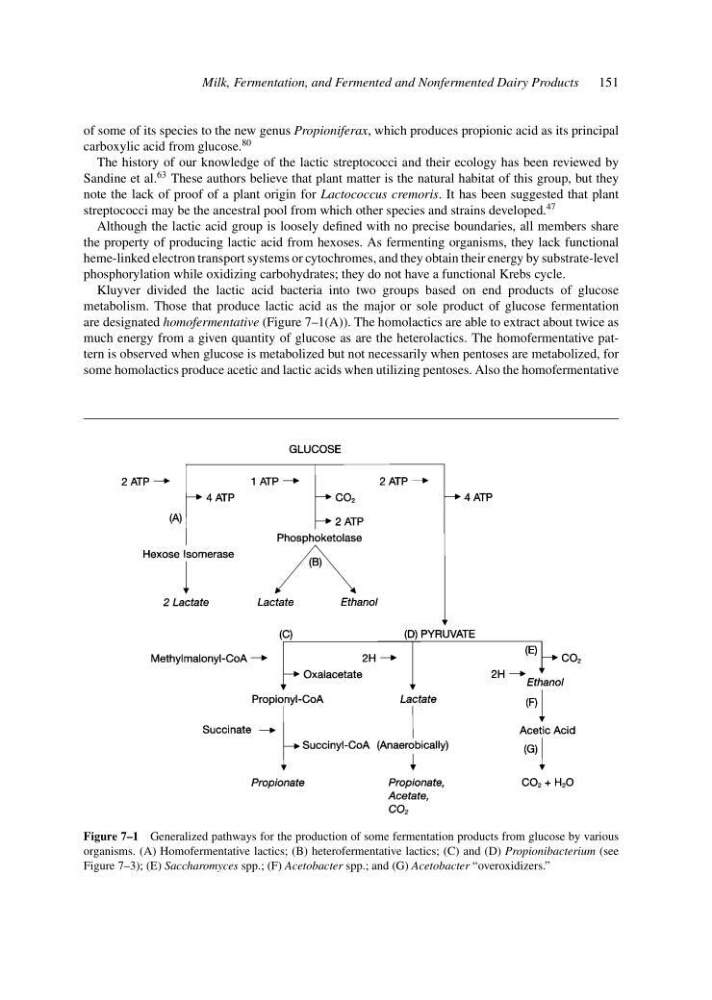
are designated homofermentative (Figure 7–1(A)). The homolactics are able to extract about twice as
much energy from a given quantity of glucose as are the heterolactics. The homofermentative pattern is observed when glucose is metabolized but not necessarily when pentoses are metabolized, for
some homolactics produce acetic and lactic acids when utilizing pentoses. Also the homofermentative
Figure 7–1 Generalized pathways for the production of some fermentation products from glucose by various
organisms. (A) Homofermentative lactics; (B) heterofermentative lactics; (C) and (D) Propionibacterium (see
Figure 7–3); (E) Saccharomyces spp.; (F) Acetobacter spp.; and (G) Acetobacter “overoxidizers.”
of some of its species to the new genus Propioniferax, which produces propionic acid as its principal
carboxylic acid from glucose.
80
The history of our knowledge of the lactic streptococci and their ecology has been reviewed by
Sandine et al.
63 These authors believe that plant matter is the natural habitat of this group, but they
note the lack of proof of a plant origin for Lactococcus cremoris. It has been suggested that plant
streptococci may be the ancestral pool from which other species and strains developed.
47
Although the lactic acid group is loosely defined with no precise boundaries, all members share
the property of producing lactic acid from hexoses. As fermenting organisms, they lack functional
heme-linked electron transport systems or cytochromes, and they obtain their energy by substrate-level
phosphorylation while oxidizing carbohydrates; they do not have a functional Krebs cycle.
Kluyver divided the lactic acid bacteria into two groups based on end products of glucose
metabolism. Those that produce lactic acid as the major or sole product of glucose fermentation
are designated homofermentative (Figure 7–1(A)). The homolactics are able to extract about twice as
much energy from a given quantity of glucose as are the heterolactics. The homofermentative pattern is observed when glucose is metabolized but not necessarily when pentoses are metabolized, for
some homolactics produce acetic and lactic acids when utilizing pentoses. Also the homofermentative
Figure 7–1 Generalized pathways for the production of some fermentation products from glucose by various
organisms. (A) Homofermentative lactics; (B) heterofermentative lactics; (C) and (D) Propionibacterium (see
Figure 7–3); (E) Saccharomyces spp.; (F) Acetobacter spp.; and (G) Acetobacter “overoxidizers.”