

142 Modern Food Microbiology
A study on the survival of Shigella sonnei in shredded cabbage revealed that numbers of this organism
remained essentially unchanged for 1 to 3 days under three conditions of packaging—aerobic, vacuum,
and in 30% N 2 + 70% CO 2 .
40 After 3 days, however, numbers decreased concomitant with decreasing
pH. Thus, the organism could survive under refrigerator or room temperature conditions, but it did
not grow.
Internalization of Pathogens
A number of studies have demonstrated the capacity of certain foodborne pathogens to enter vegetable plants and their fruits from the time of seed germination or flowering, and several are summarized
below. For a review, see Burnett and Beuchat.
11
An increase in the numbers of salmonellae during the sprouting of alfalfa seeds has been demonstrated. In one study, the naturally contaminated seeds contained <1 organism/g by an MPN procedure
and the numbers increased to 10
2
− 10
3 /g in one seed lot, and to 10
2
− 10
4 in another lot during the
germination process.
51 The maximum numbers developed after 48 h. When added to mung bean seeds,
S. Anatum and S. Montevideo increased from ca. 10
2 to ca. 10
7 after 2 days of germination.
1
From the time that Salmonella cells were inoculated on tomato plants during the flowering stage,
they persisted through fruit ripening and led to 37% of 30 tomatoes from the inoculated plants being
positive.
16 Surface and stem-scar samples contained the organisms at rates of 82 and 73% respectively. S. Montevideo was isolated 49 days after its inoculation, and S. Poona was present in 5 of
11 Salmonella-positive tomatoes.
16 In regard to L. monocytogenes, a study of 425 heads of cabbage
harvested in 1999 from farms in the southern part of the state of Texas revealed that 20 or 4.7% contained this bacterium.
36 Six additional isolates were obtained from water and environmental samples
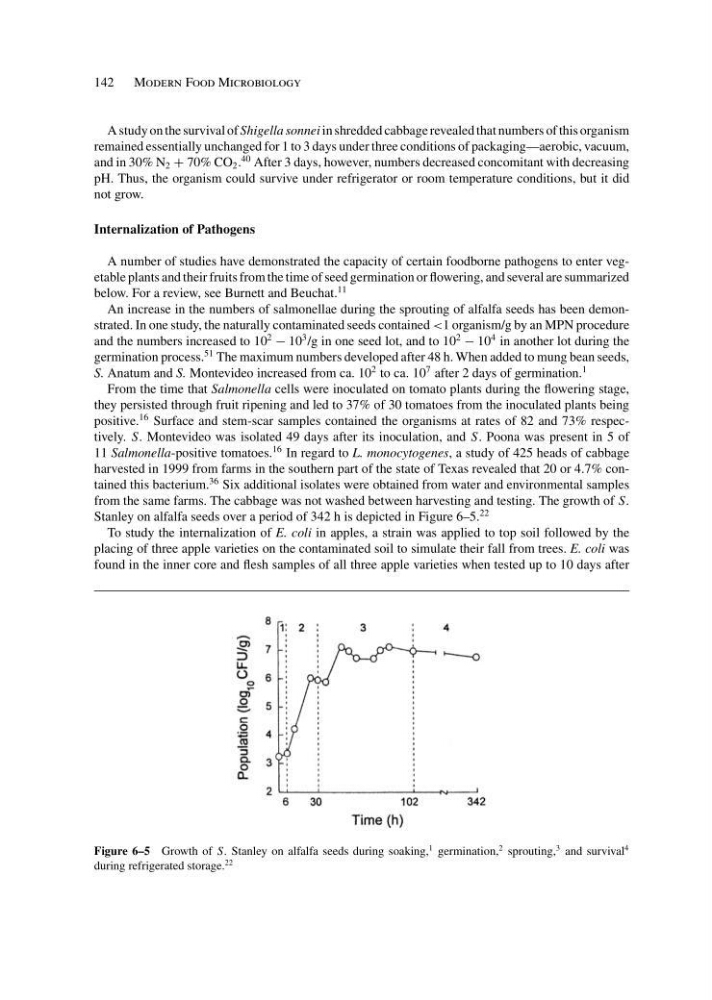
from the same farms. The cabbage was not washed between harvesting and testing. The growth of S.
Stanley on alfalfa seeds over a period of 342 h is depicted in Figure 6–5.
22
To study the internalization of E. coli in apples, a strain was applied to top soil followed by the
placing of three apple varieties on the contaminated soil to simulate their fall from trees. E. coli was
found in the inner core and flesh samples of all three apple varieties when tested up to 10 days after
Figure 6–5 Growth of S. Stanley on alfalfa seeds during soaking,
1 germination,
2 sprouting,
3 and survival
4
during refrigerated storage.
22
A study on the survival of Shigella sonnei in shredded cabbage revealed that numbers of this organism
remained essentially unchanged for 1 to 3 days under three conditions of packaging—aerobic, vacuum,
and in 30% N 2 + 70% CO 2 .
40 After 3 days, however, numbers decreased concomitant with decreasing
pH. Thus, the organism could survive under refrigerator or room temperature conditions, but it did
not grow.
Internalization of Pathogens
A number of studies have demonstrated the capacity of certain foodborne pathogens to enter vegetable plants and their fruits from the time of seed germination or flowering, and several are summarized
below. For a review, see Burnett and Beuchat.
11
An increase in the numbers of salmonellae during the sprouting of alfalfa seeds has been demonstrated. In one study, the naturally contaminated seeds contained <1 organism/g by an MPN procedure
and the numbers increased to 10
2
− 10
3 /g in one seed lot, and to 10
2
− 10
4 in another lot during the
germination process.
51 The maximum numbers developed after 48 h. When added to mung bean seeds,
S. Anatum and S. Montevideo increased from ca. 10
2 to ca. 10
7 after 2 days of germination.
1
From the time that Salmonella cells were inoculated on tomato plants during the flowering stage,
they persisted through fruit ripening and led to 37% of 30 tomatoes from the inoculated plants being
positive.
16 Surface and stem-scar samples contained the organisms at rates of 82 and 73% respectively. S. Montevideo was isolated 49 days after its inoculation, and S. Poona was present in 5 of
11 Salmonella-positive tomatoes.
16 In regard to L. monocytogenes, a study of 425 heads of cabbage
harvested in 1999 from farms in the southern part of the state of Texas revealed that 20 or 4.7% contained this bacterium.
36 Six additional isolates were obtained from water and environmental samples
from the same farms. The cabbage was not washed between harvesting and testing. The growth of S.
Stanley on alfalfa seeds over a period of 342 h is depicted in Figure 6–5.
22
To study the internalization of E. coli in apples, a strain was applied to top soil followed by the
placing of three apple varieties on the contaminated soil to simulate their fall from trees. E. coli was
found in the inner core and flesh samples of all three apple varieties when tested up to 10 days after
Figure 6–5 Growth of S. Stanley on alfalfa seeds during soaking,
1 germination,
2 sprouting,
3 and survival
4
during refrigerated storage.
22