

Vegetable and Fruit Products
141
In a fourth study, romaine lettuce and shredded cabbage were each inoculated with a nine strain
cocktail of proteolytic and nonproteolytic spores at a level of about 100 spores per gram, and the
samples were stored in vented and nonvented plastic bags.
35 The latter were vacuum packed but
vacuum was not pulled. After seven days at 21
◦ C, the cabbage packaged in nonvented bags became
toxic, but not when stored at 4.4 or 12.7
◦ C for up to 28 days. Romaine lettuce became toxic after 14 days
at 21
◦ C in nonvented packs and in 21 days in vented packs. The toxic samples were organoleptically
spoiled prior to toxin detection.
A potential health hazard for RTU vegetables is pointed out by the above studies relative to botulinal
toxin. However, these studies as well as others point to the importance of storage temperature in
controlling not only this pathogen but others, including those below. Temperature and time of storage
of RTU products are obviously critical to their safety. More on C. botulinum and other pathogens in
vacuum/modified atmosphere packaged foods is presented in Chapter 14; and on C. botulinum in fresh
foods in Table 4–7.
L. monocytogenes has been demonstrated to grow on refrigerated vegetables, including lettuce,
broccoli, cauliflower, and asparagus. Although it grew on raw tomatoes at 21
◦ C, it did not at 10
◦ C.
7
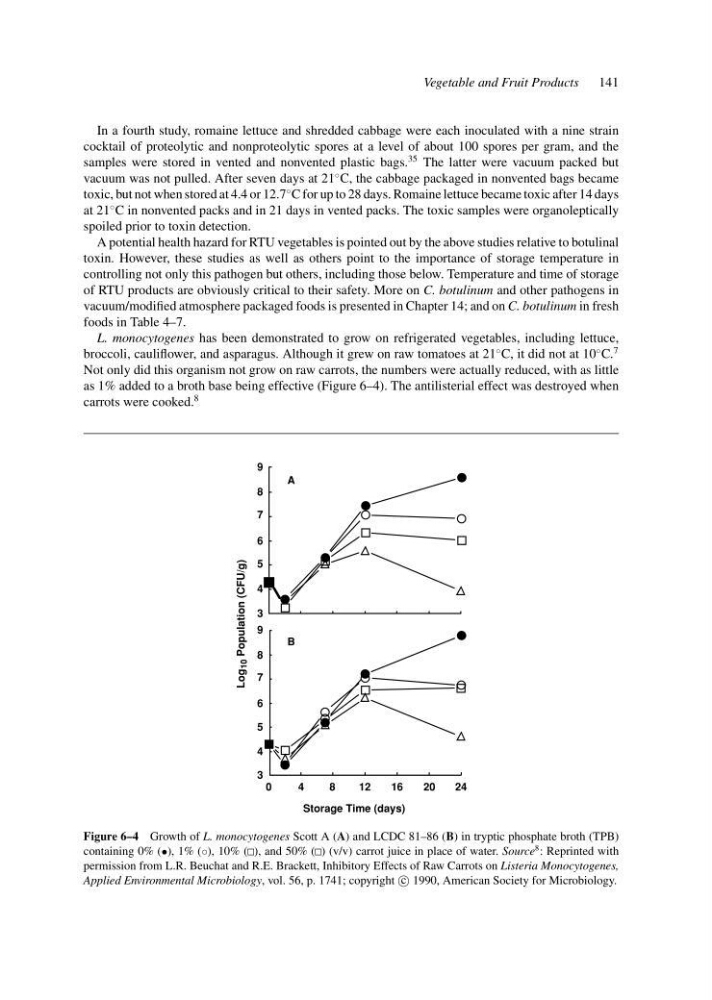
Not only did this organism not grow on raw carrots, the numbers were actually reduced, with as little
as 1% added to a broth base being effective (Figure 6–4). The antilisterial effect was destroyed when
carrots were cooked.
8
A
B
9
8
7
6
5
4
3
9
8
7
6
5
4
3
0
4
8
1 2
1 6
2 0
2 4
Storage Time (days)
Log
10 Population (CFU/g)
Figure 6–4 Growth of L. monocytogenes Scott A (A) and LCDC 81–86 (B) in tryptic phosphate broth (TPB)
containing 0% (•), 1% (◦), 10% ( ), and 50% ( ) (v/v) carrot juice in place of water. Source
8 : Reprinted with
permission from L.R. Beuchat and R.E. Brackett, Inhibitory Effects of Raw Carrots on Listeria Monocytogenes,
Applied Environmental Microbiology, vol. 56, p. 1741; copyright c
1990, American Society for Microbiology.
141
In a fourth study, romaine lettuce and shredded cabbage were each inoculated with a nine strain
cocktail of proteolytic and nonproteolytic spores at a level of about 100 spores per gram, and the
samples were stored in vented and nonvented plastic bags.
35 The latter were vacuum packed but
vacuum was not pulled. After seven days at 21
◦ C, the cabbage packaged in nonvented bags became
toxic, but not when stored at 4.4 or 12.7
◦ C for up to 28 days. Romaine lettuce became toxic after 14 days
at 21
◦ C in nonvented packs and in 21 days in vented packs. The toxic samples were organoleptically
spoiled prior to toxin detection.
A potential health hazard for RTU vegetables is pointed out by the above studies relative to botulinal
toxin. However, these studies as well as others point to the importance of storage temperature in
controlling not only this pathogen but others, including those below. Temperature and time of storage
of RTU products are obviously critical to their safety. More on C. botulinum and other pathogens in
vacuum/modified atmosphere packaged foods is presented in Chapter 14; and on C. botulinum in fresh
foods in Table 4–7.
L. monocytogenes has been demonstrated to grow on refrigerated vegetables, including lettuce,
broccoli, cauliflower, and asparagus. Although it grew on raw tomatoes at 21
◦ C, it did not at 10
◦ C.
7
Not only did this organism not grow on raw carrots, the numbers were actually reduced, with as little
as 1% added to a broth base being effective (Figure 6–4). The antilisterial effect was destroyed when
carrots were cooked.
8
A
B
9
8
7
6
5
4
3
9
8
7
6
5
4
3
0
4
8
1 2
1 6
2 0
2 4
Storage Time (days)
Log
10 Population (CFU/g)
Figure 6–4 Growth of L. monocytogenes Scott A (A) and LCDC 81–86 (B) in tryptic phosphate broth (TPB)
containing 0% (•), 1% (◦), 10% ( ), and 50% ( ) (v/v) carrot juice in place of water. Source
8 : Reprinted with
permission from L.R. Beuchat and R.E. Brackett, Inhibitory Effects of Raw Carrots on Listeria Monocytogenes,
Applied Environmental Microbiology, vol. 56, p. 1741; copyright c
1990, American Society for Microbiology.