

126 Modern Food Microbiology
Table 6–1 Microbial Numbers in Some Fresh Vegetables
Products
Log 10 cfu/g
Reference
Red and green chicory and carrot mixture
APC, 7.94
57
Coliforms, 7.03
57
Fecal coliforms, 6.74
57
Lactic acid bacteria, 6.18
57
Red chicory, endive, and carrot mixture
APC, 6.14
57
Coliforms, 4.68
57
Fecal coliforms, 4.51
57
Lactic acid bacteria, 5.86
57
Bean sprouts
APC, 7.26, 7.99
23
Coliforms, 7.49, 6.99
Broccoli
APC, 3.97
37
Carrots
APC, 4.20
37
Cauliflower
APC, 6.97
37
Celery
APC, 10.0
37
Coleslaw
APC, 7.00
37
Radish
APC, 6.04
37
Sprouts
APC 8.7; Coliforms 7.2
55
Lettuce
APC 8.6; Coliforms 5.6
55
Celery
APC 7.5; Coliforms
55
Cauliflower
APC 7.4; Coliforms 2.9
55
Broccoli
APC 6.3; Coliforms 4.8
55
Fresh retail lettuce
a
APC 6.94; Coliforms 3.25
30
Note: APC = aerobic plate count; cfu = colony-forming unit.
a Mean of 10 samples, which also contained 1.64 E. coli and 5.62 fungi.
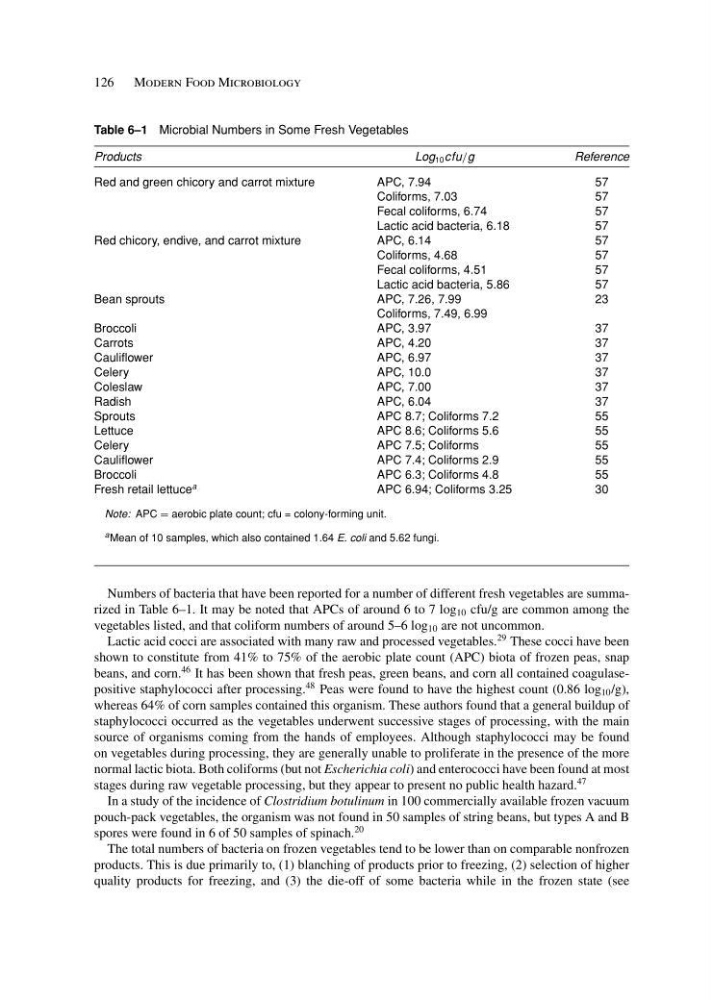
Numbers of bacteria that have been reported for a number of different fresh vegetables are summarized in Table 6–1. It may be noted that APCs of around 6 to 7 log 10 cfu/g are common among the
vegetables listed, and that coliform numbers of around 5–6 log 10 are not uncommon.
Lactic acid cocci are associated with many raw and processed vegetables.
29 These cocci have been
shown to constitute from 41% to 75% of the aerobic plate count (APC) biota of frozen peas, snap
beans, and corn.
46 It has been shown that fresh peas, green beans, and corn all contained coagulasepositive staphylococci after processing.
48 Peas were found to have the highest count (0.86 log 10 /g),
whereas 64% of corn samples contained this organism. These authors found that a general buildup of
staphylococci occurred as the vegetables underwent successive stages of processing, with the main
source of organisms coming from the hands of employees. Although staphylococci may be found
on vegetables during processing, they are generally unable to proliferate in the presence of the more
normal lactic biota. Both coliforms (but not Escherichia coli) and enterococci have been found at most
stages during raw vegetable processing, but they appear to present no public health hazard.
47
In a study of the incidence of Clostridium botulinum in 100 commercially available frozen vacuum
pouch-pack vegetables, the organism was not found in 50 samples of string beans, but types A and B
spores were found in 6 of 50 samples of spinach.
20
The total numbers of bacteria on frozen vegetables tend to be lower than on comparable nonfrozen
products. This is due primarily to, (1) blanching of products prior to freezing, (2) selection of higher
quality products for freezing, and (3) the die-off of some bacteria while in the frozen state (see
Table 6–1 Microbial Numbers in Some Fresh Vegetables
Products
Log 10 cfu/g
Reference
Red and green chicory and carrot mixture
APC, 7.94
57
Coliforms, 7.03
57
Fecal coliforms, 6.74
57
Lactic acid bacteria, 6.18
57
Red chicory, endive, and carrot mixture
APC, 6.14
57
Coliforms, 4.68
57
Fecal coliforms, 4.51
57
Lactic acid bacteria, 5.86
57
Bean sprouts
APC, 7.26, 7.99
23
Coliforms, 7.49, 6.99
Broccoli
APC, 3.97
37
Carrots
APC, 4.20
37
Cauliflower
APC, 6.97
37
Celery
APC, 10.0
37
Coleslaw
APC, 7.00
37
Radish
APC, 6.04
37
Sprouts
APC 8.7; Coliforms 7.2
55
Lettuce
APC 8.6; Coliforms 5.6
55
Celery
APC 7.5; Coliforms
55
Cauliflower
APC 7.4; Coliforms 2.9
55
Broccoli
APC 6.3; Coliforms 4.8
55
Fresh retail lettuce
a
APC 6.94; Coliforms 3.25
30
Note: APC = aerobic plate count; cfu = colony-forming unit.
a Mean of 10 samples, which also contained 1.64 E. coli and 5.62 fungi.
Numbers of bacteria that have been reported for a number of different fresh vegetables are summarized in Table 6–1. It may be noted that APCs of around 6 to 7 log 10 cfu/g are common among the
vegetables listed, and that coliform numbers of around 5–6 log 10 are not uncommon.
Lactic acid cocci are associated with many raw and processed vegetables.
29 These cocci have been
shown to constitute from 41% to 75% of the aerobic plate count (APC) biota of frozen peas, snap
beans, and corn.
46 It has been shown that fresh peas, green beans, and corn all contained coagulasepositive staphylococci after processing.
48 Peas were found to have the highest count (0.86 log 10 /g),
whereas 64% of corn samples contained this organism. These authors found that a general buildup of
staphylococci occurred as the vegetables underwent successive stages of processing, with the main
source of organisms coming from the hands of employees. Although staphylococci may be found
on vegetables during processing, they are generally unable to proliferate in the presence of the more
normal lactic biota. Both coliforms (but not Escherichia coli) and enterococci have been found at most
stages during raw vegetable processing, but they appear to present no public health hazard.
47
In a study of the incidence of Clostridium botulinum in 100 commercially available frozen vacuum
pouch-pack vegetables, the organism was not found in 50 samples of string beans, but types A and B
spores were found in 6 of 50 samples of spinach.
20
The total numbers of bacteria on frozen vegetables tend to be lower than on comparable nonfrozen
products. This is due primarily to, (1) blanching of products prior to freezing, (2) selection of higher
quality products for freezing, and (3) the die-off of some bacteria while in the frozen state (see