

118 Modern Food Microbiology
Tyramine is produced by some fish-spoilage organisms, and its production by Carnobacterium
piscicola and Weissella viridescens from isolates of vacuum-packaged sugar-salted fish has been
reported.
63 This product, normally kept under refrigeration for 2–4 weeks, may contain log 10 7–10
cfu/g of lactics, and tyramine production was reduced by lowering storage temperatures from 9
◦ C to
4
◦ C.
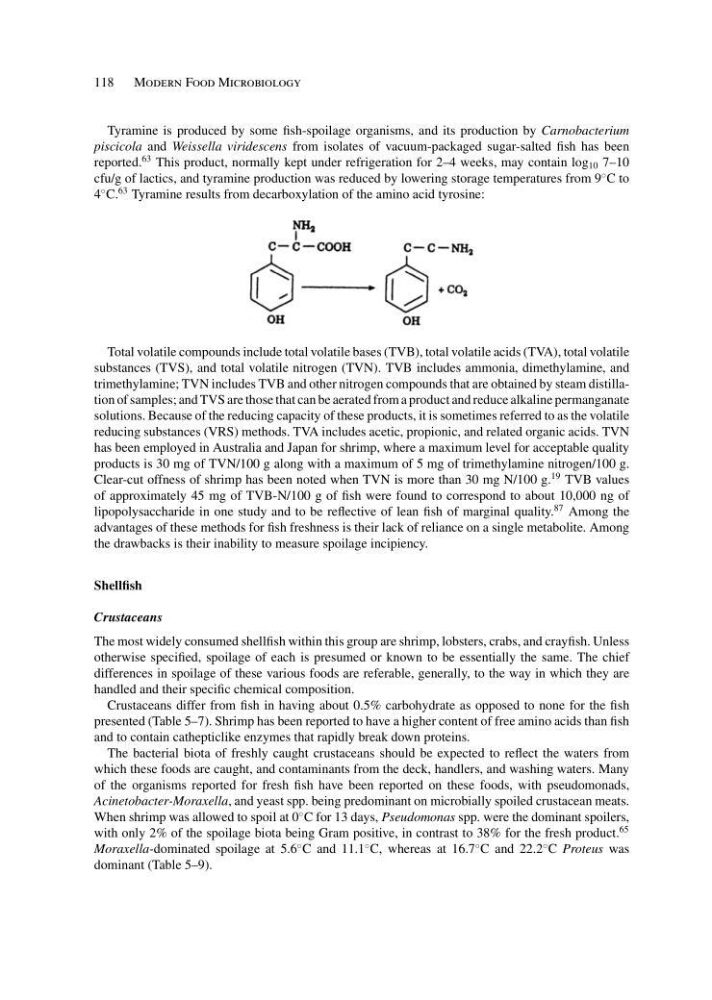
63 Tyramine results from decarboxylation of the amino acid tyrosine:
Total volatile compounds include total volatile bases (TVB), total volatile acids (TVA), total volatile
substances (TVS), and total volatile nitrogen (TVN). TVB includes ammonia, dimethylamine, and
trimethylamine; TVN includes TVB and other nitrogen compounds that are obtained by steam distillation of samples; and TVS are those that can be aerated from a product and reduce alkaline permanganate
solutions. Because of the reducing capacity of these products, it is sometimes referred to as the volatile
reducing substances (VRS) methods. TVA includes acetic, propionic, and related organic acids. TVN
has been employed in Australia and Japan for shrimp, where a maximum level for acceptable quality
products is 30 mg of TVN/100 g along with a maximum of 5 mg of trimethylamine nitrogen/100 g.
Clear-cut offness of shrimp has been noted when TVN is more than 30 mg N/100 g.
19 TVB values
of approximately 45 mg of TVB-N/100 g of fish were found to correspond to about 10,000 ng of
lipopolysaccharide in one study and to be reflective of lean fish of marginal quality.
87 Among the
advantages of these methods for fish freshness is their lack of reliance on a single metabolite. Among
the drawbacks is their inability to measure spoilage incipiency.
Shellfish
Crustaceans
The most widely consumed shellfish within this group are shrimp, lobsters, crabs, and crayfish. Unless
otherwise specified, spoilage of each is presumed or known to be essentially the same. The chief
differences in spoilage of these various foods are referable, generally, to the way in which they are
handled and their specific chemical composition.
Crustaceans differ from fish in having about 0.5% carbohydrate as opposed to none for the fish
presented (Table 5–7). Shrimp has been reported to have a higher content of free amino acids than fish
and to contain cathepticlike enzymes that rapidly break down proteins.
The bacterial biota of freshly caught crustaceans should be expected to reflect the waters from
which these foods are caught, and contaminants from the deck, handlers, and washing waters. Many
of the organisms reported for fresh fish have been reported on these foods, with pseudomonads,
Acinetobacter-Moraxella, and yeast spp. being predominant on microbially spoiled crustacean meats.
When shrimp was allowed to spoil at 0
◦ C for 13 days, Pseudomonas spp. were the dominant spoilers,
with only 2% of the spoilage biota being Gram positive, in contrast to 38% for the fresh product.
65
Moraxella-dominated spoilage at 5.6
◦ C and 11.1
◦ C, whereas at 16.7
◦ C and 22.2
◦ C Proteus was
dominant (Table 5–9).
Tyramine is produced by some fish-spoilage organisms, and its production by Carnobacterium
piscicola and Weissella viridescens from isolates of vacuum-packaged sugar-salted fish has been
reported.
63 This product, normally kept under refrigeration for 2–4 weeks, may contain log 10 7–10
cfu/g of lactics, and tyramine production was reduced by lowering storage temperatures from 9
◦ C to
4
◦ C.
63 Tyramine results from decarboxylation of the amino acid tyrosine:
Total volatile compounds include total volatile bases (TVB), total volatile acids (TVA), total volatile
substances (TVS), and total volatile nitrogen (TVN). TVB includes ammonia, dimethylamine, and
trimethylamine; TVN includes TVB and other nitrogen compounds that are obtained by steam distillation of samples; and TVS are those that can be aerated from a product and reduce alkaline permanganate
solutions. Because of the reducing capacity of these products, it is sometimes referred to as the volatile
reducing substances (VRS) methods. TVA includes acetic, propionic, and related organic acids. TVN
has been employed in Australia and Japan for shrimp, where a maximum level for acceptable quality
products is 30 mg of TVN/100 g along with a maximum of 5 mg of trimethylamine nitrogen/100 g.
Clear-cut offness of shrimp has been noted when TVN is more than 30 mg N/100 g.
19 TVB values
of approximately 45 mg of TVB-N/100 g of fish were found to correspond to about 10,000 ng of
lipopolysaccharide in one study and to be reflective of lean fish of marginal quality.
87 Among the
advantages of these methods for fish freshness is their lack of reliance on a single metabolite. Among
the drawbacks is their inability to measure spoilage incipiency.
Shellfish
Crustaceans
The most widely consumed shellfish within this group are shrimp, lobsters, crabs, and crayfish. Unless
otherwise specified, spoilage of each is presumed or known to be essentially the same. The chief
differences in spoilage of these various foods are referable, generally, to the way in which they are
handled and their specific chemical composition.
Crustaceans differ from fish in having about 0.5% carbohydrate as opposed to none for the fish
presented (Table 5–7). Shrimp has been reported to have a higher content of free amino acids than fish
and to contain cathepticlike enzymes that rapidly break down proteins.
The bacterial biota of freshly caught crustaceans should be expected to reflect the waters from
which these foods are caught, and contaminants from the deck, handlers, and washing waters. Many
of the organisms reported for fresh fish have been reported on these foods, with pseudomonads,
Acinetobacter-Moraxella, and yeast spp. being predominant on microbially spoiled crustacean meats.
When shrimp was allowed to spoil at 0
◦ C for 13 days, Pseudomonas spp. were the dominant spoilers,
with only 2% of the spoilage biota being Gram positive, in contrast to 38% for the fresh product.
65
Moraxella-dominated spoilage at 5.6
◦ C and 11.1
◦ C, whereas at 16.7
◦ C and 22.2
◦ C Proteus was
dominant (Table 5–9).