

Processed Meats and Seafoods
115
SPOILAGE OF FISH AND SHELLFISH
Fish
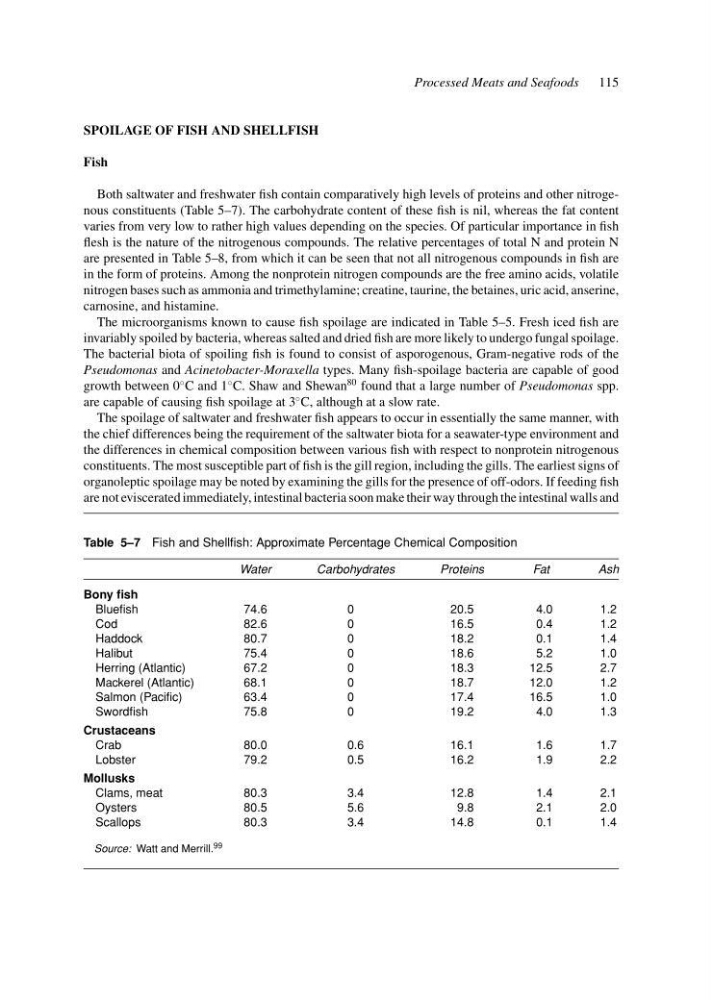
Both saltwater and freshwater fish contain comparatively high levels of proteins and other nitrogenous constituents (Table 5–7). The carbohydrate content of these fish is nil, whereas the fat content
varies from very low to rather high values depending on the species. Of particular importance in fish
flesh is the nature of the nitrogenous compounds. The relative percentages of total N and protein N
are presented in Table 5–8, from which it can be seen that not all nitrogenous compounds in fish are
in the form of proteins. Among the nonprotein nitrogen compounds are the free amino acids, volatile
nitrogen bases such as ammonia and trimethylamine; creatine, taurine, the betaines, uric acid, anserine,
carnosine, and histamine.
The microorganisms known to cause fish spoilage are indicated in Table 5–5. Fresh iced fish are
invariably spoiled by bacteria, whereas salted and dried fish are more likely to undergo fungal spoilage.
The bacterial biota of spoiling fish is found to consist of asporogenous, Gram-negative rods of the
Pseudomonas and Acinetobacter-Moraxella types. Many fish-spoilage bacteria are capable of good
growth between 0
◦ C and 1
◦ C. Shaw and Shewan
80 found that a large number of Pseudomonas spp.
are capable of causing fish spoilage at 3
◦ C, although at a slow rate.
The spoilage of saltwater and freshwater fish appears to occur in essentially the same manner, with
the chief differences being the requirement of the saltwater biota for a seawater-type environment and
the differences in chemical composition between various fish with respect to nonprotein nitrogenous
constituents. The most susceptible part of fish is the gill region, including the gills. The earliest signs of
organoleptic spoilage may be noted by examining the gills for the presence of off-odors. If feeding fish
are not eviscerated immediately, intestinal bacteria soon make their way through the intestinal walls and
Table 5–7 Fish and Shellfish: Approximate Percentage Chemical Composition
Water
Carbohydrates
Proteins
Fat
Ash
Bony fish
Bluefish
74.6
0
20.5
4.0
1.2
Cod
82.6
0
16.5
0.4
1.2
Haddock
80.7
0
18.2
0.1
1.4
Halibut
75.4
0
18.6
5.2
1.0
Herring (Atlantic)
67.2
0
18.3
12.5
2.7
Mackerel (Atlantic)
68.1
0
18.7
12.0
1.2
Salmon (Pacific)
63.4
0
17.4
16.5
1.0
Swordfish
75.8
0
19.2
4.0
1.3
Crustaceans
Crab
80.0
0.6
16.1
1.6
1.7
Lobster
79.2
0.5
16.2
1.9
2.2
Mollusks
Clams, meat
80.3
3.4
12.8
1.4
2.1
Oysters
80.5
5.6
9.8
2.1
2.0
Scallops
80.3
3.4
14.8
0.1
1.4
Source: Watt and Merrill. 99
115
SPOILAGE OF FISH AND SHELLFISH
Fish
Both saltwater and freshwater fish contain comparatively high levels of proteins and other nitrogenous constituents (Table 5–7). The carbohydrate content of these fish is nil, whereas the fat content
varies from very low to rather high values depending on the species. Of particular importance in fish
flesh is the nature of the nitrogenous compounds. The relative percentages of total N and protein N
are presented in Table 5–8, from which it can be seen that not all nitrogenous compounds in fish are
in the form of proteins. Among the nonprotein nitrogen compounds are the free amino acids, volatile
nitrogen bases such as ammonia and trimethylamine; creatine, taurine, the betaines, uric acid, anserine,
carnosine, and histamine.
The microorganisms known to cause fish spoilage are indicated in Table 5–5. Fresh iced fish are
invariably spoiled by bacteria, whereas salted and dried fish are more likely to undergo fungal spoilage.
The bacterial biota of spoiling fish is found to consist of asporogenous, Gram-negative rods of the
Pseudomonas and Acinetobacter-Moraxella types. Many fish-spoilage bacteria are capable of good
growth between 0
◦ C and 1
◦ C. Shaw and Shewan
80 found that a large number of Pseudomonas spp.
are capable of causing fish spoilage at 3
◦ C, although at a slow rate.
The spoilage of saltwater and freshwater fish appears to occur in essentially the same manner, with
the chief differences being the requirement of the saltwater biota for a seawater-type environment and
the differences in chemical composition between various fish with respect to nonprotein nitrogenous
constituents. The most susceptible part of fish is the gill region, including the gills. The earliest signs of
organoleptic spoilage may be noted by examining the gills for the presence of off-odors. If feeding fish
are not eviscerated immediately, intestinal bacteria soon make their way through the intestinal walls and
Table 5–7 Fish and Shellfish: Approximate Percentage Chemical Composition
Water
Carbohydrates
Proteins
Fat
Ash
Bony fish
Bluefish
74.6
0
20.5
4.0
1.2
Cod
82.6
0
16.5
0.4
1.2
Haddock
80.7
0
18.2
0.1
1.4
Halibut
75.4
0
18.6
5.2
1.0
Herring (Atlantic)
67.2
0
18.3
12.5
2.7
Mackerel (Atlantic)
68.1
0
18.7
12.0
1.2
Salmon (Pacific)
63.4
0
17.4
16.5
1.0
Swordfish
75.8
0
19.2
4.0
1.3
Crustaceans
Crab
80.0
0.6
16.1
1.6
1.7
Lobster
79.2
0.5
16.2
1.9
2.2
Mollusks
Clams, meat
80.3
3.4
12.8
1.4
2.1
Oysters
80.5
5.6
9.8
2.1
2.0
Scallops
80.3
3.4
14.8
0.1
1.4
Source: Watt and Merrill. 99