

Application of Sustainable and Low-Cost Sludge-Based Adsorbents …
81
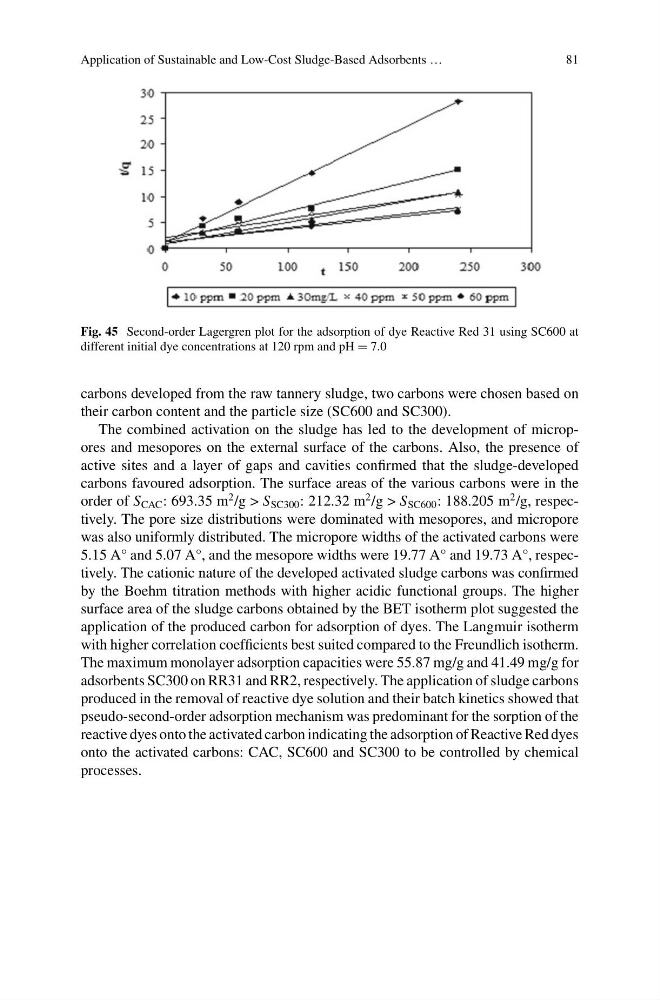
Fig. 45 Second-order Lagergren plot for the adsorption of dye Reactive Red 31 using SC600 at
different initial dye concentrations at 120 rpm and pH = 7.0
carbons developed from the raw tannery sludge, two carbons were chosen based on
their carbon content and the particle size (SC600 and SC300).
The combined activation on the sludge has led to the development of micropores and mesopores on the external surface of the carbons. Also, the presence of
active sites and a layer of gaps and cavities confirmed that the sludge-developed
carbons favoured adsorption. The surface areas of the various carbons were in the
order of S CAC : 693.35 m
2 /g > S SC300 : 212.32 m
2 /g > S SC600 : 188.205 m
2 /g, respectively. The pore size distributions were dominated with mesopores, and micropore
was also uniformly distributed. The micropore widths of the activated carbons were
5.15 A° and 5.07 A°, and the mesopore widths were 19.77 A° and 19.73 A°, respectively. The cationic nature of the developed activated sludge carbons was confirmed
by the Boehm titration methods with higher acidic functional groups. The higher
surface area of the sludge carbons obtained by the BET isotherm plot suggested the
application of the produced carbon for adsorption of dyes. The Langmuir isotherm
with higher correlation coefficients best suited compared to the Freundlich isotherm.
The maximum monolayer adsorption capacities were 55.87 mg/g and 41.49 mg/g for
adsorbents SC300 on RR31 and RR2, respectively. The application of sludge carbons
produced in the removal of reactive dye solution and their batch kinetics showed that
pseudo-second-order adsorption mechanism was predominant for the sorption of the
reactive dyes onto the activated carbon indicating the adsorption of Reactive Red dyes
onto the activated carbons: CAC, SC600 and SC300 to be controlled by chemical
processes.
81
Fig. 45 Second-order Lagergren plot for the adsorption of dye Reactive Red 31 using SC600 at
different initial dye concentrations at 120 rpm and pH = 7.0
carbons developed from the raw tannery sludge, two carbons were chosen based on
their carbon content and the particle size (SC600 and SC300).
The combined activation on the sludge has led to the development of micropores and mesopores on the external surface of the carbons. Also, the presence of
active sites and a layer of gaps and cavities confirmed that the sludge-developed
carbons favoured adsorption. The surface areas of the various carbons were in the
order of S CAC : 693.35 m
2 /g > S SC300 : 212.32 m
2 /g > S SC600 : 188.205 m
2 /g, respectively. The pore size distributions were dominated with mesopores, and micropore
was also uniformly distributed. The micropore widths of the activated carbons were
5.15 A° and 5.07 A°, and the mesopore widths were 19.77 A° and 19.73 A°, respectively. The cationic nature of the developed activated sludge carbons was confirmed
by the Boehm titration methods with higher acidic functional groups. The higher
surface area of the sludge carbons obtained by the BET isotherm plot suggested the
application of the produced carbon for adsorption of dyes. The Langmuir isotherm
with higher correlation coefficients best suited compared to the Freundlich isotherm.
The maximum monolayer adsorption capacities were 55.87 mg/g and 41.49 mg/g for
adsorbents SC300 on RR31 and RR2, respectively. The application of sludge carbons
produced in the removal of reactive dye solution and their batch kinetics showed that
pseudo-second-order adsorption mechanism was predominant for the sorption of the
reactive dyes onto the activated carbon indicating the adsorption of Reactive Red dyes
onto the activated carbons: CAC, SC600 and SC300 to be controlled by chemical
processes.