

Application of Sustainable and Low-Cost Sludge-Based Adsorbents …
73
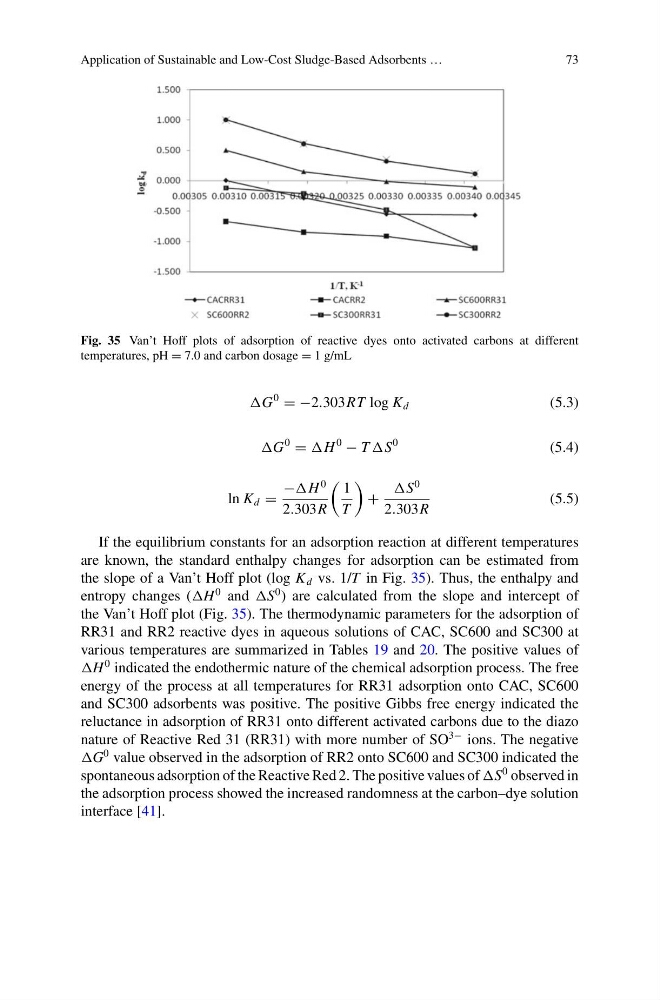
Fig. 35 Van’t Hoff plots of adsorption of reactive dyes onto activated carbons at different
temperatures, pH = 7.0 and carbon dosage = 1 g/mL
G
0
= −2.303RT log K d
(5.3)
G
0
= H
0
− T S
0
(5.4)
ln K d =
−H
0
2.303R
1
T
+
S
0
2.303R
(5.5)
If the equilibrium constants for an adsorption reaction at different temperatures
are known, the standard enthalpy changes for adsorption can be estimated from
the slope of a Van’t Hoff plot (log K d vs. 1/T in Fig. 35). Thus, the enthalpy and
entropy changes (H
0 and S
0 ) are calculated from the slope and intercept of
the Van’t Hoff plot (Fig. 35). The thermodynamic parameters for the adsorption of
RR31 and RR2 reactive dyes in aqueous solutions of CAC, SC600 and SC300 at
various temperatures are summarized in Tables 19 and 20. The positive values of
H
0 indicated the endothermic nature of the chemical adsorption process. The free
energy of the process at all temperatures for RR31 adsorption onto CAC, SC600
and SC300 adsorbents was positive. The positive Gibbs free energy indicated the
reluctance in adsorption of RR31 onto different activated carbons due to the diazo
nature of Reactive Red 31 (RR31) with more number of SO
3− ions. The negative
G
0 value observed in the adsorption of RR2 onto SC600 and SC300 indicated the
spontaneous adsorption of the Reactive Red 2. The positive values of S
0 observed in
the adsorption process showed the increased randomness at the carbon–dye solution
interface [41].
73
Fig. 35 Van’t Hoff plots of adsorption of reactive dyes onto activated carbons at different
temperatures, pH = 7.0 and carbon dosage = 1 g/mL
G
0
= −2.303RT log K d
(5.3)
G
0
= H
0
− T S
0
(5.4)
ln K d =
−H
0
2.303R
1
T
+
S
0
2.303R
(5.5)
If the equilibrium constants for an adsorption reaction at different temperatures
are known, the standard enthalpy changes for adsorption can be estimated from
the slope of a Van’t Hoff plot (log K d vs. 1/T in Fig. 35). Thus, the enthalpy and
entropy changes (H
0 and S
0 ) are calculated from the slope and intercept of
the Van’t Hoff plot (Fig. 35). The thermodynamic parameters for the adsorption of
RR31 and RR2 reactive dyes in aqueous solutions of CAC, SC600 and SC300 at
various temperatures are summarized in Tables 19 and 20. The positive values of
H
0 indicated the endothermic nature of the chemical adsorption process. The free
energy of the process at all temperatures for RR31 adsorption onto CAC, SC600
and SC300 adsorbents was positive. The positive Gibbs free energy indicated the
reluctance in adsorption of RR31 onto different activated carbons due to the diazo
nature of Reactive Red 31 (RR31) with more number of SO
3− ions. The negative
G
0 value observed in the adsorption of RR2 onto SC600 and SC300 indicated the
spontaneous adsorption of the Reactive Red 2. The positive values of S
0 observed in
the adsorption process showed the increased randomness at the carbon–dye solution
interface [41].