

Application of Sustainable and Low-Cost Sludge-Based Adsorbents …
69
adsorbed onto the carbon adsorbents and an increase in its adsorption capacity which
resulted in the enlargement of pore size or activation of the adsorbent surface.
The isotherm showed no linear variation for the Langmuir constant b, and hence
the kinetic energy of the dye molecules was independent. The observed linear relationship was statistically significant (at the 95% confidence level) as evidenced by
the R
2 values (which were close to unity). This indicated the applicability of the
isotherm and the surface. The order of increase in adsorption capacity for RR31 was
as CAC > SC300 > SC600. The tannery sludge-activated carbon had greater adsorption capacity at a particle size of 300 µm than at 600 µm. In the adsorption of RR2,
the adsorption capacity was in the order of CAC < SC600 < SC300. These adsorption capacities showed the complex nature of the adsorption. The lower adsorption
of dyes towards CAC was due to the lesser anionic charge of the dyes causing weaker
attraction towards the site of cationic charge of the CAC. Hence, the dye molecule
had to escape from the solid phase to the bulk phase. The pore size of the CAC could
not accommodate quicker adsorption as compared to the tannery-activated carbons
SC600 and SC300. The maximum monolayer adsorption capacity of SC300 was
greater than SC600 for both the reactive dyes. The adsorption capacity Q o increased
with the temperature throughout the isothermal studies.
The maximum adsorption capacity was 55.87 mg/g for RR31 on SC300 and
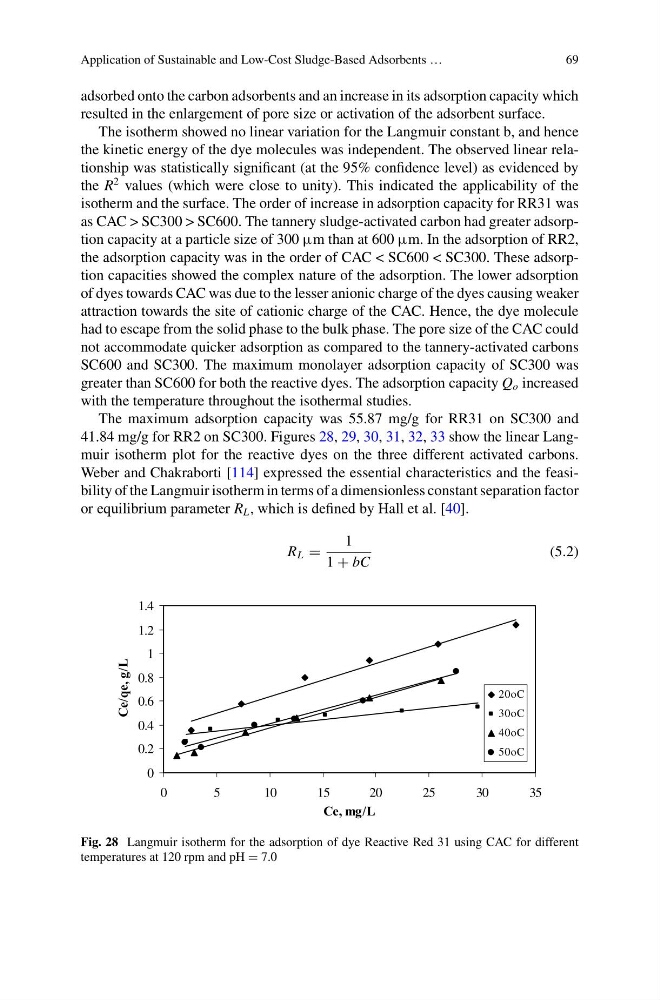
41.84 mg/g for RR2 on SC300. Figures 28, 29, 30, 31, 32, 33 show the linear Langmuir isotherm plot for the reactive dyes on the three different activated carbons.
Weber and Chakraborti [114] expressed the essential characteristics and the feasibility of the Langmuir isotherm in terms of a dimensionless constant separation factor
or equilibrium parameter R L , which is defined by Hall et al. [40].
R L =
1
1 + bC
(5.2)
0
0.2
0.4
0.6
0.8
1
1.2
1.4
0
5
10
15
20
25
30
35
Ce, mg/L
Ce/qe, g/L
20oC
30oC
40oC
50oC
Fig. 28 Langmuir isotherm for the adsorption of dye Reactive Red 31 using CAC for different
temperatures at 120 rpm and pH = 7.0
69
adsorbed onto the carbon adsorbents and an increase in its adsorption capacity which
resulted in the enlargement of pore size or activation of the adsorbent surface.
The isotherm showed no linear variation for the Langmuir constant b, and hence
the kinetic energy of the dye molecules was independent. The observed linear relationship was statistically significant (at the 95% confidence level) as evidenced by
the R
2 values (which were close to unity). This indicated the applicability of the
isotherm and the surface. The order of increase in adsorption capacity for RR31 was
as CAC > SC300 > SC600. The tannery sludge-activated carbon had greater adsorption capacity at a particle size of 300 µm than at 600 µm. In the adsorption of RR2,
the adsorption capacity was in the order of CAC < SC600 < SC300. These adsorption capacities showed the complex nature of the adsorption. The lower adsorption
of dyes towards CAC was due to the lesser anionic charge of the dyes causing weaker
attraction towards the site of cationic charge of the CAC. Hence, the dye molecule
had to escape from the solid phase to the bulk phase. The pore size of the CAC could
not accommodate quicker adsorption as compared to the tannery-activated carbons
SC600 and SC300. The maximum monolayer adsorption capacity of SC300 was
greater than SC600 for both the reactive dyes. The adsorption capacity Q o increased
with the temperature throughout the isothermal studies.
The maximum adsorption capacity was 55.87 mg/g for RR31 on SC300 and
41.84 mg/g for RR2 on SC300. Figures 28, 29, 30, 31, 32, 33 show the linear Langmuir isotherm plot for the reactive dyes on the three different activated carbons.
Weber and Chakraborti [114] expressed the essential characteristics and the feasibility of the Langmuir isotherm in terms of a dimensionless constant separation factor
or equilibrium parameter R L , which is defined by Hall et al. [40].
R L =
1
1 + bC
(5.2)
0
0.2
0.4
0.6
0.8
1
1.2
1.4
0
5
10
15
20
25
30
35
Ce, mg/L
Ce/qe, g/L
20oC
30oC
40oC
50oC
Fig. 28 Langmuir isotherm for the adsorption of dye Reactive Red 31 using CAC for different
temperatures at 120 rpm and pH = 7.0