

Application of Sustainable and Low-Cost Sludge-Based Adsorbents …
53
4.3.3 Analysis of Specific Surface Area and Pore Development
The adsorptive capacity of activated carbon is related to its specific surface area,
pore volume and pore size distribution. Generally, as the surface area of the activated
carbon increases, its adsorptive capacity also increases.
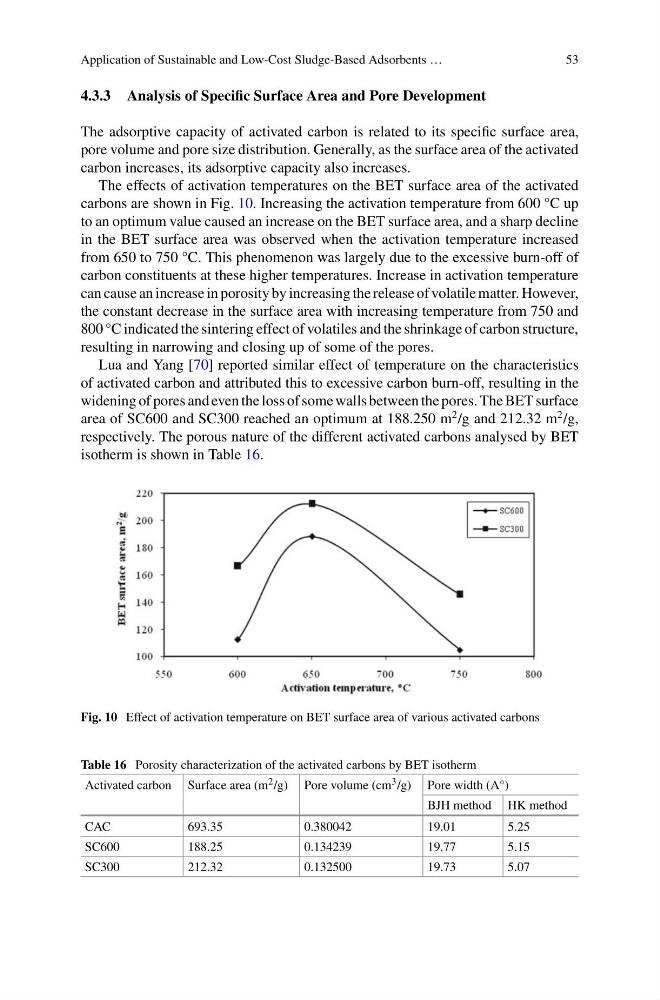
The effects of activation temperatures on the BET surface area of the activated
carbons are shown in Fig. 10. Increasing the activation temperature from 600 °C up
to an optimum value caused an increase on the BET surface area, and a sharp decline
in the BET surface area was observed when the activation temperature increased
from 650 to 750 °C. This phenomenon was largely due to the excessive burn-off of
carbon constituents at these higher temperatures. Increase in activation temperature
can cause an increase in porosity by increasing the release of volatile matter. However,
the constant decrease in the surface area with increasing temperature from 750 and
800 °C indicated the sintering effect of volatiles and the shrinkage of carbon structure,
resulting in narrowing and closing up of some of the pores.
Lua and Yang [70] reported similar effect of temperature on the characteristics
of activated carbon and attributed this to excessive carbon burn-off, resulting in the
widening of pores and even the loss of some walls between the pores. The BET surface
area of SC600 and SC300 reached an optimum at 188.250 m
2 /g and 212.32 m
2 /g,
respectively. The porous nature of the different activated carbons analysed by BET
isotherm is shown in Table 16.
Fig. 10 Effect of activation temperature on BET surface area of various activated carbons
Table 16 Porosity characterization of the activated carbons by BET isotherm
Activated carbon Surface area (m 2 /g) Pore volume (cm 3 /g) Pore width (A°)
BJH method HK method
CAC
693.35
0.380042
19.01
5.25
SC600
188.25
0.134239
19.77
5.15
SC300
212.32
0.132500
19.73
5.07
53
4.3.3 Analysis of Specific Surface Area and Pore Development
The adsorptive capacity of activated carbon is related to its specific surface area,
pore volume and pore size distribution. Generally, as the surface area of the activated
carbon increases, its adsorptive capacity also increases.
The effects of activation temperatures on the BET surface area of the activated
carbons are shown in Fig. 10. Increasing the activation temperature from 600 °C up
to an optimum value caused an increase on the BET surface area, and a sharp decline
in the BET surface area was observed when the activation temperature increased
from 650 to 750 °C. This phenomenon was largely due to the excessive burn-off of
carbon constituents at these higher temperatures. Increase in activation temperature
can cause an increase in porosity by increasing the release of volatile matter. However,
the constant decrease in the surface area with increasing temperature from 750 and
800 °C indicated the sintering effect of volatiles and the shrinkage of carbon structure,
resulting in narrowing and closing up of some of the pores.
Lua and Yang [70] reported similar effect of temperature on the characteristics
of activated carbon and attributed this to excessive carbon burn-off, resulting in the
widening of pores and even the loss of some walls between the pores. The BET surface
area of SC600 and SC300 reached an optimum at 188.250 m
2 /g and 212.32 m
2 /g,
respectively. The porous nature of the different activated carbons analysed by BET
isotherm is shown in Table 16.
Fig. 10 Effect of activation temperature on BET surface area of various activated carbons
Table 16 Porosity characterization of the activated carbons by BET isotherm
Activated carbon Surface area (m 2 /g) Pore volume (cm 3 /g) Pore width (A°)
BJH method HK method
CAC
693.35
0.380042
19.01
5.25
SC600
188.25
0.134239
19.77
5.15
SC300
212.32
0.132500
19.73
5.07