

Reuse of Salt-Containing Dyeing Effluents by Means …
21
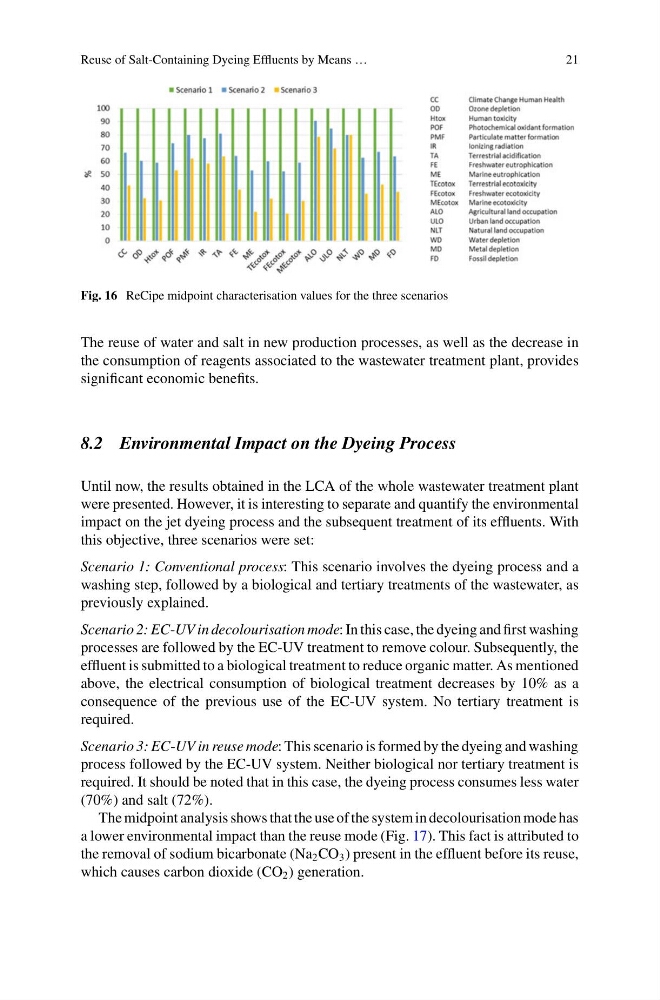
Fig. 16 ReCipe midpoint characterisation values for the three scenarios
The reuse of water and salt in new production processes, as well as the decrease in
the consumption of reagents associated to the wastewater treatment plant, provides
significant economic benefits.
8.2 Environmental Impact on the Dyeing Process
Until now, the results obtained in the LCA of the whole wastewater treatment plant
were presented. However, it is interesting to separate and quantify the environmental
impact on the jet dyeing process and the subsequent treatment of its effluents. With
this objective, three scenarios were set:
Scenario 1: Conventional process: This scenario involves the dyeing process and a
washing step, followed by a biological and tertiary treatments of the wastewater, as
previously explained.
Scenario 2: EC-UV in decolourisation mode: In this case, the dyeing and first washing
processes are followed by the EC-UV treatment to remove colour. Subsequently, the
effluent is submitted to a biological treatment to reduce organic matter. As mentioned
above, the electrical consumption of biological treatment decreases by 10% as a
consequence of the previous use of the EC-UV system. No tertiary treatment is
required.
Scenario 3: EC-UV in reuse mode: This scenario is formed by the dyeing and washing
process followed by the EC-UV system. Neither biological nor tertiary treatment is
required. It should be noted that in this case, the dyeing process consumes less water
(70%) and salt (72%).
The midpoint analysis shows that the use of the system in decolourisation mode has
a lower environmental impact than the reuse mode (Fig. 17). This fact is attributed to
the removal of sodium bicarbonate (Na 2 CO 3 ) present in the effluent before its reuse,
which causes carbon dioxide (CO 2 ) generation.
21
Fig. 16 ReCipe midpoint characterisation values for the three scenarios
The reuse of water and salt in new production processes, as well as the decrease in
the consumption of reagents associated to the wastewater treatment plant, provides
significant economic benefits.
8.2 Environmental Impact on the Dyeing Process
Until now, the results obtained in the LCA of the whole wastewater treatment plant
were presented. However, it is interesting to separate and quantify the environmental
impact on the jet dyeing process and the subsequent treatment of its effluents. With
this objective, three scenarios were set:
Scenario 1: Conventional process: This scenario involves the dyeing process and a
washing step, followed by a biological and tertiary treatments of the wastewater, as
previously explained.
Scenario 2: EC-UV in decolourisation mode: In this case, the dyeing and first washing
processes are followed by the EC-UV treatment to remove colour. Subsequently, the
effluent is submitted to a biological treatment to reduce organic matter. As mentioned
above, the electrical consumption of biological treatment decreases by 10% as a
consequence of the previous use of the EC-UV system. No tertiary treatment is
required.
Scenario 3: EC-UV in reuse mode: This scenario is formed by the dyeing and washing
process followed by the EC-UV system. Neither biological nor tertiary treatment is
required. It should be noted that in this case, the dyeing process consumes less water
(70%) and salt (72%).
The midpoint analysis shows that the use of the system in decolourisation mode has
a lower environmental impact than the reuse mode (Fig. 17). This fact is attributed to
the removal of sodium bicarbonate (Na 2 CO 3 ) present in the effluent before its reuse,
which causes carbon dioxide (CO 2 ) generation.