

Reuse of Salt-Containing Dyeing Effluents by Means …
19
dyes, different conductivity values, salt concentration, etc. In many cases, excellent
reuse results have been obtained. However, in some cases, colour differences are too
high and do not accomplish the acceptance criteria. A specific reason to explain this
trouble has not yet been found. For this reason, the combination of factors that can
significantly influence or even prevent the reuse of the discoloured effluents is still
under research.
8 Environmental Impact of EC-UV Treatment
As explained above, EC-UV is a new system that can be applied to treat coloured
and saline effluent, being particularly suitable for the purification of the wastewater
from the reactive jet dyeing process.
The implementation of the system in the textile industry has clear environmental
advantages, both in the wastewater treatment plant of the company [35] and in the
dyeing process [36]. A summary of the results obtained in Life Cycle Assessment
(LCA) performed according to ISO 14040 standards [37] is presented below.
8.1 Environmental Impact on the Wastewater Treatment
Plant
The environmental assessment was carried out considering three scenarios:
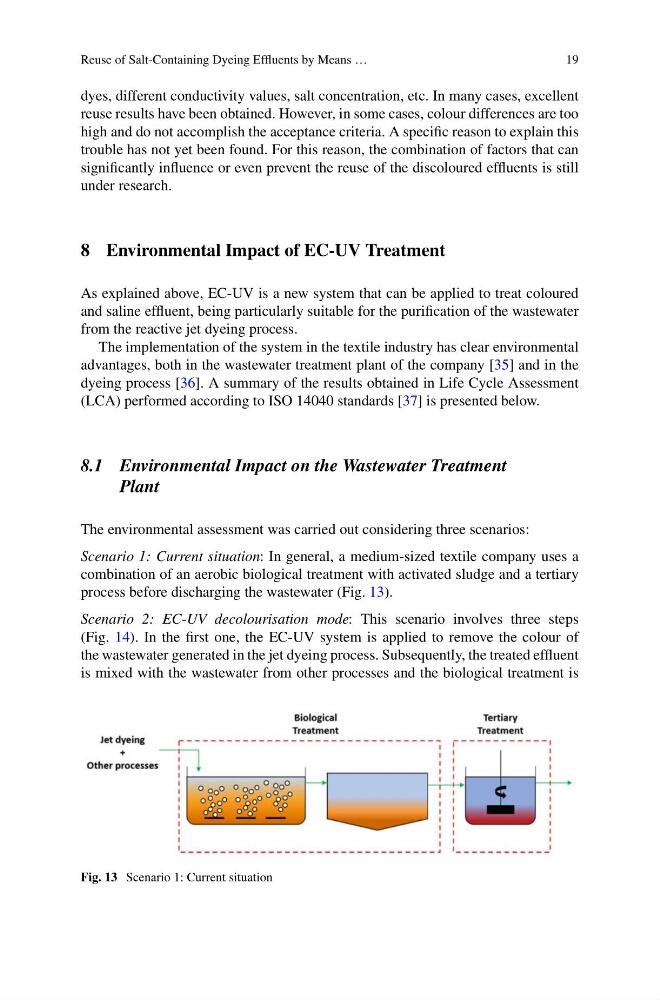
Scenario 1: Current situation: In general, a medium-sized textile company uses a
combination of an aerobic biological treatment with activated sludge and a tertiary
process before discharging the wastewater (Fig. 13).
Scenario 2: EC-UV decolourisation mode: This scenario involves three steps
(Fig. 14). In the first one, the EC-UV system is applied to remove the colour of
the wastewater generated in the jet dyeing process. Subsequently, the treated effluent
is mixed with the wastewater from other processes and the biological treatment is
Fig. 13 Scenario 1: Current situation
19
dyes, different conductivity values, salt concentration, etc. In many cases, excellent
reuse results have been obtained. However, in some cases, colour differences are too
high and do not accomplish the acceptance criteria. A specific reason to explain this
trouble has not yet been found. For this reason, the combination of factors that can
significantly influence or even prevent the reuse of the discoloured effluents is still
under research.
8 Environmental Impact of EC-UV Treatment
As explained above, EC-UV is a new system that can be applied to treat coloured
and saline effluent, being particularly suitable for the purification of the wastewater
from the reactive jet dyeing process.
The implementation of the system in the textile industry has clear environmental
advantages, both in the wastewater treatment plant of the company [35] and in the
dyeing process [36]. A summary of the results obtained in Life Cycle Assessment
(LCA) performed according to ISO 14040 standards [37] is presented below.
8.1 Environmental Impact on the Wastewater Treatment
Plant
The environmental assessment was carried out considering three scenarios:
Scenario 1: Current situation: In general, a medium-sized textile company uses a
combination of an aerobic biological treatment with activated sludge and a tertiary
process before discharging the wastewater (Fig. 13).
Scenario 2: EC-UV decolourisation mode: This scenario involves three steps
(Fig. 14). In the first one, the EC-UV system is applied to remove the colour of
the wastewater generated in the jet dyeing process. Subsequently, the treated effluent
is mixed with the wastewater from other processes and the biological treatment is
Fig. 13 Scenario 1: Current situation