

16
C. Gutiérrez-Bouzán et al.
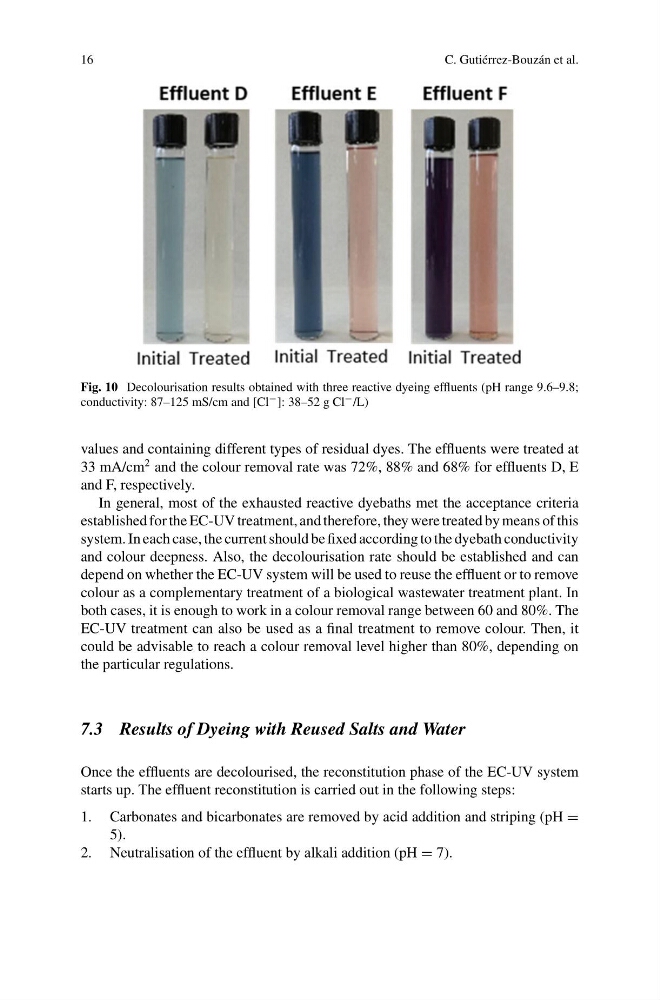
Fig. 10 Decolourisation results obtained with three reactive dyeing effluents (pH range 9.6–9.8;
conductivity: 87–125 mS/cm and [Cl − ]: 38–52 g Cl − /L)
values and containing different types of residual dyes. The effluents were treated at
33 mA/cm
2 and the colour removal rate was 72%, 88% and 68% for effluents D, E
and F, respectively.
In general, most of the exhausted reactive dyebaths met the acceptance criteria
established for the EC-UV treatment, and therefore, they were treated by means of this
system. In each case, the current should be fixed according to the dyebath conductivity
and colour deepness. Also, the decolourisation rate should be established and can
depend on whether the EC-UV system will be used to reuse the effluent or to remove
colour as a complementary treatment of a biological wastewater treatment plant. In
both cases, it is enough to work in a colour removal range between 60 and 80%. The
EC-UV treatment can also be used as a final treatment to remove colour. Then, it
could be advisable to reach a colour removal level higher than 80%, depending on
the particular regulations.
7.3 Results of Dyeing with Reused Salts and Water
Once the effluents are decolourised, the reconstitution phase of the EC-UV system
starts up. The effluent reconstitution is carried out in the following steps:
1. Carbonates and bicarbonates are removed by acid addition and striping (pH =
5).
2. Neutralisation of the effluent by alkali addition (pH = 7).
C. Gutiérrez-Bouzán et al.
Fig. 10 Decolourisation results obtained with three reactive dyeing effluents (pH range 9.6–9.8;
conductivity: 87–125 mS/cm and [Cl − ]: 38–52 g Cl − /L)
values and containing different types of residual dyes. The effluents were treated at
33 mA/cm
2 and the colour removal rate was 72%, 88% and 68% for effluents D, E
and F, respectively.
In general, most of the exhausted reactive dyebaths met the acceptance criteria
established for the EC-UV treatment, and therefore, they were treated by means of this
system. In each case, the current should be fixed according to the dyebath conductivity
and colour deepness. Also, the decolourisation rate should be established and can
depend on whether the EC-UV system will be used to reuse the effluent or to remove
colour as a complementary treatment of a biological wastewater treatment plant. In
both cases, it is enough to work in a colour removal range between 60 and 80%. The
EC-UV treatment can also be used as a final treatment to remove colour. Then, it
could be advisable to reach a colour removal level higher than 80%, depending on
the particular regulations.
7.3 Results of Dyeing with Reused Salts and Water
Once the effluents are decolourised, the reconstitution phase of the EC-UV system
starts up. The effluent reconstitution is carried out in the following steps:
1. Carbonates and bicarbonates are removed by acid addition and striping (pH =
5).
2. Neutralisation of the effluent by alkali addition (pH = 7).