

208
R. Sivaranjanee and P. Senthil Kumar
improved soil fertility and better crop yields. Biochar is very porous, and as a result, it
has a very large surface area. This porous surface makes a great home for beneficial
microbes and helps them to thrive and multiply. Biochar can be inoculated with
beneficial microbes simply by adding it to compost worm castings or compost tea
before application to the garden. The increased microbial will in turn feed earthworms
and increase their numbers and the amount of castings they leave in the garden.
Biochar also has high cation exchange capacity which attracts positively charged
nutrients, and as a result, biochar attracts and holds onto nutrients and prevents
them from leaching from the soil. Biochar improves soil structure and soil aeration.
Agricultural wastes, rice husks, bagasse, paper products, animal manures, and even
urban green waste can be used as major feedstock for preparing biochar.
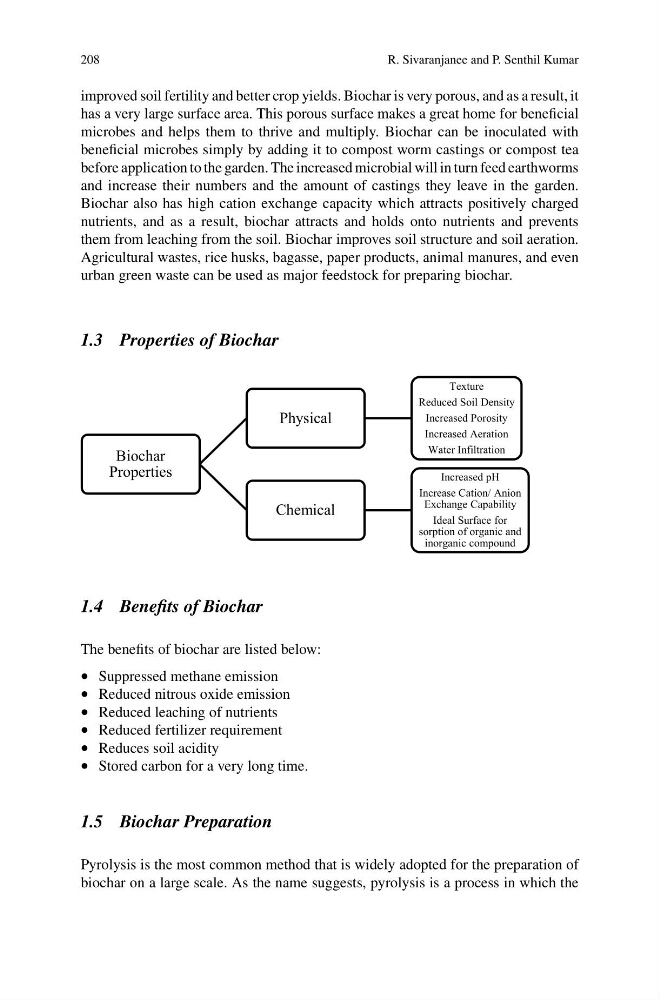
1.3 Properties of Biochar
Biochar
Properties
Physical
Texture
Reduced Soil Density
Increased Porosity
Increased Aeration
Water Infiltration
Chemical
Increased pH
Increase Cation/ Anion
Exchange Capability
Ideal Surface for
sorption of organic and
inorganic compound
1.4 Benefits of Biochar
The benefits of biochar are listed below:
• Suppressed methane emission
• Reduced nitrous oxide emission
• Reduced leaching of nutrients
• Reduced fertilizer requirement
• Reduces soil acidity
• Stored carbon for a very long time.
1.5 Biochar Preparation
Pyrolysis is the most common method that is widely adopted for the preparation of
biochar on a large scale. As the name suggests, pyrolysis is a process in which the
R. Sivaranjanee and P. Senthil Kumar
improved soil fertility and better crop yields. Biochar is very porous, and as a result, it
has a very large surface area. This porous surface makes a great home for beneficial
microbes and helps them to thrive and multiply. Biochar can be inoculated with
beneficial microbes simply by adding it to compost worm castings or compost tea
before application to the garden. The increased microbial will in turn feed earthworms
and increase their numbers and the amount of castings they leave in the garden.
Biochar also has high cation exchange capacity which attracts positively charged
nutrients, and as a result, biochar attracts and holds onto nutrients and prevents
them from leaching from the soil. Biochar improves soil structure and soil aeration.
Agricultural wastes, rice husks, bagasse, paper products, animal manures, and even
urban green waste can be used as major feedstock for preparing biochar.
1.3 Properties of Biochar
Biochar
Properties
Physical
Texture
Reduced Soil Density
Increased Porosity
Increased Aeration
Water Infiltration
Chemical
Increased pH
Increase Cation/ Anion
Exchange Capability
Ideal Surface for
sorption of organic and
inorganic compound
1.4 Benefits of Biochar
The benefits of biochar are listed below:
• Suppressed methane emission
• Reduced nitrous oxide emission
• Reduced leaching of nutrients
• Reduced fertilizer requirement
• Reduces soil acidity
• Stored carbon for a very long time.
1.5 Biochar Preparation
Pyrolysis is the most common method that is widely adopted for the preparation of
biochar on a large scale. As the name suggests, pyrolysis is a process in which the