

Advanced Oxidation Processes (AOP)—Effective Innovative …
197
bubble reaches the critical resonance size, they implode violently and generate high
atmospheric pressures (500–10,000 atm) and transient high temperatures (3000–
5000 K). This subsequently leads to the dissociation of water molecules into highly
reactive hydroxyl radicals, which eventually split into oxygen and react with the
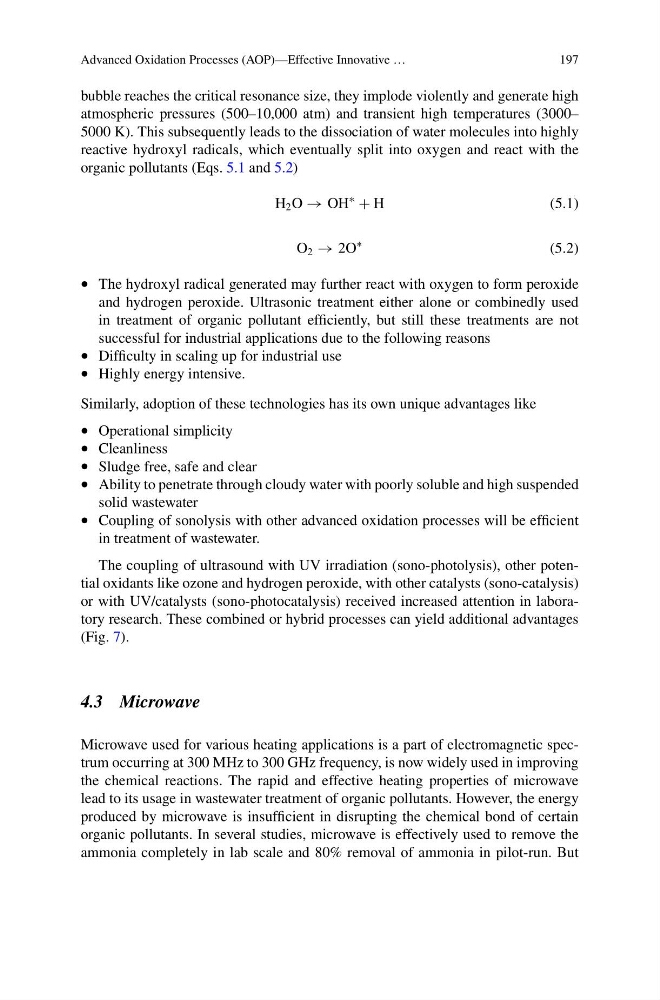
organic pollutants (Eqs. 5.1 and 5.2)
H 2 O → OH
∗
+ H
(5.1)
O 2 → 2O
∗
(5.2)
• The hydroxyl radical generated may further react with oxygen to form peroxide
and hydrogen peroxide. Ultrasonic treatment either alone or combinedly used
in treatment of organic pollutant efficiently, but still these treatments are not
successful for industrial applications due to the following reasons
• Difficulty in scaling up for industrial use
• Highly energy intensive.
Similarly, adoption of these technologies has its own unique advantages like
• Operational simplicity
• Cleanliness
• Sludge free, safe and clear
• Ability to penetrate through cloudy water with poorly soluble and high suspended
solid wastewater
• Coupling of sonolysis with other advanced oxidation processes will be efficient
in treatment of wastewater.
The coupling of ultrasound with UV irradiation (sono-photolysis), other potential oxidants like ozone and hydrogen peroxide, with other catalysts (sono-catalysis)
or with UV/catalysts (sono-photocatalysis) received increased attention in laboratory research. These combined or hybrid processes can yield additional advantages
(Fig. 7).
4.3 Microwave
Microwave used for various heating applications is a part of electromagnetic spectrum occurring at 300 MHz to 300 GHz frequency, is now widely used in improving
the chemical reactions. The rapid and effective heating properties of microwave
lead to its usage in wastewater treatment of organic pollutants. However, the energy
produced by microwave is insufficient in disrupting the chemical bond of certain
organic pollutants. In several studies, microwave is effectively used to remove the
ammonia completely in lab scale and 80% removal of ammonia in pilot-run. But
197
bubble reaches the critical resonance size, they implode violently and generate high
atmospheric pressures (500–10,000 atm) and transient high temperatures (3000–
5000 K). This subsequently leads to the dissociation of water molecules into highly
reactive hydroxyl radicals, which eventually split into oxygen and react with the
organic pollutants (Eqs. 5.1 and 5.2)
H 2 O → OH
∗
+ H
(5.1)
O 2 → 2O
∗
(5.2)
• The hydroxyl radical generated may further react with oxygen to form peroxide
and hydrogen peroxide. Ultrasonic treatment either alone or combinedly used
in treatment of organic pollutant efficiently, but still these treatments are not
successful for industrial applications due to the following reasons
• Difficulty in scaling up for industrial use
• Highly energy intensive.
Similarly, adoption of these technologies has its own unique advantages like
• Operational simplicity
• Cleanliness
• Sludge free, safe and clear
• Ability to penetrate through cloudy water with poorly soluble and high suspended
solid wastewater
• Coupling of sonolysis with other advanced oxidation processes will be efficient
in treatment of wastewater.
The coupling of ultrasound with UV irradiation (sono-photolysis), other potential oxidants like ozone and hydrogen peroxide, with other catalysts (sono-catalysis)
or with UV/catalysts (sono-photocatalysis) received increased attention in laboratory research. These combined or hybrid processes can yield additional advantages
(Fig. 7).
4.3 Microwave
Microwave used for various heating applications is a part of electromagnetic spectrum occurring at 300 MHz to 300 GHz frequency, is now widely used in improving
the chemical reactions. The rapid and effective heating properties of microwave
lead to its usage in wastewater treatment of organic pollutants. However, the energy
produced by microwave is insufficient in disrupting the chemical bond of certain
organic pollutants. In several studies, microwave is effectively used to remove the
ammonia completely in lab scale and 80% removal of ammonia in pilot-run. But