

Advanced Oxidation Processes (AOP)—Effective Innovative …
191
the efficiency of the process also depends upon the electrode, catalyst concentration,
electrolytes, current density, dissolved oxygen levels and temperature.
3.5.2 Photo-Fenton
Ultraviolet radiation treatment process with Fenton reagents is known as photoFenton process. This process combines hydrogen peroxide and Fe
2+ or Fe
3+ ion and
UV radiation resulting in production of more hydroxyl radicals. The main advantage
of this process eliminated the drawbacks of the Fenton process and increases the
degradation rate of the organic contaminants. In the classical Fenton process, the
Fe
3+ ions in the reactor are accumulated, and the reaction does not take place, until
all Fe
2+ ions are exhausted. But in the photo-Fenton process, as mentioned in the
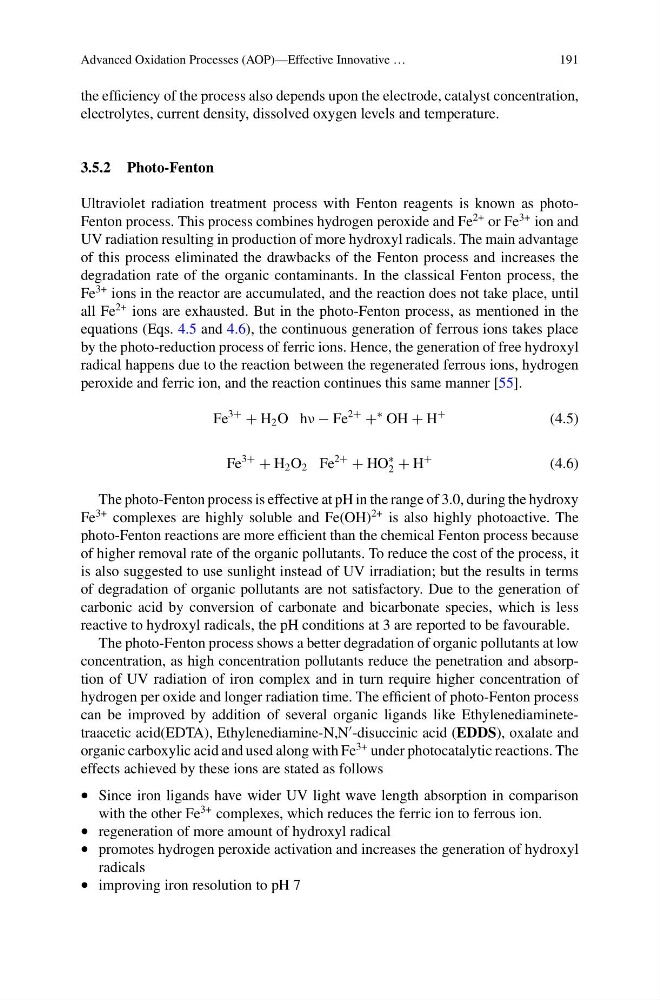
equations (Eqs. 4.5 and 4.6), the continuous generation of ferrous ions takes place
by the photo-reduction process of ferric ions. Hence, the generation of free hydroxyl
radical happens due to the reaction between the regenerated ferrous ions, hydrogen
peroxide and ferric ion, and the reaction continues this same manner [55].
Fe
3+
+ H 2 O hν − Fe
2+
+
∗ OH + H
+
(4.5)
Fe
3+
+ H 2 O 2 Fe
2+
+ HO
∗
2 + H
+
(4.6)
The photo-Fenton process is effective at pH in the range of 3.0, during the hydroxy
Fe
3+ complexes are highly soluble and Fe(OH)
2+ is also highly photoactive. The
photo-Fenton reactions are more efficient than the chemical Fenton process because
of higher removal rate of the organic pollutants. To reduce the cost of the process, it
is also suggested to use sunlight instead of UV irradiation; but the results in terms
of degradation of organic pollutants are not satisfactory. Due to the generation of
carbonic acid by conversion of carbonate and bicarbonate species, which is less
reactive to hydroxyl radicals, the pH conditions at 3 are reported to be favourable.
The photo-Fenton process shows a better degradation of organic pollutants at low
concentration, as high concentration pollutants reduce the penetration and absorption of UV radiation of iron complex and in turn require higher concentration of
hydrogen per oxide and longer radiation time. The efficient of photo-Fenton process
can be improved by addition of several organic ligands like Ethylenediaminetetraacetic acid(EDTA), Ethylenediamine-N,N
-disuccinic acid (EDDS), oxalate and
organic carboxylic acid and used along with Fe
3+ under photocatalytic reactions. The
effects achieved by these ions are stated as follows
• Since iron ligands have wider UV light wave length absorption in comparison
with the other Fe
3+ complexes, which reduces the ferric ion to ferrous ion.
• regeneration of more amount of hydroxyl radical
• promotes hydrogen peroxide activation and increases the generation of hydroxyl
radicals
• improving iron resolution to pH 7
191
the efficiency of the process also depends upon the electrode, catalyst concentration,
electrolytes, current density, dissolved oxygen levels and temperature.
3.5.2 Photo-Fenton
Ultraviolet radiation treatment process with Fenton reagents is known as photoFenton process. This process combines hydrogen peroxide and Fe
2+ or Fe
3+ ion and
UV radiation resulting in production of more hydroxyl radicals. The main advantage
of this process eliminated the drawbacks of the Fenton process and increases the
degradation rate of the organic contaminants. In the classical Fenton process, the
Fe
3+ ions in the reactor are accumulated, and the reaction does not take place, until
all Fe
2+ ions are exhausted. But in the photo-Fenton process, as mentioned in the
equations (Eqs. 4.5 and 4.6), the continuous generation of ferrous ions takes place
by the photo-reduction process of ferric ions. Hence, the generation of free hydroxyl
radical happens due to the reaction between the regenerated ferrous ions, hydrogen
peroxide and ferric ion, and the reaction continues this same manner [55].
Fe
3+
+ H 2 O hν − Fe
2+
+
∗ OH + H
+
(4.5)
Fe
3+
+ H 2 O 2 Fe
2+
+ HO
∗
2 + H
+
(4.6)
The photo-Fenton process is effective at pH in the range of 3.0, during the hydroxy
Fe
3+ complexes are highly soluble and Fe(OH)
2+ is also highly photoactive. The
photo-Fenton reactions are more efficient than the chemical Fenton process because
of higher removal rate of the organic pollutants. To reduce the cost of the process, it
is also suggested to use sunlight instead of UV irradiation; but the results in terms
of degradation of organic pollutants are not satisfactory. Due to the generation of
carbonic acid by conversion of carbonate and bicarbonate species, which is less
reactive to hydroxyl radicals, the pH conditions at 3 are reported to be favourable.
The photo-Fenton process shows a better degradation of organic pollutants at low
concentration, as high concentration pollutants reduce the penetration and absorption of UV radiation of iron complex and in turn require higher concentration of
hydrogen per oxide and longer radiation time. The efficient of photo-Fenton process
can be improved by addition of several organic ligands like Ethylenediaminetetraacetic acid(EDTA), Ethylenediamine-N,N
-disuccinic acid (EDDS), oxalate and
organic carboxylic acid and used along with Fe
3+ under photocatalytic reactions. The
effects achieved by these ions are stated as follows
• Since iron ligands have wider UV light wave length absorption in comparison
with the other Fe
3+ complexes, which reduces the ferric ion to ferrous ion.
• regeneration of more amount of hydroxyl radical
• promotes hydrogen peroxide activation and increases the generation of hydroxyl
radicals
• improving iron resolution to pH 7