

190
R. Sukanya Devi et al.
3.5.1 Electro-Fenton Process
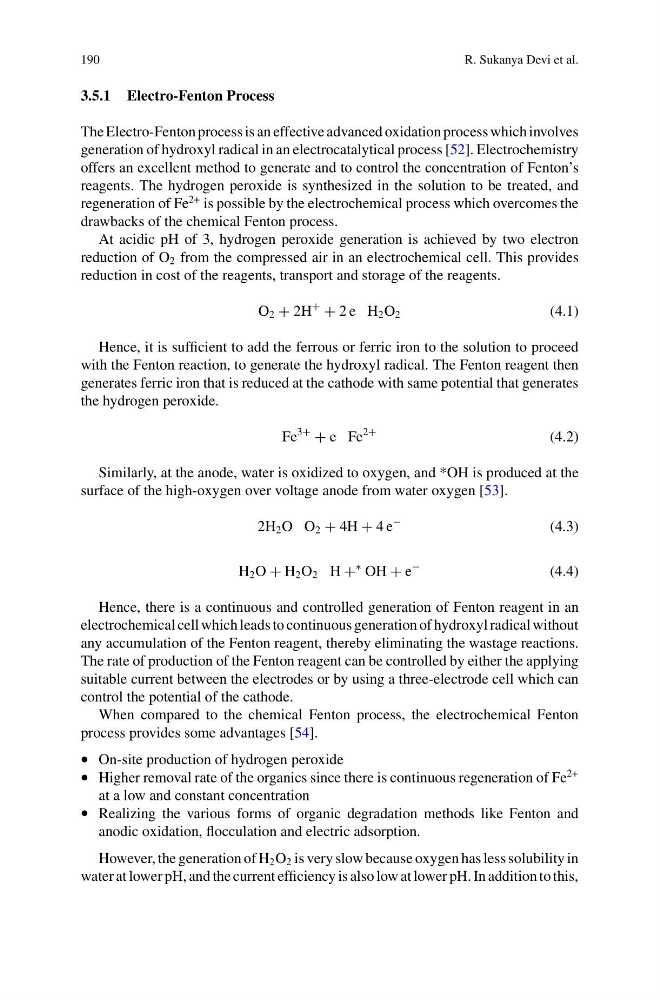
The Electro-Fenton process is an effective advanced oxidation process which involves
generation of hydroxyl radical in an electrocatalytical process [52]. Electrochemistry
offers an excellent method to generate and to control the concentration of Fenton’s
reagents. The hydrogen peroxide is synthesized in the solution to be treated, and
regeneration of Fe
2+ is possible by the electrochemical process which overcomes the
drawbacks of the chemical Fenton process.
At acidic pH of 3, hydrogen peroxide generation is achieved by two electron
reduction of O 2 from the compressed air in an electrochemical cell. This provides
reduction in cost of the reagents, transport and storage of the reagents.
O 2 + 2H
+
+ 2 e H 2 O 2
(4.1)
Hence, it is sufficient to add the ferrous or ferric iron to the solution to proceed
with the Fenton reaction, to generate the hydroxyl radical. The Fenton reagent then
generates ferric iron that is reduced at the cathode with same potential that generates
the hydrogen peroxide.
Fe
3+
+ e Fe
2+
(4.2)
Similarly, at the anode, water is oxidized to oxygen, and *OH is produced at the
surface of the high-oxygen over voltage anode from water oxygen [53].
2H 2 O O 2 + 4H + 4 e
−
(4.3)
H 2 O + H 2 O 2 H +
∗ OH + e
−
(4.4)
Hence, there is a continuous and controlled generation of Fenton reagent in an
electrochemical cell which leads to continuous generation of hydroxyl radical without
any accumulation of the Fenton reagent, thereby eliminating the wastage reactions.
The rate of production of the Fenton reagent can be controlled by either the applying
suitable current between the electrodes or by using a three-electrode cell which can
control the potential of the cathode.
When compared to the chemical Fenton process, the electrochemical Fenton
process provides some advantages [54].
• On-site production of hydrogen peroxide
• Higher removal rate of the organics since there is continuous regeneration of Fe
2+
at a low and constant concentration
• Realizing the various forms of organic degradation methods like Fenton and
anodic oxidation, flocculation and electric adsorption.
However, the generation of H 2 O 2 is very slow because oxygen has less solubility in
water at lower pH, and the current efficiency is also low at lower pH. In addition to this,
R. Sukanya Devi et al.
3.5.1 Electro-Fenton Process
The Electro-Fenton process is an effective advanced oxidation process which involves
generation of hydroxyl radical in an electrocatalytical process [52]. Electrochemistry
offers an excellent method to generate and to control the concentration of Fenton’s
reagents. The hydrogen peroxide is synthesized in the solution to be treated, and
regeneration of Fe
2+ is possible by the electrochemical process which overcomes the
drawbacks of the chemical Fenton process.
At acidic pH of 3, hydrogen peroxide generation is achieved by two electron
reduction of O 2 from the compressed air in an electrochemical cell. This provides
reduction in cost of the reagents, transport and storage of the reagents.
O 2 + 2H
+
+ 2 e H 2 O 2
(4.1)
Hence, it is sufficient to add the ferrous or ferric iron to the solution to proceed
with the Fenton reaction, to generate the hydroxyl radical. The Fenton reagent then
generates ferric iron that is reduced at the cathode with same potential that generates
the hydrogen peroxide.
Fe
3+
+ e Fe
2+
(4.2)
Similarly, at the anode, water is oxidized to oxygen, and *OH is produced at the
surface of the high-oxygen over voltage anode from water oxygen [53].
2H 2 O O 2 + 4H + 4 e
−
(4.3)
H 2 O + H 2 O 2 H +
∗ OH + e
−
(4.4)
Hence, there is a continuous and controlled generation of Fenton reagent in an
electrochemical cell which leads to continuous generation of hydroxyl radical without
any accumulation of the Fenton reagent, thereby eliminating the wastage reactions.
The rate of production of the Fenton reagent can be controlled by either the applying
suitable current between the electrodes or by using a three-electrode cell which can
control the potential of the cathode.
When compared to the chemical Fenton process, the electrochemical Fenton
process provides some advantages [54].
• On-site production of hydrogen peroxide
• Higher removal rate of the organics since there is continuous regeneration of Fe
2+
at a low and constant concentration
• Realizing the various forms of organic degradation methods like Fenton and
anodic oxidation, flocculation and electric adsorption.
However, the generation of H 2 O 2 is very slow because oxygen has less solubility in
water at lower pH, and the current efficiency is also low at lower pH. In addition to this,