

Advanced Oxidation Processes (AOP)—Effective Innovative …
181
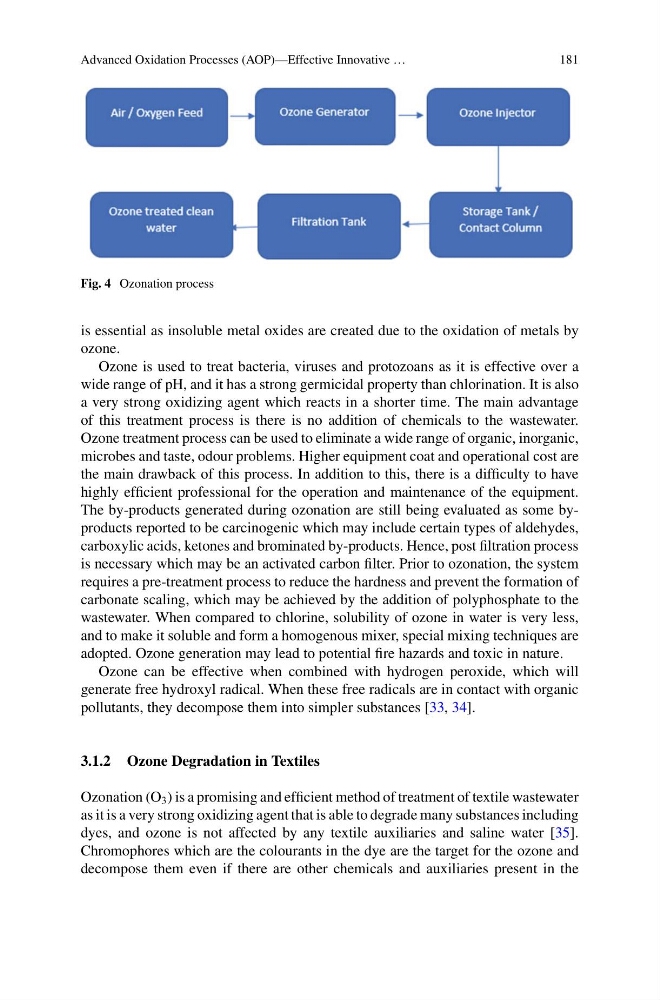
Fig. 4 Ozonation process
is essential as insoluble metal oxides are created due to the oxidation of metals by
ozone.
Ozone is used to treat bacteria, viruses and protozoans as it is effective over a
wide range of pH, and it has a strong germicidal property than chlorination. It is also
a very strong oxidizing agent which reacts in a shorter time. The main advantage
of this treatment process is there is no addition of chemicals to the wastewater.
Ozone treatment process can be used to eliminate a wide range of organic, inorganic,
microbes and taste, odour problems. Higher equipment coat and operational cost are
the main drawback of this process. In addition to this, there is a difficulty to have
highly efficient professional for the operation and maintenance of the equipment.
The by-products generated during ozonation are still being evaluated as some byproducts reported to be carcinogenic which may include certain types of aldehydes,
carboxylic acids, ketones and brominated by-products. Hence, post filtration process
is necessary which may be an activated carbon filter. Prior to ozonation, the system
requires a pre-treatment process to reduce the hardness and prevent the formation of
carbonate scaling, which may be achieved by the addition of polyphosphate to the
wastewater. When compared to chlorine, solubility of ozone in water is very less,
and to make it soluble and form a homogenous mixer, special mixing techniques are
adopted. Ozone generation may lead to potential fire hazards and toxic in nature.
Ozone can be effective when combined with hydrogen peroxide, which will
generate free hydroxyl radical. When these free radicals are in contact with organic
pollutants, they decompose them into simpler substances [33, 34].
3.1.2 Ozone Degradation in Textiles
Ozonation (O 3 ) is a promising and efficient method of treatment of textile wastewater
as it is a very strong oxidizing agent that is able to degrade many substances including
dyes, and ozone is not affected by any textile auxiliaries and saline water [35].
Chromophores which are the colourants in the dye are the target for the ozone and
decompose them even if there are other chemicals and auxiliaries present in the
181
Fig. 4 Ozonation process
is essential as insoluble metal oxides are created due to the oxidation of metals by
ozone.
Ozone is used to treat bacteria, viruses and protozoans as it is effective over a
wide range of pH, and it has a strong germicidal property than chlorination. It is also
a very strong oxidizing agent which reacts in a shorter time. The main advantage
of this treatment process is there is no addition of chemicals to the wastewater.
Ozone treatment process can be used to eliminate a wide range of organic, inorganic,
microbes and taste, odour problems. Higher equipment coat and operational cost are
the main drawback of this process. In addition to this, there is a difficulty to have
highly efficient professional for the operation and maintenance of the equipment.
The by-products generated during ozonation are still being evaluated as some byproducts reported to be carcinogenic which may include certain types of aldehydes,
carboxylic acids, ketones and brominated by-products. Hence, post filtration process
is necessary which may be an activated carbon filter. Prior to ozonation, the system
requires a pre-treatment process to reduce the hardness and prevent the formation of
carbonate scaling, which may be achieved by the addition of polyphosphate to the
wastewater. When compared to chlorine, solubility of ozone in water is very less,
and to make it soluble and form a homogenous mixer, special mixing techniques are
adopted. Ozone generation may lead to potential fire hazards and toxic in nature.
Ozone can be effective when combined with hydrogen peroxide, which will
generate free hydroxyl radical. When these free radicals are in contact with organic
pollutants, they decompose them into simpler substances [33, 34].
3.1.2 Ozone Degradation in Textiles
Ozonation (O 3 ) is a promising and efficient method of treatment of textile wastewater
as it is a very strong oxidizing agent that is able to degrade many substances including
dyes, and ozone is not affected by any textile auxiliaries and saline water [35].
Chromophores which are the colourants in the dye are the target for the ozone and
decompose them even if there are other chemicals and auxiliaries present in the