

174
R. Sukanya Devi et al.
1 Introduction
Textile industries have their root which dates back to many centuries, and it is a major
contributor for the country’s economy in terms of industrial production, employment
and exports. The Indian textile industry dates back to centuries, and it contributes
to 14% of India’s industrial production, 4% GDP and 17% of the country’s export
[1]. The industry provides direct employment to over 35 million people, and it is
the second largest employment provider. The structure of the textile industry is
complex [2]. The textile industry has different sectors from fibre manufacturing,
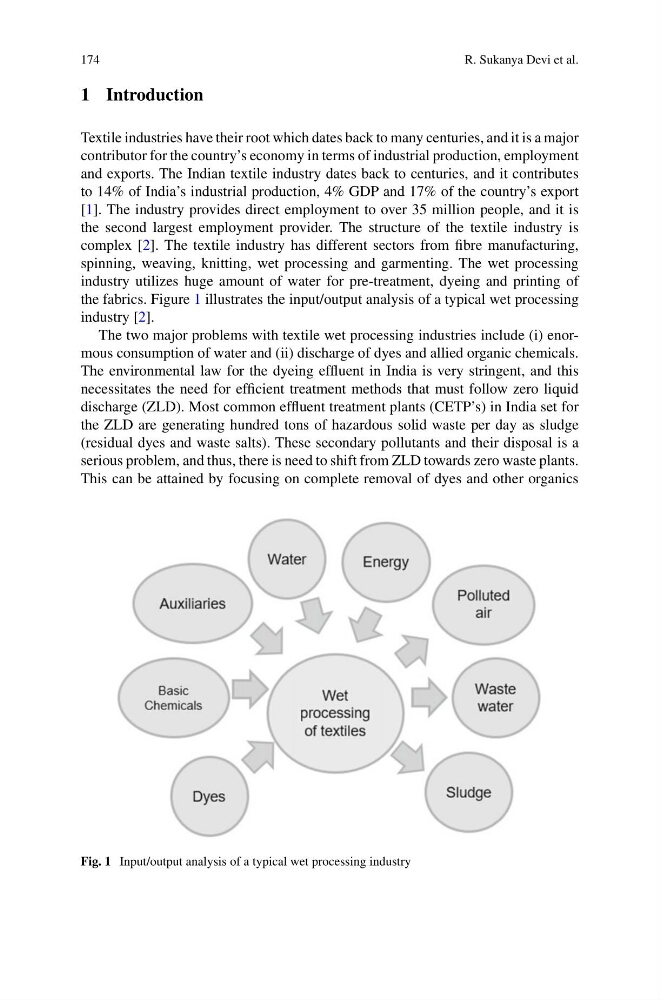
spinning, weaving, knitting, wet processing and garmenting. The wet processing
industry utilizes huge amount of water for pre-treatment, dyeing and printing of
the fabrics. Figure 1 illustrates the input/output analysis of a typical wet processing
industry [2].
The two major problems with textile wet processing industries include (i) enormous consumption of water and (ii) discharge of dyes and allied organic chemicals.
The environmental law for the dyeing effluent in India is very stringent, and this
necessitates the need for efficient treatment methods that must follow zero liquid
discharge (ZLD). Most common effluent treatment plants (CETP’s) in India set for
the ZLD are generating hundred tons of hazardous solid waste per day as sludge
(residual dyes and waste salts). These secondary pollutants and their disposal is a
serious problem, and thus, there is need to shift from ZLD towards zero waste plants.
This can be attained by focusing on complete removal of dyes and other organics
Fig. 1 Input/output analysis of a typical wet processing industry
R. Sukanya Devi et al.
1 Introduction
Textile industries have their root which dates back to many centuries, and it is a major
contributor for the country’s economy in terms of industrial production, employment
and exports. The Indian textile industry dates back to centuries, and it contributes
to 14% of India’s industrial production, 4% GDP and 17% of the country’s export
[1]. The industry provides direct employment to over 35 million people, and it is
the second largest employment provider. The structure of the textile industry is
complex [2]. The textile industry has different sectors from fibre manufacturing,
spinning, weaving, knitting, wet processing and garmenting. The wet processing
industry utilizes huge amount of water for pre-treatment, dyeing and printing of
the fabrics. Figure 1 illustrates the input/output analysis of a typical wet processing
industry [2].
The two major problems with textile wet processing industries include (i) enormous consumption of water and (ii) discharge of dyes and allied organic chemicals.
The environmental law for the dyeing effluent in India is very stringent, and this
necessitates the need for efficient treatment methods that must follow zero liquid
discharge (ZLD). Most common effluent treatment plants (CETP’s) in India set for
the ZLD are generating hundred tons of hazardous solid waste per day as sludge
(residual dyes and waste salts). These secondary pollutants and their disposal is a
serious problem, and thus, there is need to shift from ZLD towards zero waste plants.
This can be attained by focusing on complete removal of dyes and other organics
Fig. 1 Input/output analysis of a typical wet processing industry