

Photo-Catalytic-Assisted Method for Treating Industrial …
171
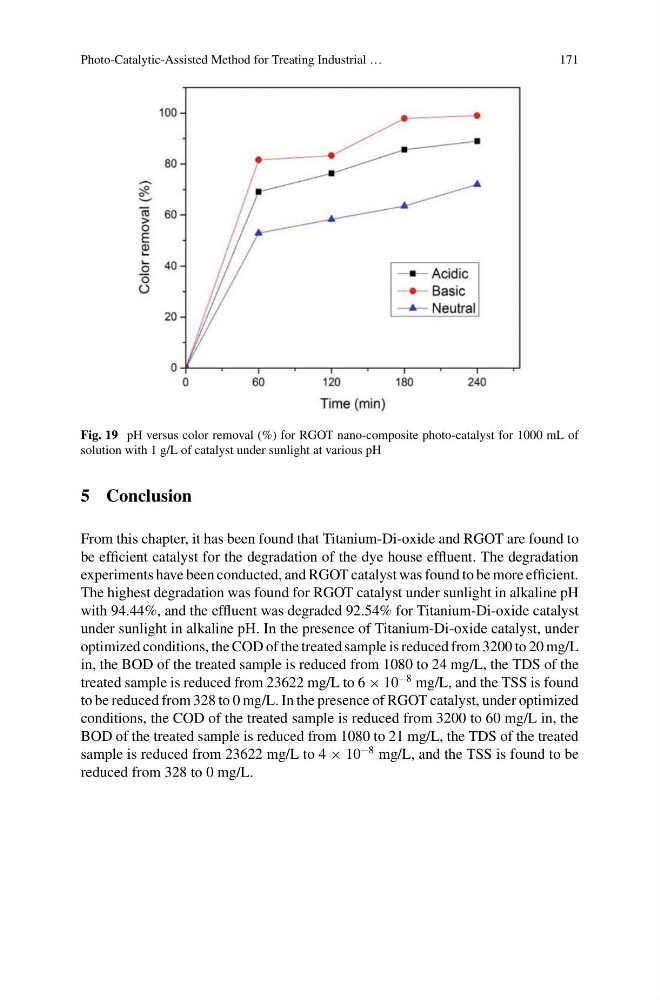
Fig. 19 pH versus color removal (%) for RGOT nano-composite photo-catalyst for 1000 mL of
solution with 1 g/L of catalyst under sunlight at various pH
5 Conclusion
From this chapter, it has been found that Titanium-Di-oxide and RGOT are found to
be efficient catalyst for the degradation of the dye house effluent. The degradation
experiments have been conducted, and RGOT catalyst was found to be more efficient.
The highest degradation was found for RGOT catalyst under sunlight in alkaline pH
with 94.44%, and the effluent was degraded 92.54% for Titanium-Di-oxide catalyst
under sunlight in alkaline pH. In the presence of Titanium-Di-oxide catalyst, under
optimized conditions, the COD of the treated sample is reduced from 3200 to 20 mg/L
in, the BOD of the treated sample is reduced from 1080 to 24 mg/L, the TDS of the
treated sample is reduced from 23622 mg/L to 6 × 10
−8 mg/L, and the TSS is found
to be reduced from 328 to 0 mg/L. In the presence of RGOT catalyst, under optimized
conditions, the COD of the treated sample is reduced from 3200 to 60 mg/L in, the
BOD of the treated sample is reduced from 1080 to 21 mg/L, the TDS of the treated
sample is reduced from 23622 mg/L to 4 × 10
−8 mg/L, and the TSS is found to be
reduced from 328 to 0 mg/L.
171
Fig. 19 pH versus color removal (%) for RGOT nano-composite photo-catalyst for 1000 mL of
solution with 1 g/L of catalyst under sunlight at various pH
5 Conclusion
From this chapter, it has been found that Titanium-Di-oxide and RGOT are found to
be efficient catalyst for the degradation of the dye house effluent. The degradation
experiments have been conducted, and RGOT catalyst was found to be more efficient.
The highest degradation was found for RGOT catalyst under sunlight in alkaline pH
with 94.44%, and the effluent was degraded 92.54% for Titanium-Di-oxide catalyst
under sunlight in alkaline pH. In the presence of Titanium-Di-oxide catalyst, under
optimized conditions, the COD of the treated sample is reduced from 3200 to 20 mg/L
in, the BOD of the treated sample is reduced from 1080 to 24 mg/L, the TDS of the
treated sample is reduced from 23622 mg/L to 6 × 10
−8 mg/L, and the TSS is found
to be reduced from 328 to 0 mg/L. In the presence of RGOT catalyst, under optimized
conditions, the COD of the treated sample is reduced from 3200 to 60 mg/L in, the
BOD of the treated sample is reduced from 1080 to 21 mg/L, the TDS of the treated
sample is reduced from 23622 mg/L to 4 × 10
−8 mg/L, and the TSS is found to be
reduced from 328 to 0 mg/L.