

170
M. Parthiban and G. Devanand
Table 2 Treated effluent character estimation
S.No. Effluent characteristics
(mg/L)
Before treatment (mg/L) After treatment (mg/L)
Titanium-Di-oxide RGOT
1.
COD
3200
20
60
2.
BOD
1080
24
21
3.
TDS
23,622
6 × 10 −8
4 × 10 −8
4.
TSS
328
0
0
4.5 Effluent Characteristics of Treated Sample
The effluent characteristics were drastically reduced after the treatment with the
abovementioned catalyst, namely TiO 2 and RGOT catalyst. The above catalyst
provides best results for treating the dye house effluents (Table 2).
4.6 Decolorisation Efficiency
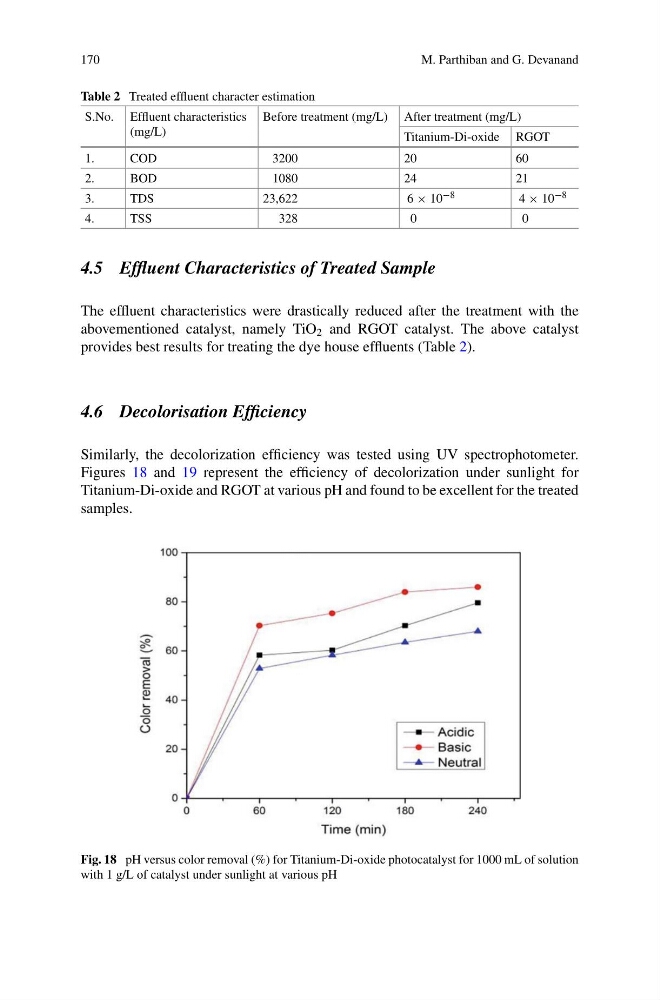
Similarly, the decolorization efficiency was tested using UV spectrophotometer.
Figures 18 and 19 represent the efficiency of decolorization under sunlight for
Titanium-Di-oxide and RGOT at various pH and found to be excellent for the treated
samples.
Fig. 18 pH versus color removal (%) for Titanium-Di-oxide photocatalyst for 1000 mL of solution
with 1 g/L of catalyst under sunlight at various pH
M. Parthiban and G. Devanand
Table 2 Treated effluent character estimation
S.No. Effluent characteristics
(mg/L)
Before treatment (mg/L) After treatment (mg/L)
Titanium-Di-oxide RGOT
1.
COD
3200
20
60
2.
BOD
1080
24
21
3.
TDS
23,622
6 × 10 −8
4 × 10 −8
4.
TSS
328
0
0
4.5 Effluent Characteristics of Treated Sample
The effluent characteristics were drastically reduced after the treatment with the
abovementioned catalyst, namely TiO 2 and RGOT catalyst. The above catalyst
provides best results for treating the dye house effluents (Table 2).
4.6 Decolorisation Efficiency
Similarly, the decolorization efficiency was tested using UV spectrophotometer.
Figures 18 and 19 represent the efficiency of decolorization under sunlight for
Titanium-Di-oxide and RGOT at various pH and found to be excellent for the treated
samples.
Fig. 18 pH versus color removal (%) for Titanium-Di-oxide photocatalyst for 1000 mL of solution
with 1 g/L of catalyst under sunlight at various pH