

Photo-Catalytic-Assisted Method for Treating Industrial …
165
surface. A small amount of sample was collected, filtered and considered as initial
concentration of the effluent solution. After the adsorption study, it is then kept in
sunlight at an intensity of 70,000 lx. After the zero time reading was taken. Aliquots
were taken at regular intervals and then filtered through a Millipore syringe filter of
0.45 μm, and the decolorization was determined through absorbance at maximum
wavelength (λ max 538 nm) using UV–visible spectrophotometer (Shimadzu1800,
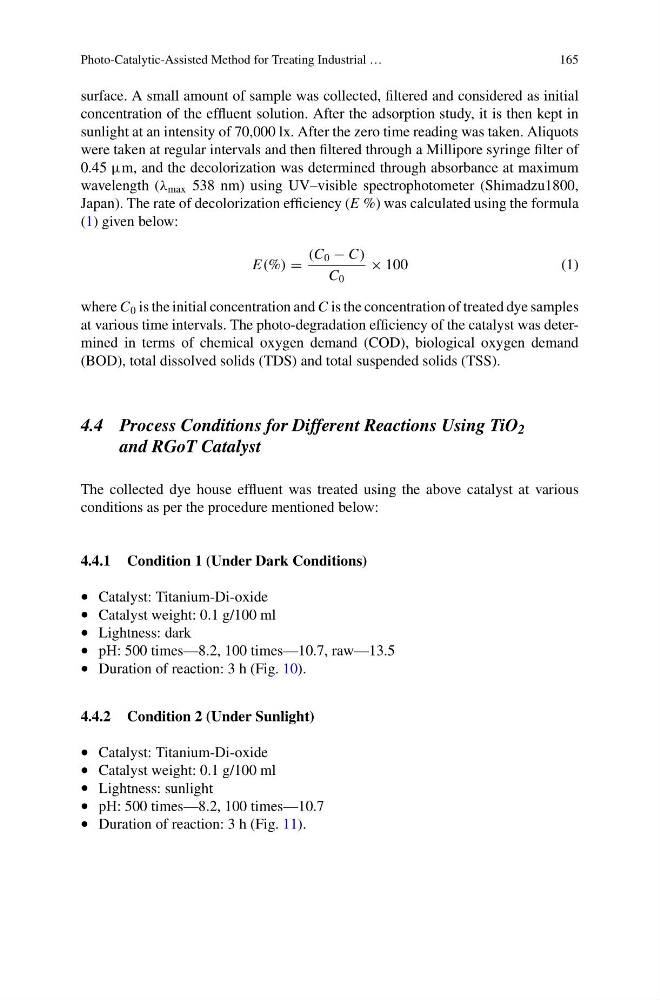
Japan). The rate of decolorization efficiency (E %) was calculated using the formula
(1) given below:
E(%) =
(C 0 − C)
C 0
× 100
(1)
where C 0 is the initial concentration and C is the concentration of treated dye samples
at various time intervals. The photo-degradation efficiency of the catalyst was determined in terms of chemical oxygen demand (COD), biological oxygen demand
(BOD), total dissolved solids (TDS) and total suspended solids (TSS).
4.4 Process Conditions for Different Reactions Using TiO 2
and RGoT Catalyst
The collected dye house effluent was treated using the above catalyst at various
conditions as per the procedure mentioned below:
4.4.1 Condition 1 (Under Dark Conditions)
• Catalyst: Titanium-Di-oxide
• Catalyst weight: 0.1 g/100 ml
• Lightness: dark
• pH: 500 times—8.2, 100 times—10.7, raw—13.5
• Duration of reaction: 3 h (Fig. 10).
4.4.2 Condition 2 (Under Sunlight)
• Catalyst: Titanium-Di-oxide
• Catalyst weight: 0.1 g/100 ml
• Lightness: sunlight
• pH: 500 times—8.2, 100 times—10.7
• Duration of reaction: 3 h (Fig. 11).
165
surface. A small amount of sample was collected, filtered and considered as initial
concentration of the effluent solution. After the adsorption study, it is then kept in
sunlight at an intensity of 70,000 lx. After the zero time reading was taken. Aliquots
were taken at regular intervals and then filtered through a Millipore syringe filter of
0.45 μm, and the decolorization was determined through absorbance at maximum
wavelength (λ max 538 nm) using UV–visible spectrophotometer (Shimadzu1800,
Japan). The rate of decolorization efficiency (E %) was calculated using the formula
(1) given below:
E(%) =
(C 0 − C)
C 0
× 100
(1)
where C 0 is the initial concentration and C is the concentration of treated dye samples
at various time intervals. The photo-degradation efficiency of the catalyst was determined in terms of chemical oxygen demand (COD), biological oxygen demand
(BOD), total dissolved solids (TDS) and total suspended solids (TSS).
4.4 Process Conditions for Different Reactions Using TiO 2
and RGoT Catalyst
The collected dye house effluent was treated using the above catalyst at various
conditions as per the procedure mentioned below:
4.4.1 Condition 1 (Under Dark Conditions)
• Catalyst: Titanium-Di-oxide
• Catalyst weight: 0.1 g/100 ml
• Lightness: dark
• pH: 500 times—8.2, 100 times—10.7, raw—13.5
• Duration of reaction: 3 h (Fig. 10).
4.4.2 Condition 2 (Under Sunlight)
• Catalyst: Titanium-Di-oxide
• Catalyst weight: 0.1 g/100 ml
• Lightness: sunlight
• pH: 500 times—8.2, 100 times—10.7
• Duration of reaction: 3 h (Fig. 11).