

Reuse of Salt-Containing Dyeing Effluents by Means …
9
5 Description of the EC-UV System
The coupled electrochemical–ultraviolet treatment explained in the previous section
has to be implemented through a process that makes it feasible to be applied in the
target industry. Beyond the issues related to the industrial implementation (to be
explained in the next section), the basic process requires three core steps to remove
colour from the effluent and eventually prepare it for its reuse in textile dyeing:
• Generation of oxidant species in an electrochemical cell
• Oxidation (decolouration) reaction
• Water conditioning for reuse (optional).
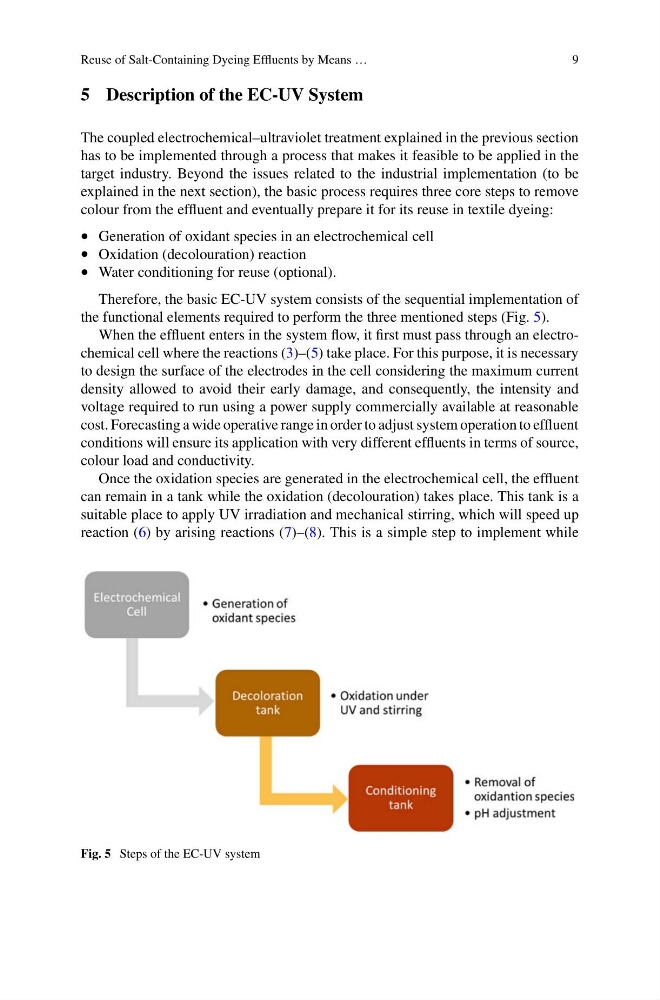
Therefore, the basic EC-UV system consists of the sequential implementation of
the functional elements required to perform the three mentioned steps (Fig. 5).
When the effluent enters in the system flow, it first must pass through an electrochemical cell where the reactions (3)–(5) take place. For this purpose, it is necessary
to design the surface of the electrodes in the cell considering the maximum current
density allowed to avoid their early damage, and consequently, the intensity and
voltage required to run using a power supply commercially available at reasonable
cost. Forecasting a wide operative range in order to adjust system operation to effluent
conditions will ensure its application with very different effluents in terms of source,
colour load and conductivity.
Once the oxidation species are generated in the electrochemical cell, the effluent
can remain in a tank while the oxidation (decolouration) takes place. This tank is a
suitable place to apply UV irradiation and mechanical stirring, which will speed up
reaction (6) by arising reactions (7)–(8). This is a simple step to implement while
Fig. 5 Steps of the EC-UV system
9
5 Description of the EC-UV System
The coupled electrochemical–ultraviolet treatment explained in the previous section
has to be implemented through a process that makes it feasible to be applied in the
target industry. Beyond the issues related to the industrial implementation (to be
explained in the next section), the basic process requires three core steps to remove
colour from the effluent and eventually prepare it for its reuse in textile dyeing:
• Generation of oxidant species in an electrochemical cell
• Oxidation (decolouration) reaction
• Water conditioning for reuse (optional).
Therefore, the basic EC-UV system consists of the sequential implementation of
the functional elements required to perform the three mentioned steps (Fig. 5).
When the effluent enters in the system flow, it first must pass through an electrochemical cell where the reactions (3)–(5) take place. For this purpose, it is necessary
to design the surface of the electrodes in the cell considering the maximum current
density allowed to avoid their early damage, and consequently, the intensity and
voltage required to run using a power supply commercially available at reasonable
cost. Forecasting a wide operative range in order to adjust system operation to effluent
conditions will ensure its application with very different effluents in terms of source,
colour load and conductivity.
Once the oxidation species are generated in the electrochemical cell, the effluent
can remain in a tank while the oxidation (decolouration) takes place. This tank is a
suitable place to apply UV irradiation and mechanical stirring, which will speed up
reaction (6) by arising reactions (7)–(8). This is a simple step to implement while
Fig. 5 Steps of the EC-UV system