

138
K. Amutha
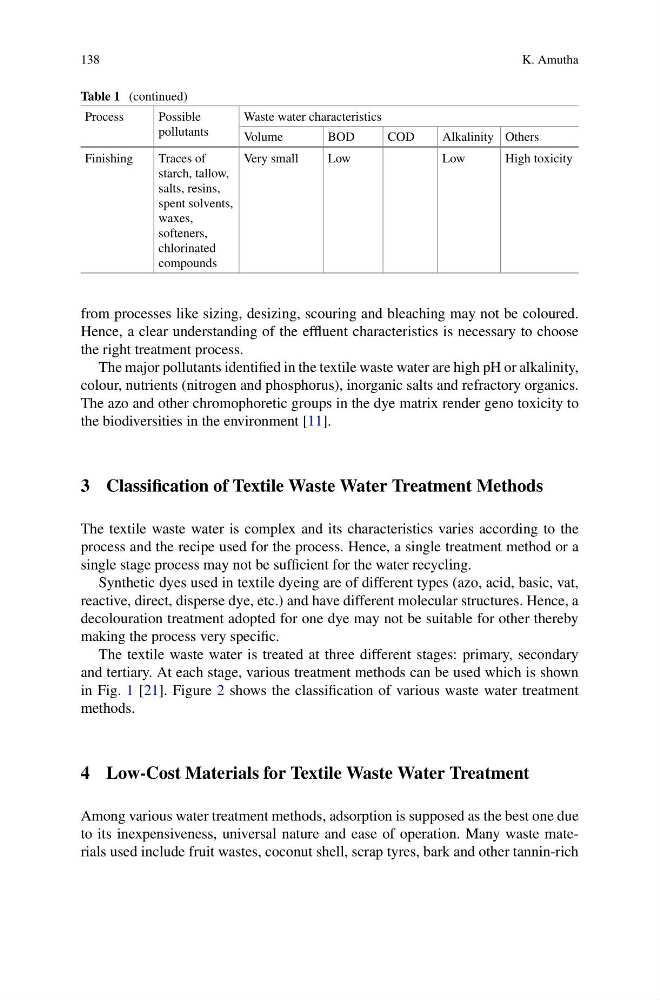
Table 1 (continued)
Process
Possible
pollutants
Waste water characteristics
Volume
BOD
COD
Alkalinity Others
Finishing
Traces of
starch, tallow,
salts, resins,
spent solvents,
waxes,
softeners,
chlorinated
compounds
Very small
Low
Low
High toxicity
from processes like sizing, desizing, scouring and bleaching may not be coloured.
Hence, a clear understanding of the effluent characteristics is necessary to choose
the right treatment process.
The major pollutants identified in the textile waste water are high pH or alkalinity,
colour, nutrients (nitrogen and phosphorus), inorganic salts and refractory organics.
The azo and other chromophoretic groups in the dye matrix render geno toxicity to
the biodiversities in the environment [11].
3 Classification of Textile Waste Water Treatment Methods
The textile waste water is complex and its characteristics varies according to the
process and the recipe used for the process. Hence, a single treatment method or a
single stage process may not be sufficient for the water recycling.
Synthetic dyes used in textile dyeing are of different types (azo, acid, basic, vat,
reactive, direct, disperse dye, etc.) and have different molecular structures. Hence, a
decolouration treatment adopted for one dye may not be suitable for other thereby
making the process very specific.
The textile waste water is treated at three different stages: primary, secondary
and tertiary. At each stage, various treatment methods can be used which is shown
in Fig. 1 [21]. Figure 2 shows the classification of various waste water treatment
methods.
4 Low-Cost Materials for Textile Waste Water Treatment
Among various water treatment methods, adsorption is supposed as the best one due
to its inexpensiveness, universal nature and ease of operation. Many waste materials used include fruit wastes, coconut shell, scrap tyres, bark and other tannin-rich
K. Amutha
Table 1 (continued)
Process
Possible
pollutants
Waste water characteristics
Volume
BOD
COD
Alkalinity Others
Finishing
Traces of
starch, tallow,
salts, resins,
spent solvents,
waxes,
softeners,
chlorinated
compounds
Very small
Low
Low
High toxicity
from processes like sizing, desizing, scouring and bleaching may not be coloured.
Hence, a clear understanding of the effluent characteristics is necessary to choose
the right treatment process.
The major pollutants identified in the textile waste water are high pH or alkalinity,
colour, nutrients (nitrogen and phosphorus), inorganic salts and refractory organics.
The azo and other chromophoretic groups in the dye matrix render geno toxicity to
the biodiversities in the environment [11].
3 Classification of Textile Waste Water Treatment Methods
The textile waste water is complex and its characteristics varies according to the
process and the recipe used for the process. Hence, a single treatment method or a
single stage process may not be sufficient for the water recycling.
Synthetic dyes used in textile dyeing are of different types (azo, acid, basic, vat,
reactive, direct, disperse dye, etc.) and have different molecular structures. Hence, a
decolouration treatment adopted for one dye may not be suitable for other thereby
making the process very specific.
The textile waste water is treated at three different stages: primary, secondary
and tertiary. At each stage, various treatment methods can be used which is shown
in Fig. 1 [21]. Figure 2 shows the classification of various waste water treatment
methods.
4 Low-Cost Materials for Textile Waste Water Treatment
Among various water treatment methods, adsorption is supposed as the best one due
to its inexpensiveness, universal nature and ease of operation. Many waste materials used include fruit wastes, coconut shell, scrap tyres, bark and other tannin-rich