

Dyestuff Adsorbing Natural Composites for Wastewater Treatments
117
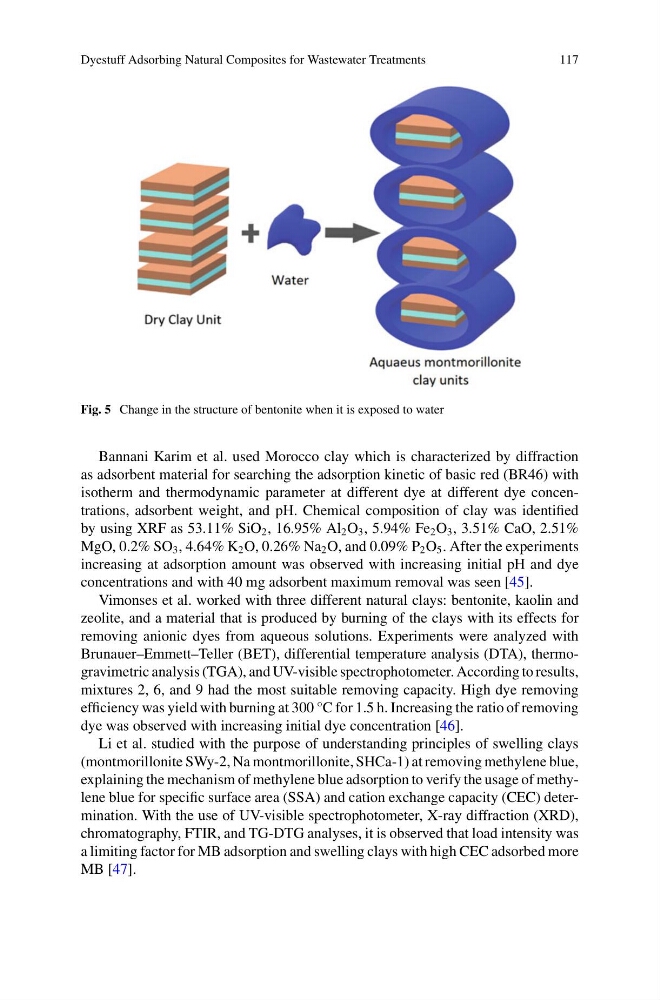
Fig. 5 Change in the structure of bentonite when it is exposed to water
Bannani Karim et al. used Morocco clay which is characterized by diffraction
as adsorbent material for searching the adsorption kinetic of basic red (BR46) with
isotherm and thermodynamic parameter at different dye at different dye concentrations, adsorbent weight, and pH. Chemical composition of clay was identified
by using XRF as 53.11% SiO 2 , 16.95% Al 2 O 3 , 5.94% Fe 2 O 3 , 3.51% CaO, 2.51%
MgO, 0.2% SO 3 , 4.64% K 2 O, 0.26% Na 2 O, and 0.09% P 2 O 5 . After the experiments
increasing at adsorption amount was observed with increasing initial pH and dye
concentrations and with 40 mg adsorbent maximum removal was seen [45].
Vimonses et al. worked with three different natural clays: bentonite, kaolin and
zeolite, and a material that is produced by burning of the clays with its effects for
removing anionic dyes from aqueous solutions. Experiments were analyzed with
Brunauer–Emmett–Teller (BET), differential temperature analysis (DTA), thermogravimetric analysis (TGA), and UV-visible spectrophotometer. According to results,
mixtures 2, 6, and 9 had the most suitable removing capacity. High dye removing
efficiency was yield with burning at 300 °C for 1.5 h. Increasing the ratio of removing
dye was observed with increasing initial dye concentration [46].
Li et al. studied with the purpose of understanding principles of swelling clays
(montmorillonite SWy-2, Na montmorillonite, SHCa-1) at removing methylene blue,
explaining the mechanism of methylene blue adsorption to verify the usage of methylene blue for specific surface area (SSA) and cation exchange capacity (CEC) determination. With the use of UV-visible spectrophotometer, X-ray diffraction (XRD),
chromatography, FTIR, and TG-DTG analyses, it is observed that load intensity was
a limiting factor for MB adsorption and swelling clays with high CEC adsorbed more
MB [47].
117
Fig. 5 Change in the structure of bentonite when it is exposed to water
Bannani Karim et al. used Morocco clay which is characterized by diffraction
as adsorbent material for searching the adsorption kinetic of basic red (BR46) with
isotherm and thermodynamic parameter at different dye at different dye concentrations, adsorbent weight, and pH. Chemical composition of clay was identified
by using XRF as 53.11% SiO 2 , 16.95% Al 2 O 3 , 5.94% Fe 2 O 3 , 3.51% CaO, 2.51%
MgO, 0.2% SO 3 , 4.64% K 2 O, 0.26% Na 2 O, and 0.09% P 2 O 5 . After the experiments
increasing at adsorption amount was observed with increasing initial pH and dye
concentrations and with 40 mg adsorbent maximum removal was seen [45].
Vimonses et al. worked with three different natural clays: bentonite, kaolin and
zeolite, and a material that is produced by burning of the clays with its effects for
removing anionic dyes from aqueous solutions. Experiments were analyzed with
Brunauer–Emmett–Teller (BET), differential temperature analysis (DTA), thermogravimetric analysis (TGA), and UV-visible spectrophotometer. According to results,
mixtures 2, 6, and 9 had the most suitable removing capacity. High dye removing
efficiency was yield with burning at 300 °C for 1.5 h. Increasing the ratio of removing
dye was observed with increasing initial dye concentration [46].
Li et al. studied with the purpose of understanding principles of swelling clays
(montmorillonite SWy-2, Na montmorillonite, SHCa-1) at removing methylene blue,
explaining the mechanism of methylene blue adsorption to verify the usage of methylene blue for specific surface area (SSA) and cation exchange capacity (CEC) determination. With the use of UV-visible spectrophotometer, X-ray diffraction (XRD),
chromatography, FTIR, and TG-DTG analyses, it is observed that load intensity was
a limiting factor for MB adsorption and swelling clays with high CEC adsorbed more
MB [47].