

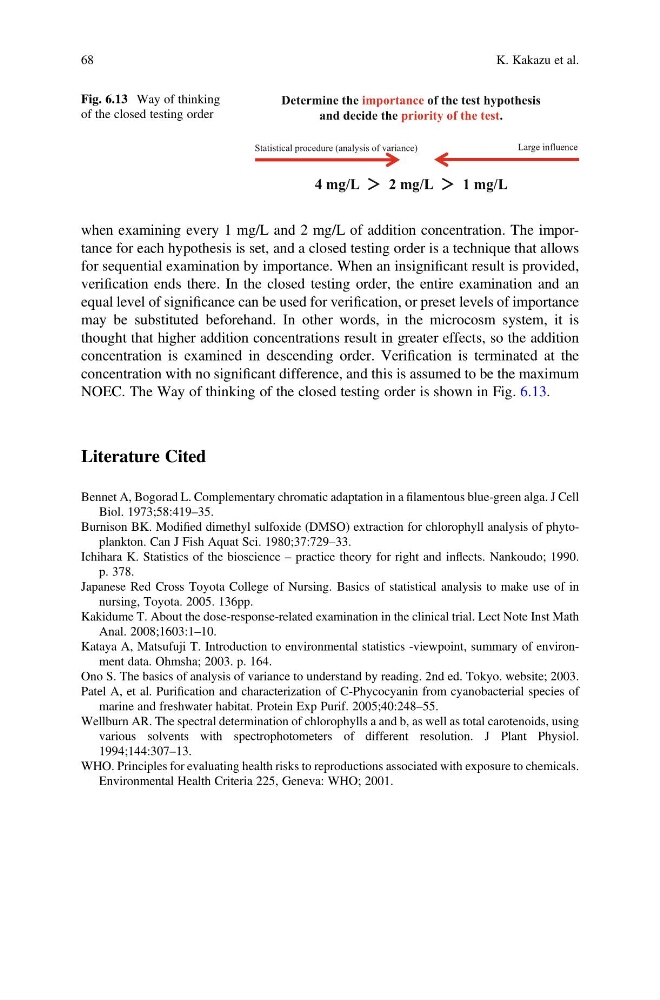
when examining every 1 mg/L and 2 mg/L of addition concentration. The importance for each hypothesis is set, and a closed testing order is a technique that allows
for sequential examination by importance. When an insignificant result is provided,
verification ends there. In the closed testing order, the entire examination and an
equal level of significance can be used for verification, or preset levels of importance
may be substituted beforehand. In other words, in the microcosm system, it is
thought that higher addition concentrations result in greater effects, so the addition
concentration is examined in descending order. Verification is terminated at the
concentration with no significant difference, and this is assumed to be the maximum
NOEC. The Way of thinking of the closed testing order is shown in Fig. 6.13.
Literature Cited
Bennet A, Bogorad L. Complementary chromatic adaptation in a filamentous blue-green alga. J Cell
Biol. 1973;58:419–35.
Burnison BK. Modified dimethyl sulfoxide (DMSO) extraction for chlorophyll analysis of phytoplankton. Can J Fish Aquat Sci. 1980;37:729–33.
Ichihara K. Statistics of the bioscience – practice theory for right and inflects. Nankoudo; 1990.
p. 378.
Japanese Red Cross Toyota College of Nursing. Basics of statistical analysis to make use of in
nursing, Toyota. 2005. 136pp.
Kakidume T. About the dose-response-related examination in the clinical trial. Lect Note Inst Math
Anal. 2008;1603:1–10.
Kataya A, Matsufuji T. Introduction to environmental statistics -viewpoint, summary of environment data. Ohmsha; 2003. p. 164.
Ono S. The basics of analysis of variance to understand by reading. 2nd ed. Tokyo. website; 2003.
Patel A, et al. Purification and characterization of C-Phycocyanin from cyanobacterial species of
marine and freshwater habitat. Protein Exp Purif. 2005;40:248–55.
Wellburn AR. The spectral determination of chlorophylls a and b, as well as total carotenoids, using
various solvents with spectrophotometers of different resolution. J Plant Physiol.
1994;144:307–13.
WHO. Principles for evaluating health risks to reproductions associated with exposure to chemicals.
Environmental Health Criteria 225, Geneva: WHO; 2001.
Determine the importance of the test hypothesis
and decide the priority of the test.
Statistical procedure (analysis of variance)
Large influence
4 mg/L
2 mg/L
1 mg/L
Fig. 6.13 Way of thinking
of the closed testing order
68
K. Kakazu et al.
for sequential examination by importance. When an insignificant result is provided,
verification ends there. In the closed testing order, the entire examination and an
equal level of significance can be used for verification, or preset levels of importance
may be substituted beforehand. In other words, in the microcosm system, it is
thought that higher addition concentrations result in greater effects, so the addition
concentration is examined in descending order. Verification is terminated at the
concentration with no significant difference, and this is assumed to be the maximum
NOEC. The Way of thinking of the closed testing order is shown in Fig. 6.13.
Literature Cited
Bennet A, Bogorad L. Complementary chromatic adaptation in a filamentous blue-green alga. J Cell
Biol. 1973;58:419–35.
Burnison BK. Modified dimethyl sulfoxide (DMSO) extraction for chlorophyll analysis of phytoplankton. Can J Fish Aquat Sci. 1980;37:729–33.
Ichihara K. Statistics of the bioscience – practice theory for right and inflects. Nankoudo; 1990.
p. 378.
Japanese Red Cross Toyota College of Nursing. Basics of statistical analysis to make use of in
nursing, Toyota. 2005. 136pp.
Kakidume T. About the dose-response-related examination in the clinical trial. Lect Note Inst Math
Anal. 2008;1603:1–10.
Kataya A, Matsufuji T. Introduction to environmental statistics -viewpoint, summary of environment data. Ohmsha; 2003. p. 164.
Ono S. The basics of analysis of variance to understand by reading. 2nd ed. Tokyo. website; 2003.
Patel A, et al. Purification and characterization of C-Phycocyanin from cyanobacterial species of
marine and freshwater habitat. Protein Exp Purif. 2005;40:248–55.
Wellburn AR. The spectral determination of chlorophylls a and b, as well as total carotenoids, using
various solvents with spectrophotometers of different resolution. J Plant Physiol.
1994;144:307–13.
WHO. Principles for evaluating health risks to reproductions associated with exposure to chemicals.
Environmental Health Criteria 225, Geneva: WHO; 2001.
Determine the importance of the test hypothesis
and decide the priority of the test.
Statistical procedure (analysis of variance)
Large influence
4 mg/L
2 mg/L
1 mg/L
Fig. 6.13 Way of thinking
of the closed testing order
68
K. Kakazu et al.