

Therefore, when three H 0 are considered to be the truth, the probability of a type I
error is greater than 1–0.953 ¼ 0.14, and it will be unpredictable.
In this way, when the t-test is simply repeated:
• The probability of a type I error throughout the analysis increases.
• When data are not independent, the probability of the type I error becomes
unknown.
In this case, it is necessary to use multivariate techniques. However, in the daily
operation of the microcosm and after having examined groups A, B, and C on the
first day by multiple comparisons, on the subsequent days, the test will be repeated.
Therefore, it may be said that this is statistically a mistake because the probability
of rejecting the null hypothesis, H 0 (μA ¼ μB ¼ μC), for groups A, B, and C
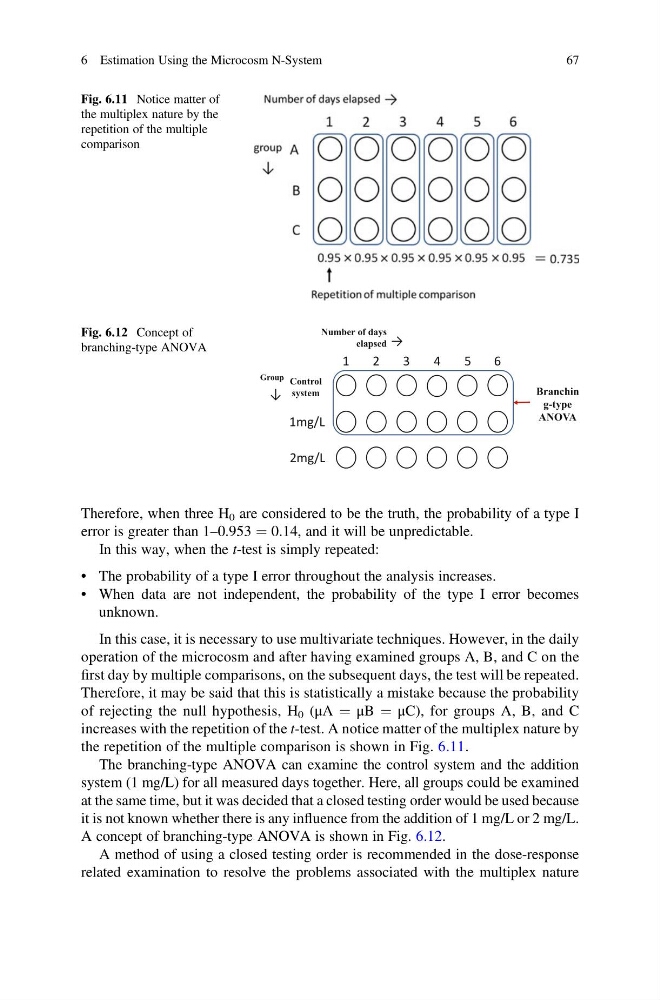
increases with the repetition of the t-test. A notice matter of the multiplex nature by
the repetition of the multiple comparison is shown in Fig. 6.11.
The branching-type ANOVA can examine the control system and the addition
system (1 mg/L) for all measured days together. Here, all groups could be examined
at the same time, but it was decided that a closed testing order would be used because
it is not known whether there is any influence from the addition of 1 mg/L or 2 mg/L.
A concept of branching-type ANOVA is shown in Fig. 6.12.
A method of using a closed testing order is recommended in the dose-response
related examination to resolve the problems associated with the multiplex nature
Fig. 6.11 Notice matter of
the multiplex nature by the
repetition of the multiple
comparison
1mg/L
1
2
6
5
4
3
→
↓
2mg/L
Number of days
elapsed
Group Control
system
Branchin
g-type
ANOVA
Fig. 6.12 Concept of
branching-type ANOVA
6 Estimation Using the Microcosm N-System
67
error is greater than 1–0.953 ¼ 0.14, and it will be unpredictable.
In this way, when the t-test is simply repeated:
• The probability of a type I error throughout the analysis increases.
• When data are not independent, the probability of the type I error becomes
unknown.
In this case, it is necessary to use multivariate techniques. However, in the daily
operation of the microcosm and after having examined groups A, B, and C on the
first day by multiple comparisons, on the subsequent days, the test will be repeated.
Therefore, it may be said that this is statistically a mistake because the probability
of rejecting the null hypothesis, H 0 (μA ¼ μB ¼ μC), for groups A, B, and C
increases with the repetition of the t-test. A notice matter of the multiplex nature by
the repetition of the multiple comparison is shown in Fig. 6.11.
The branching-type ANOVA can examine the control system and the addition
system (1 mg/L) for all measured days together. Here, all groups could be examined
at the same time, but it was decided that a closed testing order would be used because
it is not known whether there is any influence from the addition of 1 mg/L or 2 mg/L.
A concept of branching-type ANOVA is shown in Fig. 6.12.
A method of using a closed testing order is recommended in the dose-response
related examination to resolve the problems associated with the multiplex nature
Fig. 6.11 Notice matter of
the multiplex nature by the
repetition of the multiple
comparison
1mg/L
1
2
6
5
4
3
→
↓
2mg/L
Number of days
elapsed
Group Control
system
Branchin
g-type
ANOVA
Fig. 6.12 Concept of
branching-type ANOVA
6 Estimation Using the Microcosm N-System
67