

as that used in the test group is used in the control group. When a material (e.g.,
organic solvents, such as acetone) other than pure water (demineralized water) is used
as a solvent, both the pure water and solvent should be added to the control group.
5.3.2 Preparation of Test Substances
Allow the test material to dissolve in distilled or Milli-Q water. When it is difficult to
dissolve, scatter it via sonication. If no other method is used, dispersants such as
inorganic acids and bases, HCl, NaOH, or acetone, Cremophor RH40 and 0.01%
methylcellulose aqueous solution, HCO-50, HCO-60, and others (<100 μL/L) are
used; however, this should be minimized. Regulate the concentration of the analyte
after addition to the microcosm; this then becomes the designated test concentration
in the microcosm.
5.3.3 Addition of Test Substances (During the Stationary
Phase)
cultivation
substance addition
15days
DO measurement
analysis
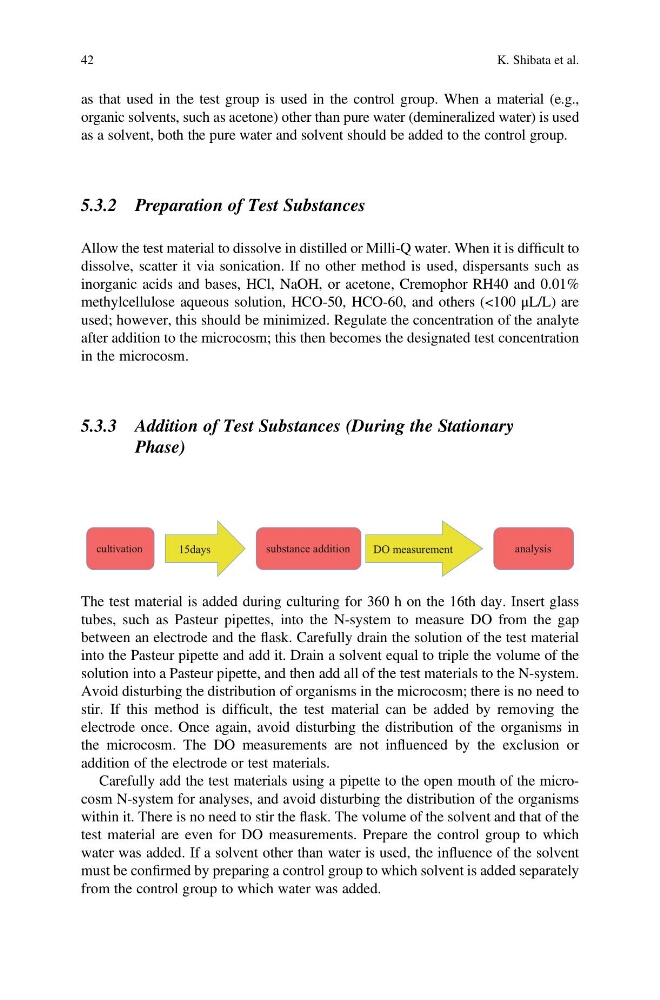
The test material is added during culturing for 360 h on the 16th day. Insert glass
tubes, such as Pasteur pipettes, into the N-system to measure DO from the gap
between an electrode and the flask. Carefully drain the solution of the test material
into the Pasteur pipette and add it. Drain a solvent equal to triple the volume of the
solution into a Pasteur pipette, and then add all of the test materials to the N-system.
Avoid disturbing the distribution of organisms in the microcosm; there is no need to
stir. If this method is difficult, the test material can be added by removing the
electrode once. Once again, avoid disturbing the distribution of the organisms in
the microcosm. The DO measurements are not influenced by the exclusion or
addition of the electrode or test materials.
Carefully add the test materials using a pipette to the open mouth of the microcosm N-system for analyses, and avoid disturbing the distribution of the organisms
within it. There is no need to stir the flask. The volume of the solvent and that of the
test material are even for DO measurements. Prepare the control group to which
water was added. If a solvent other than water is used, the influence of the solvent
must be confirmed by preparing a control group to which solvent is added separately
from the control group to which water was added.
42
K. Shibata et al.
organic solvents, such as acetone) other than pure water (demineralized water) is used
as a solvent, both the pure water and solvent should be added to the control group.
5.3.2 Preparation of Test Substances
Allow the test material to dissolve in distilled or Milli-Q water. When it is difficult to
dissolve, scatter it via sonication. If no other method is used, dispersants such as
inorganic acids and bases, HCl, NaOH, or acetone, Cremophor RH40 and 0.01%
methylcellulose aqueous solution, HCO-50, HCO-60, and others (<100 μL/L) are
used; however, this should be minimized. Regulate the concentration of the analyte
after addition to the microcosm; this then becomes the designated test concentration
in the microcosm.
5.3.3 Addition of Test Substances (During the Stationary
Phase)
cultivation
substance addition
15days
DO measurement
analysis
The test material is added during culturing for 360 h on the 16th day. Insert glass
tubes, such as Pasteur pipettes, into the N-system to measure DO from the gap
between an electrode and the flask. Carefully drain the solution of the test material
into the Pasteur pipette and add it. Drain a solvent equal to triple the volume of the
solution into a Pasteur pipette, and then add all of the test materials to the N-system.
Avoid disturbing the distribution of organisms in the microcosm; there is no need to
stir. If this method is difficult, the test material can be added by removing the
electrode once. Once again, avoid disturbing the distribution of the organisms in
the microcosm. The DO measurements are not influenced by the exclusion or
addition of the electrode or test materials.
Carefully add the test materials using a pipette to the open mouth of the microcosm N-system for analyses, and avoid disturbing the distribution of the organisms
within it. There is no need to stir the flask. The volume of the solvent and that of the
test material are even for DO measurements. Prepare the control group to which
water was added. If a solvent other than water is used, the influence of the solvent
must be confirmed by preparing a control group to which solvent is added separately
from the control group to which water was added.
42
K. Shibata et al.