

bottom of the 300 mL Erlenmeyer flask to a depth of ~1 cm. Do not block the mouth
of the flask. Stirring of the flask is not necessary, as spatial inhomogeneity is
considered an ecological characteristic.
Additionally, it is appropriate to use the fluorescence-type (optical) DO meter in
the microcosm test due to its ease of maintenance and stable performance.
4.2.3 Calibration of the DO Meter
Pour 210 mL of distilled water or Milli-Q water into a 300 mL Erlenmeyer flask,
attach a DO electrode in the manner prescribed in Sects. 4.2.1 and 4.2.2, and measure
DO continuously overnight every 30 min. Review the DO concentration to confirm
that it is stable, and then calibrate the concentration at that time as 100%. Additionally, finish calibrating atmospheric pressure before the calibration of DO when there
is an automatic correction function based on the atmospheric pressure.
4.2.4 Oxygen Dissolution Rate
The rate (δD) at which oxygen moves between the atmosphere and the water is
influenced by the state of the electrode, the incubator, the stirrer, the opening of the
mouth of the flask, and other variables. Therefore, every experimental replicate (i.e.,
the flask, electrode, stirrer, etc.) should be tested, and the oxygen dissolution rate
should be determined individually or in bulk by calculating the average. If possible,
it is desirable to measure δD twice, immediately before and immediately after an
experiment, and to obtain the mean DO concentration; δD should be measured
according to the protocol described below.
4.2.4.1 Experiment
Pour 210 mL of distilled or Milli-Q water into a 300 mL Erlenmeyer flask, and aerate
with oxygen or nitrogen. Measure the DO concentration of the liquid phase so that it
is higher than the equilibrium level in the atmosphere (in the case of oxygen) or so
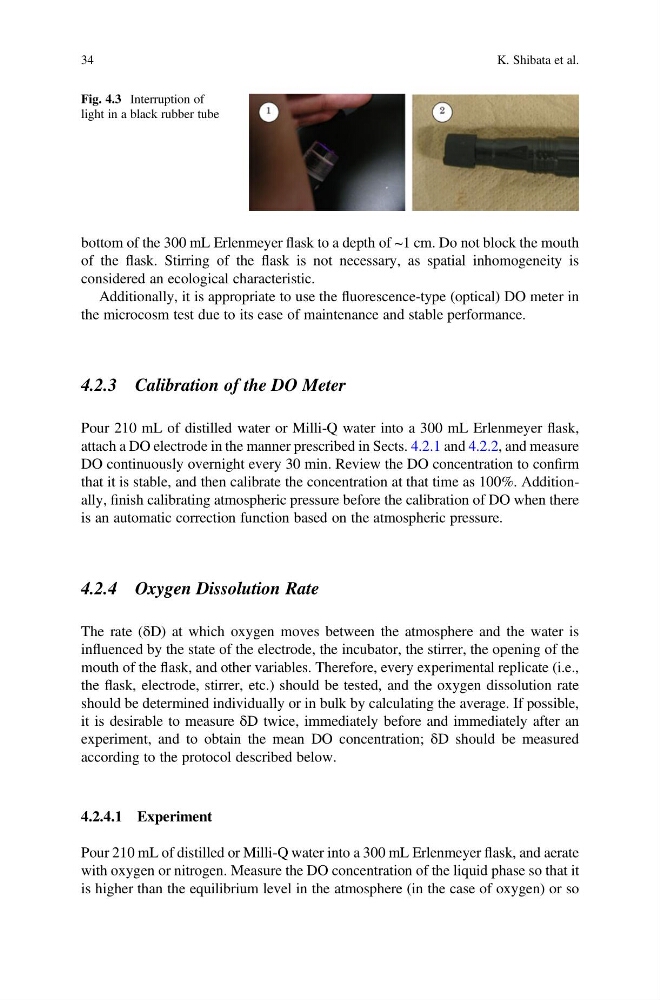
Fig. 4.3 Interruption of
light in a black rubber tube
34
K. Shibata et al.
of the flask. Stirring of the flask is not necessary, as spatial inhomogeneity is
considered an ecological characteristic.
Additionally, it is appropriate to use the fluorescence-type (optical) DO meter in
the microcosm test due to its ease of maintenance and stable performance.
4.2.3 Calibration of the DO Meter
Pour 210 mL of distilled water or Milli-Q water into a 300 mL Erlenmeyer flask,
attach a DO electrode in the manner prescribed in Sects. 4.2.1 and 4.2.2, and measure
DO continuously overnight every 30 min. Review the DO concentration to confirm
that it is stable, and then calibrate the concentration at that time as 100%. Additionally, finish calibrating atmospheric pressure before the calibration of DO when there
is an automatic correction function based on the atmospheric pressure.
4.2.4 Oxygen Dissolution Rate
The rate (δD) at which oxygen moves between the atmosphere and the water is
influenced by the state of the electrode, the incubator, the stirrer, the opening of the
mouth of the flask, and other variables. Therefore, every experimental replicate (i.e.,
the flask, electrode, stirrer, etc.) should be tested, and the oxygen dissolution rate
should be determined individually or in bulk by calculating the average. If possible,
it is desirable to measure δD twice, immediately before and immediately after an
experiment, and to obtain the mean DO concentration; δD should be measured
according to the protocol described below.
4.2.4.1 Experiment
Pour 210 mL of distilled or Milli-Q water into a 300 mL Erlenmeyer flask, and aerate
with oxygen or nitrogen. Measure the DO concentration of the liquid phase so that it
is higher than the equilibrium level in the atmosphere (in the case of oxygen) or so
Fig. 4.3 Interruption of
light in a black rubber tube
34
K. Shibata et al.