

• Perforated cap for DO electrode (unnecessary if the DO meter is able to perform
measurements in standing water)
• Vinyl tube (unnecessary if the DO meter is able to perform measurements in
standing water)
• Circular glass cover (unnecessary if the DO meter is able to perform measurements in standing water)
• Insulating material (e.g., silicon sponge sheet) and blank paper or a white acrylic
plate (unnecessary if the DO meter is able to perform measurements in standing
water)
4.2 Dissolved Oxygen (DO) Meter Protocols
4.2.1 Electrode DO Meter
1. Wash the tip (gold cathode, silver anode) of the DO meter, a cap, an O-ring, and a
rotor well in pure water (demineralized water), and ensure that they are dry before
proceeding.
2. Remove any color change from the cathode by polishing its surface. Polish
horizontally with a super fine-grit sandpaper (greater than a #1000) to clean the
gold cathode. If the electrode is not smoothed, it will cause the membrane to tear
during attachment.
3. When refuse collects in the ditch around the gold cathode, remove it using the tip
of a toothpick. Additionally, this prevents touching of the cathode, as the triangular part of the electrode is very fragile.
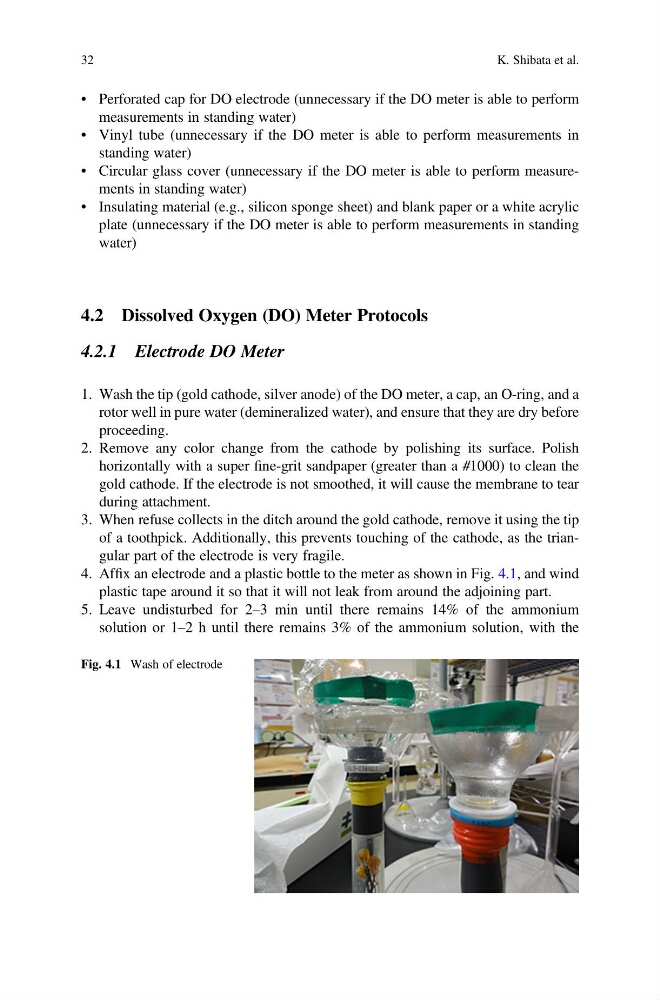
4. Affix an electrode and a plastic bottle to the meter as shown in Fig. 4.1, and wind
plastic tape around it so that it will not leak from around the adjoining part.
5. Leave undisturbed for 2–3 min until there remains 14% of the ammonium
solution or 1–2 h until there remains 3% of the ammonium solution, with the
Fig. 4.1 Wash of electrode
32
K. Shibata et al.
measurements in standing water)
• Vinyl tube (unnecessary if the DO meter is able to perform measurements in
standing water)
• Circular glass cover (unnecessary if the DO meter is able to perform measurements in standing water)
• Insulating material (e.g., silicon sponge sheet) and blank paper or a white acrylic
plate (unnecessary if the DO meter is able to perform measurements in standing
water)
4.2 Dissolved Oxygen (DO) Meter Protocols
4.2.1 Electrode DO Meter
1. Wash the tip (gold cathode, silver anode) of the DO meter, a cap, an O-ring, and a
rotor well in pure water (demineralized water), and ensure that they are dry before
proceeding.
2. Remove any color change from the cathode by polishing its surface. Polish
horizontally with a super fine-grit sandpaper (greater than a #1000) to clean the
gold cathode. If the electrode is not smoothed, it will cause the membrane to tear
during attachment.
3. When refuse collects in the ditch around the gold cathode, remove it using the tip
of a toothpick. Additionally, this prevents touching of the cathode, as the triangular part of the electrode is very fragile.
4. Affix an electrode and a plastic bottle to the meter as shown in Fig. 4.1, and wind
plastic tape around it so that it will not leak from around the adjoining part.
5. Leave undisturbed for 2–3 min until there remains 14% of the ammonium
solution or 1–2 h until there remains 3% of the ammonium solution, with the
Fig. 4.1 Wash of electrode
32
K. Shibata et al.