

Coryneform Bacteria
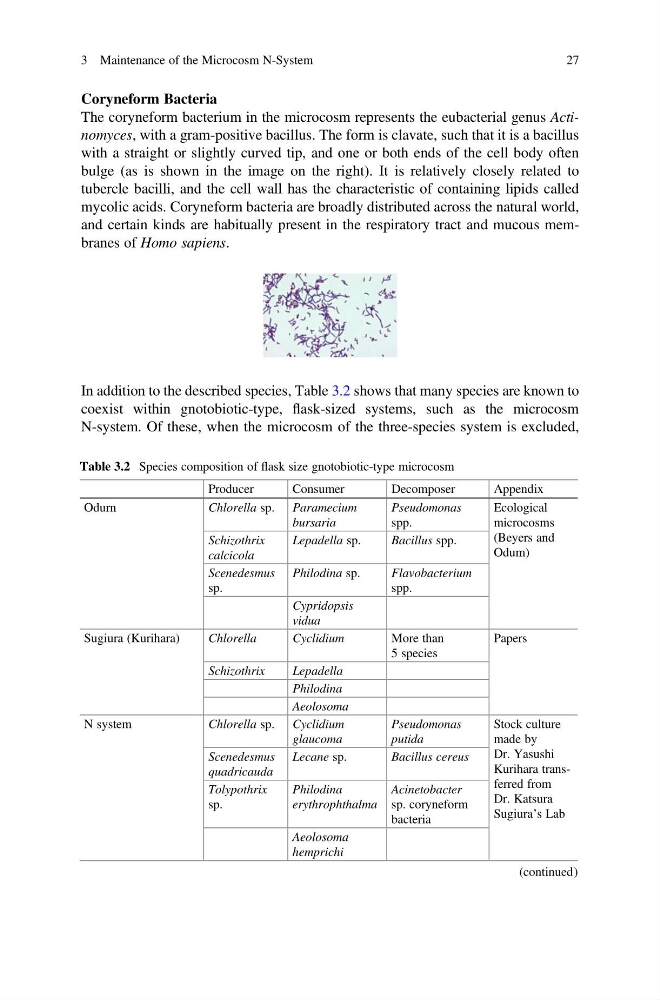
The coryneform bacterium in the microcosm represents the eubacterial genus Actinomyces, with a gram-positive bacillus. The form is clavate, such that it is a bacillus
with a straight or slightly curved tip, and one or both ends of the cell body often
bulge (as is shown in the image on the right). It is relatively closely related to
tubercle bacilli, and the cell wall has the characteristic of containing lipids called
mycolic acids. Coryneform bacteria are broadly distributed across the natural world,
and certain kinds are habitually present in the respiratory tract and mucous membranes of Homo sapiens.
In addition to the described species, Table 3.2 shows that many species are known to
coexist within gnotobiotic-type, flask-sized systems, such as the microcosm
N-system. Of these, when the microcosm of the three-species system is excluded,
Table 3.2 Species composition of flask size gnotobiotic-type microcosm
Producer
Consumer
Decomposer
Appendix
Odurn
Chlorella sp. Paramecium
bursaria
Pseudomonas
spp.
Ecological
microcosms
(Beyers and
Odum)
Schizothrix
calcicola
Lepadella sp.
Bacillus spp.
Scenedesmus
sp.
Philodina sp.
Flavobacterium
spp.
Cypridopsis
vidua
Sugiura (Kurihara)
Chlorella
Cyclidium
More than
5 species
Papers
Schizothrix
Lepadella
Philodina
Aeolosoma
N system
Chlorella sp. Cyclidium
glaucoma
Pseudomonas
putida
Stock culture
made by
Dr. Yasushi
Kurihara transferred from
Dr. Katsura
Sugiura’s Lab
Scenedesmus
quadricauda
Lecane sp.
Bacillus cereus
Tolypothrix
sp.
Philodina
erythrophthalma
Acinetobacter
sp. coryneform
bacteria
Aeolosoma
hemprichi
(continued)
3 Maintenance of the Microcosm N-System
27
The coryneform bacterium in the microcosm represents the eubacterial genus Actinomyces, with a gram-positive bacillus. The form is clavate, such that it is a bacillus
with a straight or slightly curved tip, and one or both ends of the cell body often
bulge (as is shown in the image on the right). It is relatively closely related to
tubercle bacilli, and the cell wall has the characteristic of containing lipids called
mycolic acids. Coryneform bacteria are broadly distributed across the natural world,
and certain kinds are habitually present in the respiratory tract and mucous membranes of Homo sapiens.
In addition to the described species, Table 3.2 shows that many species are known to
coexist within gnotobiotic-type, flask-sized systems, such as the microcosm
N-system. Of these, when the microcosm of the three-species system is excluded,
Table 3.2 Species composition of flask size gnotobiotic-type microcosm
Producer
Consumer
Decomposer
Appendix
Odurn
Chlorella sp. Paramecium
bursaria
Pseudomonas
spp.
Ecological
microcosms
(Beyers and
Odum)
Schizothrix
calcicola
Lepadella sp.
Bacillus spp.
Scenedesmus
sp.
Philodina sp.
Flavobacterium
spp.
Cypridopsis
vidua
Sugiura (Kurihara)
Chlorella
Cyclidium
More than
5 species
Papers
Schizothrix
Lepadella
Philodina
Aeolosoma
N system
Chlorella sp. Cyclidium
glaucoma
Pseudomonas
putida
Stock culture
made by
Dr. Yasushi
Kurihara transferred from
Dr. Katsura
Sugiura’s Lab
Scenedesmus
quadricauda
Lecane sp.
Bacillus cereus
Tolypothrix
sp.
Philodina
erythrophthalma
Acinetobacter
sp. coryneform
bacteria
Aeolosoma
hemprichi
(continued)
3 Maintenance of the Microcosm N-System
27